
English
Views: 0 Author: Site Editor Publish Time: 2026-07-28 Origin: Site


Procuring the exact chemical components required for complex formulations often dictates the ultimate success of manufacturing and research endeavors. Few substances illustrate this reality more clearly than polyethylene glycol tert-octylphenyl ether, a foundational nonionic surfactant utilized heavily across biopharma and industrial sectors. While its exceptional ability to lower surface tension and enable precise cell lysis remains well-documented, sourcing it today presents unique challenges.
Modern buyers must continuously navigate strict purity grades, scale-up feasibility checks, and rapidly evolving environmental compliance standards across global markets. Procurement teams often struggle to balance performance needs against stringent regulatory shifts. We designed this comprehensive guide to help you overcome these exact hurdles.
You will discover an evidence-based framework for evaluating, safely implementing, and reliably sourcing CAS 9002-93-1 based on your distinct operational requirements. Procurement managers, lab directors, and industrial engineers will learn how to align chemical specifications directly with their end-product goals.
Let us examine the baseline chemical architecture of this compound. The structure features two highly distinct functional parts. It possesses a hydrophilic polyethylene oxide chain alongside a lipophilic aromatic hydrocarbon group. This dual nature allows it to interact simultaneously with water and oils. It efficiently breaks down stubborn lipid barriers. Because it is a nonionic surfactant, it carries no net electrical charge in solution. This neutral state prevents unwanted interactions with salts, proteins, or other charged molecules in your formulations.
Performance metrics dictate how well the chemical operates in real-world scenarios. We see excellent stability across broadly varying temperatures and pH levels. Its critical micelle concentration (CMC) sits at a notably low threshold. This means you need very little product to achieve maximum surface tension reduction. Once the concentration reaches the CMC, surfactant molecules group together to form micelles. These micelles encapsulate oils and membrane lipids effectively.
Another crucial metric is the cloud point. The cloud point typically ranges between 63°C and 69°C in aqueous solutions. Beyond this temperature threshold, the solution separates into two distinct phases. You must monitor this thermal boundary closely during heated industrial processes to avoid phase separation.
What do these chemical properties mean for your bottom line? They translate directly into measurable business outcomes. Facilities consistently report reduced processing times during extraction protocols. You will also achieve higher yields in complex emulsion formulations. Furthermore, it offers vastly improved stability compared to traditional ionic alternatives. You can streamline your production workflows and reduce costly batch failures by leveraging these stable operational mechanisms.
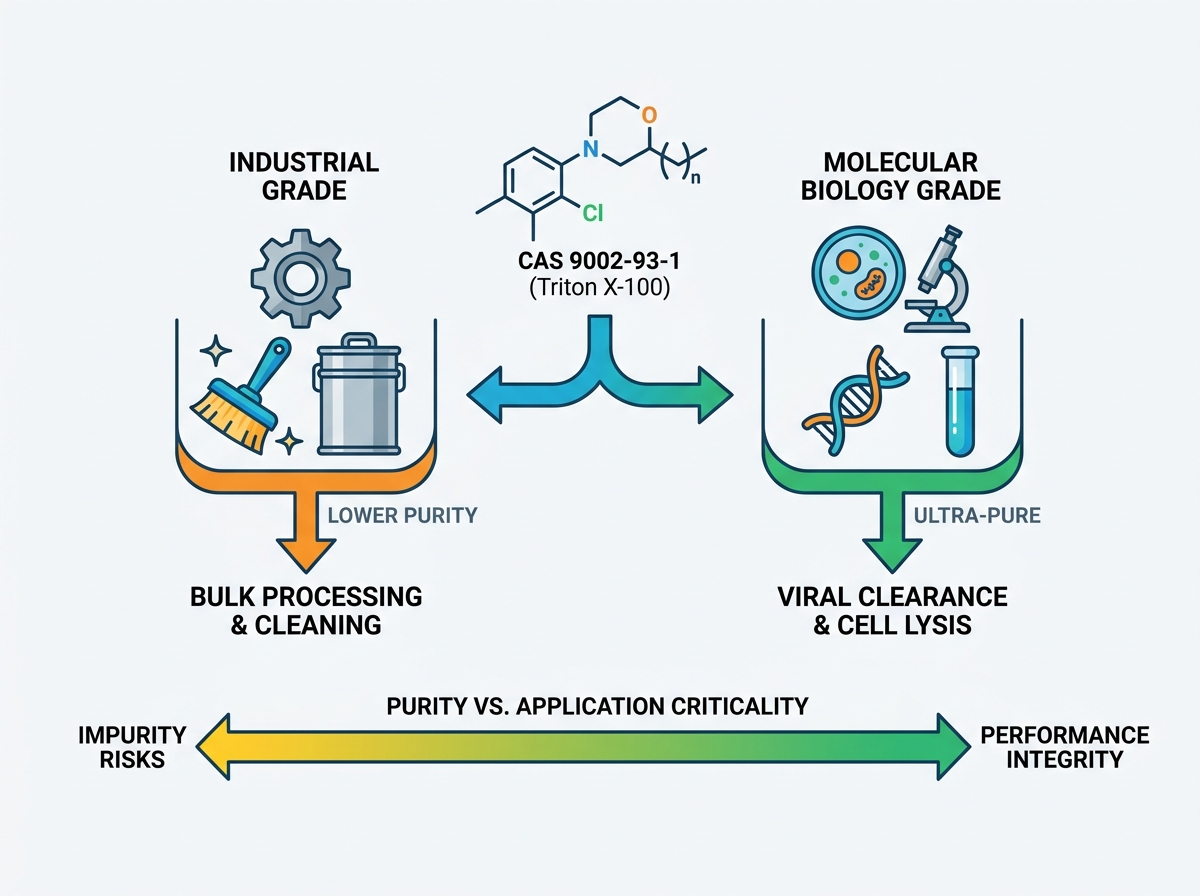
Different sectors leverage this surfactant to achieve vastly different end goals. Understanding industry-specific success criteria ensures you apply the chemical correctly. We will break down the primary uses and performance targets across three major sectors.
Biomedical research relies heavily on consistent membrane disruption. This surfactant serves as a cornerstone reagent for cellular workflows.
Heavy industry demands robust, high-volume performance. The focus shifts from delicate biological preservation to aggressive dispersion.
Analytical testing requires precision and minimal interference. Reagent manufacturers depend on its neutral characteristics.
Understanding purity grades helps you optimize both product performance and procurement budgets. You must align the grade directly with your intended application. Choosing the wrong tier often leads to catastrophic batch failures or wasted capital.
You generally choose between industrial-grade, lab-grade, and ultra-pure variations of CAS 9002-93-1. Industrial tiers suit heavy-duty cleaning and metalworking where trace contaminants do not impact the final product. Lab-grade materials offer better consistency for general educational or basic research purposes. Ultra-pure pharmacopeia grades undergo rigorous purification. Suppliers strictly reserve these for sensitive biological protocols and commercial pharmaceutical production.
You must watch out for the operational risks associated with trace impurities. Peroxides, carbonyls, and heavy metals frequently persist in lower-grade batches. These impurities cause severe oxidative damage in biological applications. If you use industrial-grade material for protein extraction, the trace peroxides will likely destroy your samples. This ruins months of expensive research or halts production lines entirely.
To avoid over-specifying or under-specifying, you need a clear evaluation framework. Paying for ultra-pure grades in industrial degreasing wastes money. Conversely, risking lab-grade material in pharma production invites regulatory audits. The cost-to-performance matrix below illustrates how to balance these factors.
Application and Purity Grade Decision Matrix
| Application Area | Recommended Grade | Critical Impurities to Avoid | Budget Impact |
|---|---|---|---|
| Heavy-Duty Detergents | Industrial Bulk Grade | Particulates, High Water Content | Low Cost, High Volume |
| Paints and Coatings | Industrial / Technical Grade | Unreacted Alcohols | Moderate Cost |
| General Lab Research | Laboratory Grade | Heavy Metals (ppm levels) | Medium Cost |
| Protein Extraction & Assays | Ultra-Pure / Molecular Grade | Peroxides, Carbonyls | High Cost, Low Volume |
| Viral Inactivation (Pharma) | Pharmacopeia / cGMP Grade | Endotoxins, Any Trace Organics | Premium Cost |
Safety protocols protect your workforce and ensure uninterrupted daily operations. Always consult the latest Material Safety Data Sheet (MSDS) before integrating this surfactant into your facility. While it is highly effective, it poses severe eye and skin irritation risks upon direct contact. Prolonged exposure can lead to lasting tissue damage.
Workers must wear appropriate personal protective equipment (PPE) at all times. You should mandate the use of splash-proof chemical goggles, heavy-duty nitrile gloves, and full-length lab coats. Proper ventilation remains equally necessary. Local exhaust ventilation prevents vapor or mist accumulation during heated industrial processes. You should also install emergency eyewash stations near all handling areas.
Regulatory scrutiny is rapidly reshaping how global industries utilize this chemical. Environmental authorities have flagged its degradation products, specifically octylphenol, for ecological risks. Octylphenol demonstrates endocrine-disrupting properties in aquatic environments. Consequently, the EU REACH framework recently categorized this substance under Annex XIV. This categorization strictly limits its use and mandates specific authorization for European manufacturing.
You must actively prepare your facility for these shifting compliance realities. We recommend implementing the following risk mitigation strategy:
Finding a reliable supplier requires a methodical and uncompromising auditing process. Sourcing substandard materials can quietly ruin your entire production schedule. Start by requesting comprehensive documentation from every potential vendor.
You need fully updated Safety Data Sheets (SDS) and highly detailed Certificates of Analysis (CoAs). Ask for origin statements to verify the actual manufacturing source rather than just a distributor address. This documentation proves the supplier understands basic quality control parameters. When reviewing the CoA, ensure the reported test dates align with the actual batch you plan to purchase. Expired or generic CoAs represent a massive red flag.
Next, assess the supplier's scalability and specialized packaging capabilities. You might start by ordering small catalog volumes in milliliters for R&D testing. Eventually, your operations will require pilot or full production scales involving heavy drums or totes. Your supplier must manage this volume transition effortlessly. They must guarantee that the chemical specifications will not drift when you scale up the order. A supplier who excels at shipping small lab bottles might struggle with bulk moisture control in 55-gallon drums.
Finally, you should establish structured pilot testing protocols for every new supplier qualification. Do not simply switch suppliers based on a cheaper price quote.
This disciplined approach secures your supply chain and maintains your final product integrity over the long term.
Selecting the ideal surfactant requires a careful balance of chemical science and procurement strategy. You must weigh its unparalleled performance in reducing surface tension against specific grade limitations and regional compliance realities. Your operational success depends entirely on how well you manage these interconnected variables. Rushing the sourcing process often leads to costly formulation failures or regulatory penalties down the line.
Successful deployment relies on aligning your chemical specifications directly with your end-product goals. You must rigorously vet supplier transparency and insist on comprehensive batch documentation. To move forward effectively, we recommend taking the following actionable steps:
A: It typically maintains a shelf life of two to three years. You should store it in a cool, dry, and well-ventilated area. Keep containers tightly sealed to prevent moisture ingress. It is sensitive to direct light and prone to oxidation over time. Regulate temperature controls strictly to avoid premature degradation and phase separation.
A: It features a bulkier hydrophobic head group compared to Tween 20. This makes it structurally much more aggressive. It disrupts cell membranes faster and more comprehensively. While Tween 20 remains mild and preserves delicate protein-protein interactions, this surfactant excels at achieving complete cellular membrane lysis.
A: Yes, several biodegradable substitutes exist for organizations facing strict ESG or REACH limitations. Alkyl polyglucosides (APGs) and specific alcohol ethoxylates frequently serve as viable replacements. Suppliers now formulate specialized eco-friendly kits designed to match the original performance. Always test these alternatives thoroughly in your specific assay.
A: You must scrutinize the trace impurity profile very carefully. Pay close attention to the peroxide value and carbonyl content. Ensure strict absorbance limits align with your ultraviolet spectrophotometry requirements. Heavy metal concentrations must fall below precise parts-per-million thresholds to prevent oxidative damage to sensitive biological compounds.


