
English
Views: 0 Author: Site Editor Publish Time: 2026-07-22 Origin: Site


Choosing between lower-molecular-weight PEGs is rarely about basic functionality. Instead, it usually boils down to optimizing formulation stability, manufacturing efficiency, and active pharmaceutical ingredient (API) solubility. While both compounds appear as clear, viscous liquids at room temperature, a subtle molecular weight difference fundamentally alters their behavior. They possess entirely distinct hygroscopicity levels, freezing points, and solvent capacities. You must understand these variations to avoid critical manufacturing bottlenecks or compromised product shelf life. If you select the wrong grade, you risk phase separation, unexpected crystallization, or regulatory hurdles down the line. We will explore the core chemical properties separating these two excipients. You will gain an evidence-based comparison to help you determine exactly which grade aligns best for your specific production requirements, equipment constraints, and rigorous industry compliance standards.
Understanding the baseline properties of these two compounds is essential for successful product development. Their physical characteristics diverge significantly despite their similar chemical structures.
The primary structural difference lies in their average molecular weights. Polyethylene Glycol 200 has an average molecular weight of 200 daltons. It consists of shorter polymer chains. PEG 400 averages 400 daltons. It features longer repeating ethylene oxide units. This subtle difference in chain length directly dictates their physical behavior. Shorter chains slip past one another easily. Longer chains entangle more readily. This entanglement creates higher resistance to flow.
Chain length impacts both fluid dynamics and thermal behavior. You will notice immediate handling differences on the production floor.
Physical Properties Comparison Chart
| Property | PEG 200 | PEG 400 |
|---|---|---|
| Average Molecular Weight | 190 - 210 | 380 - 420 |
| Viscosity at 25°C | ~50 cSt | ~90 cSt |
| Freezing Point | Approx. -65°C | 4°C to 8°C |
| Physical State at Room Temp | Thin Liquid | Viscous Liquid |
Both liquids readily absorb moisture from the surrounding air. However, lower molecular weights are inherently more hygroscopic. The 200 grade absorbs atmospheric moisture much faster than PEG 400. This rapid moisture uptake impacts formulation stability. It becomes a critical factor for moisture-sensitive active ingredients. You must account for this behavior during storage and mixing. Excess water ingress can prematurely degrade sensitive compounds. It can also alter the final volume of your chemical batches.
Both grades exhibit exceptionally low vapor pressure at room temperature. They do not evaporate easily. However, the lighter grade is slightly more volatile under extreme heat. If your process involves high-temperature vacuum distillation, you might experience minor product loss. PEG 400 remains more stable under prolonged thermal stress. It resists evaporation highly effectively during high-heat sterilization cycles.
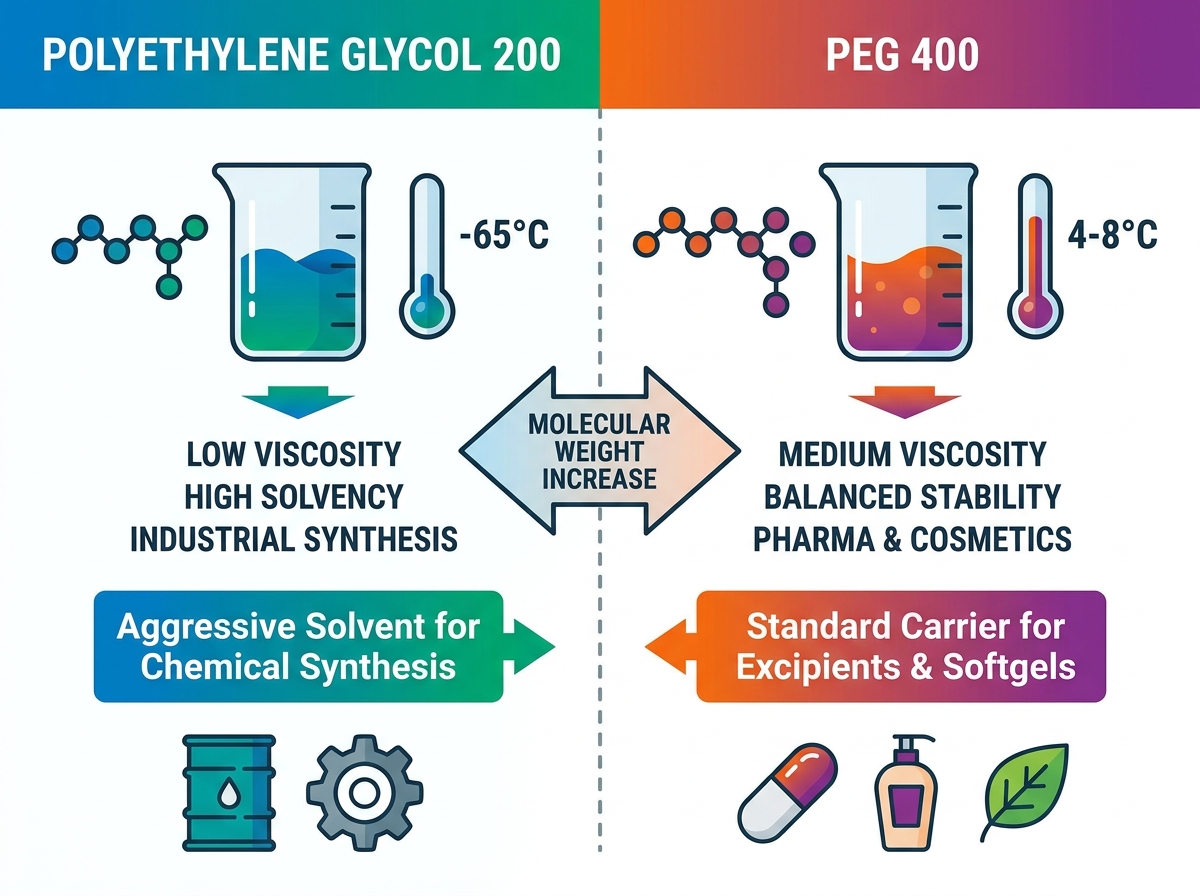
Formulators often face a trade-off between aggressive solvency and gentle stability. Your choice here directly influences the efficacy and shelf life of the final product.
Solvency power varies based on molecular weight. You should evaluate Polyethylene Glycol 200 as a highly aggressive solvent. It excels at dissolving challenging, poorly water-soluble compounds. Its smaller molecular size penetrates crystalline structures easily. Conversely, you should evaluate PEG 400 as a gentle, stable carrier. It maintains excellent solubility without denaturing sensitive botanical extracts or complex proteins. It offers a balanced microenvironment for delicate active pharmaceutical ingredients.
Manufacturing often involves high-shear mixing and heat sterilization phases. You must consider how each grade responds to these stresses. The lighter grade can thin out excessively under intense heat. This thinning might temporarily compromise emulsion stability during cooling. PEG 400 provides superior thermal buffering. It maintains a more consistent viscosity profile across broad temperature ranges. It protects delicate emulsions from breaking during aggressive high-shear homogenization processes.
Viscosity differences directly alter sensory feedback. For topical ointments, the heavier grade provides a richer, more luxurious spreadability. It creates a protective barrier on the skin. The lighter grade absorbs quickly but may feel slightly tacky. For oral liquids, PEG 400 offers a smooth, syrupy mouthfeel. It helps mask the harsh taste of specific medications. The 200 variant feels much thinner on the palate. Formulators must match these tactile properties to consumer expectations.
Different industries favor specific grades based on regulatory precedents and functional requirements. Aligning your choice with industry norms reduces compliance friction.
The medical sector relies heavily on well-documented excipients. PEG 400 acts as the dominant choice for liquid-filled soft gelatin capsules. It does not dissolve the gelatin shell. It also serves extensively in ophthalmic solutions and parenteral formulations. Regulatory bodies recognize its long history of safe internal use. Meanwhile, the lower molecular weight variant finds niche uses. Manufacturers utilize it in specialized veterinary medicines. They also use it for specific localized API delivery systems where maximum initial solubility is paramount.
Cosmetic chemists leverage these liquids to enhance product feel and moisture retention. They primarily use PEG 400 as a reliable humectant. It draws moisture to the epidermis effectively. It also acts as a viscosity modifier and solvent in premium creams and lotions. The heavier molecular weight prevents the product from feeling overly watery. It stabilizes fragrance oils and essential extracts. It keeps complex cosmetic emulsions perfectly blended during long shipping routes.
Industrial applications prioritize cost-efficiency, extreme temperature tolerance, and rapid solvency. Polyethylene Glycol 200 shines in this sector. Engineers prioritize it for industrial lubricants and heat transfer fluids. Its remarkably low freezing point prevents equipment damage during winter operation. It also serves effectively in wood preservation treatments. The small molecules penetrate dense cellular structures easily. Furthermore, it acts as a vital intermediate in complex chemical synthesis processes. It provides exceptional reaction kinetics for polymer manufacturing.
Transitioning a formulation from the lab to commercial production introduces mechanical and environmental challenges. You must anticipate these handling risks early.
Fluid dynamics shift drastically during seasonal temperature changes. Pumping PEG 400 in unheated facilities during winter months introduces significant risks. The liquid can thicken or partially freeze. This leads to severe line blockages. You may need to install expensive heat-traced piping. You might also require jacketed storage tanks. Using the 200 grade mitigates this cold-flow issue entirely. It remains a highly pumpable liquid regardless of standard warehouse temperature drops.
Both grades demand rigorous moisture control protocols. Hygroscopicity poses a constant threat to bulk chemical integrity. You must follow strict guidelines for preventing moisture ingress. Keep bulk storage drums tightly sealed. Use nitrogen blanketing for large storage totes. Limit the time containers remain open during batching. If moisture contaminates the supply, it can throw off chemical ratios. This ultimately compromises the stability of your finished batches.
Highly concentrated liquid PEGs can interact negatively with certain plastics. You must evaluate the potential for plasticizer extraction. This occurs often in specific polymer-based packaging materials. The lighter, more aggressive 200 grade can degrade low-density polyethylene (LDPE) over long periods. It may leach chemical plasticizers into the product. You should conduct accelerated compatibility testing using your intended final packaging. Glass or high-density polyethylene (HDPE) usually offers safer, more stable containment options.
Selecting the optimal grade requires a systematic approach. You must weigh physical constraints against strict regulatory demands.
Use a structured decision process to guide your procurement strategy. Ask your engineering and formulation teams the following baseline questions:
Your end-market dictates your compliance burden. You cannot simply swap industrial grades for pharmaceutical applications. You must focus on regulatory auditing early in the sourcing phase. Ensure you source USP/EP/NF certified grades for any human-contact products. Carefully review the vendor’s Certificates of Analysis (CoA). You must verify residual ethylene oxide and 1,4-dioxane limits. These toxic byproducts must fall below strict regulatory thresholds. Global health authorities closely monitor these specific impurities in cosmetic and pharmaceutical submissions.
Choosing the correct excipient sets the foundation for your product's success. Polyethylene Glycol 200 acts as the high-solvency, low-viscosity workhorse. It handles industrial applications, extreme cold environments, and highly specific chemical formulations with ease. Meanwhile, PEG 400 remains the safer, highly stable baseline. It dominates human-contact products across the pharmaceutical and cosmetic industries. To move forward, we recommend ordering lab-scale samples of both materials. Conduct baseline solubility screens, rheology profiling, and accelerated stability testing. Complete this physical testing before you commit to commercial-scale pilot batches. This proactive approach prevents costly reformulation delays.
A: Rarely 1:1. Substitution requires reformulation due to significant shifts in viscosity, moisture absorption, and API solubility.
A: Both have extremely low toxicity, but PEG 400 has a much more robust history and regulatory approval profile for internal pharmaceutical use.
A: PEG 400 can crystallize or freeze in standard refrigeration [~4°C], whereas PEG 200 remains fluid down to roughly -65°C.
A: Yes, typically 1 to 2 years if kept tightly sealed to prevent moisture absorption and stored away from direct heat to prevent oxidation.


