
English
Views: 0 Author: Site Editor Publish Time: 2026-07-23 Origin: Site


Chemical formulation and procurement demand absolute precision. Selecting the wrong molecular weight of Polyethylene Glycol (PEG) carries extremely high stakes. It can quickly compromise product stability. It might unexpectedly alter fluid viscosity. You could even face costly regulatory compliance failures. We must evaluate raw materials carefully. Polyethylene Glycol 200 stands out as a reliable starting point. It is a low-molecular-weight, clear liquid variant. Formulators highly favor it for exceptional solvency. It also boasts exceptionally low toxicity. This article acts as your dedicated technical buyer’s guide. We will thoroughly evaluate this compound against heavier PEGs like PEG-400. We also clarify key differences between similar-sounding glycols. You will learn how to align these physical properties directly with your specific application requirements. Read on to optimize your chemical procurement strategy today.
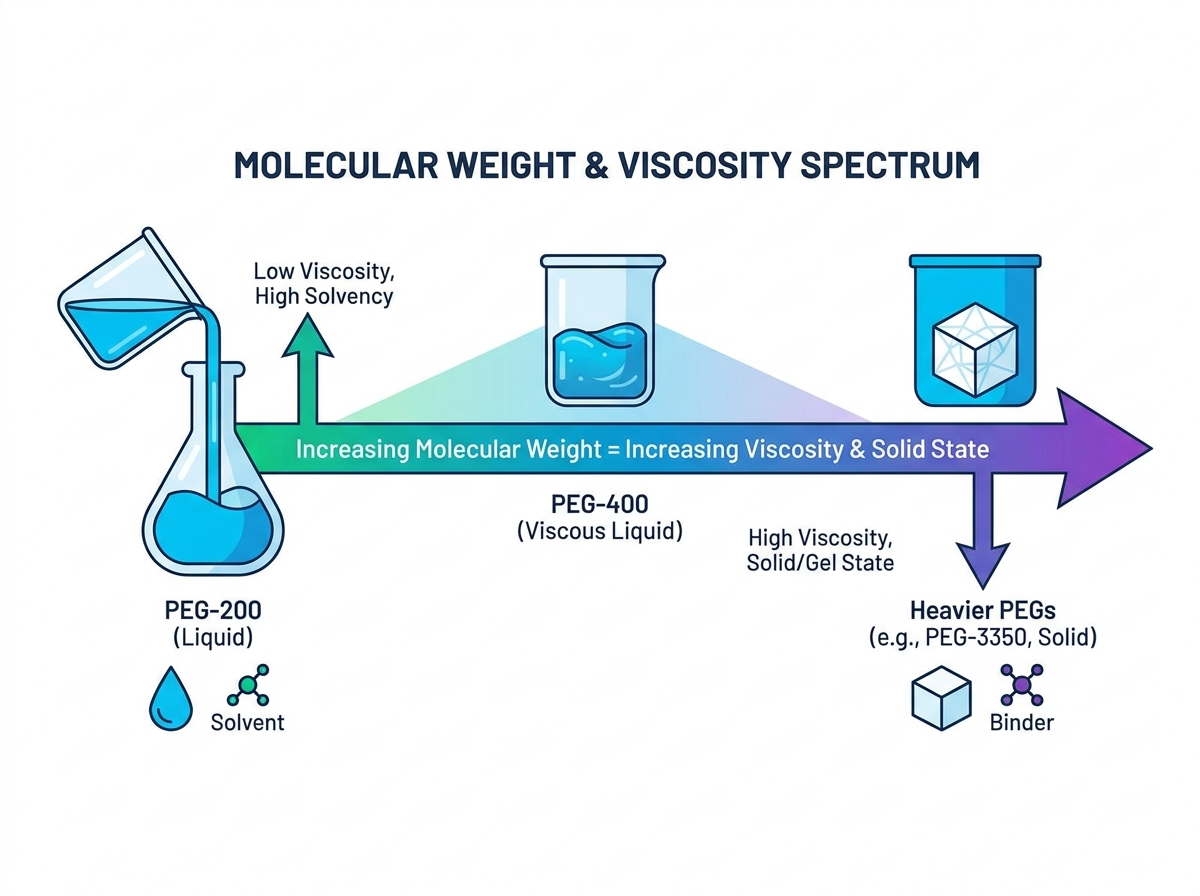
What does the number "200" actually signify? It represents the average molecular weight of the polymer chain. This specific mathematical value dictates the physical state of the chemical compound. Due to its very low molecular mass, it remains a completely clear liquid at room temperature. Heavier variants progressively turn into viscous pastes, waxy solids, or hard powders. You must understand this fundamental material difference before formulating.
Physical properties shift dramatically as molecular weight changes. We observe a strong inverse relationship between molecular weight and hygroscopicity. Hygroscopicity describes the ability to absorb ambient moisture from the surrounding air. Polyethylene Glycol 200 is highly hygroscopic. It pulls moisture actively compared to solid variants like PEG-3350. You must account for this phenomenon during warehouse storage and active mixing.
How do you frame your initial business problem? Your formulation success criteria dictate your starting point. Do you need a highly active liquid solvent? Or do you require a solid binder and dry lubricant? If you need rapid dissolution and ultra-low viscosity, you choose a low-molecular-weight PEG. It provides the perfect liquid foundation. It blends seamlessly into complex aqueous systems without clumping or requiring excess heat.
Let us closely contrast these two highly popular liquid PEGs. The kinetic viscosity differs significantly between them. PEG-200 is much thinner and flows far more readily. This eases everyday pumping and pouring. You will notice this handling benefit especially at much lower temperatures. It saves electrical energy during winter manufacturing processes. It prevents expensive line blockages inside cold production facilities.
Their solvency profiles also vary slightly but impactfully. Both solubilize Active Pharmaceutical Ingredients (APIs) quite effectively. They also dissolve complex industrial active compounds. However, their specific ideal use cases branch apart based strictly on molecular size.
Here is a breakdown of their primary applications:
Let us look at a structural comparison chart to clarify these metrics.
| Physical Parameter | PEG-200 | PEG-400 |
|---|---|---|
| Average Molecular Weight | 190 - 210 | 380 - 420 |
| Physical State (at 20°C) | Clear, mobile liquid | Slightly viscous liquid |
| Kinematic Viscosity (cSt at 99°C) | 4.3 | 7.3 |
| Hygroscopicity Level | Very High | High |
Notice the critical decision pivot here. In basic industrial applications, you can often interchange them safely. A simple viscosity adjustment might suffice for a heavy cleaning fluid. But pharmaceutical and cosmetic choices remain highly rigid. You must adhere to exact formulation monographs. A regulatory audit will penalize unauthorized ingredient substitutions. You simply cannot swap them blindly without conducting thorough stability tests.
Industry professionals and search queries often confuse these specific chemicals. They sound incredibly similar but behave very differently. We must address this concept confusion directly. Using the wrong glycol variant can ruin an entire product batch. It can also pose severe human health risks.
First, we compare our core subject to Ethylene Glycol (EG). The critical difference lies directly in inherent toxicity. EG is highly toxic to humans and animals. Manufacturers use it primarily as an automotive antifreeze base. Conversely, Polyethylene Glycol 200 is a polymerized version of ethylene oxide. This specific polymerization process creates a distinctly non-toxic profile. You can safely use it in many highly regulated consumer products. It absolutely does not cause the metabolic poisoning associated with EG.
Next, let us evaluate Propylene Glycol (PG). Formulators use both chemicals as effective humectants and solvents. PG is widely used in commercial food processing. You also find it extensively in commercial vaping liquids. However, PEG-200 offers entirely different solvent polarities. You will favor it when your unique formulation requires much lower volatility. It simply stays put longer than PG. It will not evaporate quickly under normal atmospheric conditions, providing lasting moisture retention.
You must test solubility and compatibility early in your development cycle. This PEG exhibits a broad, highly forgiving solubility profile. It dissolves perfectly in water. You can mix it easily with acetone and various alcohols. However, watch out for specific chemical incompatibilities. It will not mix well with aliphatic hydrocarbons. This greatly limits its use in certain petroleum-based mixtures. You must verify these complex interactions in your lab.
Regulatory and compliance dimensions are always crucial. You must strictly differentiate between industrial and medical grades. Industrial grade (often called technical grade) is fine for heavy machinery lubricants. Pharmaceutical and food applications demand USP/NF certified grades. Always advise your procurement buyers to verify these monographs. They must check the analytical paperwork before taking delivery of any bulk shipments.
Toxicity and sensitization require careful scientific review. Established scientific consensus confirms its general safety. Standard PubMed and NIH literature support this conclusion. It maintains a highly safe toxicological profile for topical skin use. Oral applications are also generally safe. However, this assumes you meet strict manufacturing purity standards. Any contamination voids this safety assumption.
Thermal stability serves as another major evaluation point. How does it perform under sustained heat? It offers excellent resistance to evaporation. It outlasts lower glycols under high thermal stress. You must still consider open-cup flash point guidelines. Keep it completely away from open flames during high-heat processing to prevent accidental ignition.
The ethoxylation process carries inherent manufacturing risks. This chemical process can occasionally leave behind dangerous impurities. You must actively watch out for 1,4-dioxane and unreacted ethylene oxide residues. High-quality procurement demands strict, transparent documentation. You must demand accurate Certificates of Analysis (COAs) for every single batch. These documents verify trace levels sit well below strict regulatory thresholds. Never skip this mandatory verification step.
Oxidation and storage present daily operational challenges. Liquid PEGs can degrade slowly over time. They suffer from auto-oxidation when exposed constantly to ambient air. We must actively prevent this chemical degradation. You should use inert gas blanketing for all long-term storage tanks. Nitrogen works best for this protective purpose. It displaces ambient oxygen and significantly extends overall shelf life.
Hygroscopicity management is equally vital for total quality control. Unwanted moisture absorption ruins exact formulation concentration ratios. Here are practical environmental controls for your manufacturing floor:
Apply smart shortlisting logic before buying large quantities. Do not commit to bulk drums immediately. We highly recommend a pilot-scale trial first. Test the kinetic viscosity stability of your new blend. Verify active ingredient solubility at exact room temperature. Only scale up to massive intermediate bulk containers once these lab tests pass completely.
What is the final formulation verdict? Polyethylene Glycol 200 remains a premier chemical choice. You select it specifically when ultra-low viscosity is absolutely non-negotiable. It delivers high solvency and incredibly low volatility perfectly. It solves highly complex manufacturing challenges.
Take these actionable next steps immediately to optimize your workflow:
A: No, PEGs themselves are not true surfactants. They lack the distinct hydrophobic and hydrophilic structural balance (HLB) required for standard surfactant behavior. However, chemical manufacturers frequently use them as foundational building blocks to synthesize powerful PEG-surfactants.
A: Typically, no. You cannot simply swap them without consequence. They possess differing kinetic viscosities. They also exert notably different osmotic pressures on the final product. A direct 1:1 substitution will likely alter your product's flow, tactile feel, and long-term stability.
A: The standard shelf life is generally one to two years from the actual date of manufacture. You must maintain proper storage conditions to achieve this duration. Store the liquid in tightly sealed containers. Keep it in a cool, dry place and use nitrogen blanketing to prevent auto-oxidation.
A: Yes, it is widely considered safe for direct skin contact. Leading industry safety panels confirm this excellent safety profile. However, this remains strictly contingent on chemical purity. You must ensure the absolute absence of sensitizing byproducts, specifically trace levels of 1,4-dioxane and unreacted ethylene oxide.


