
English
Views: 0 Author: Site Editor Publish Time: 2026-07-23 Origin: Site


Formulators and procurement engineers frequently struggle. You must balance solvent efficiency, volatility, and regulatory compliance. Selecting low-molecular-weight glycols brings constant challenges. A slight miscalculation can ruin an entire production batch. Polyethylene Glycol 200 offers a highly reliable alternative. It provides a distinct combination of desirable traits. This chemical is a clear, viscous liquid at room temperature. It boasts high hygroscopicity alongside remarkably low toxicity. These properties make it ideal across multiple demanding sectors.
Evaluating its specific industrial and commercial applications is critical. Doing so helps determine if it meets your physical parameters. You also ensure strict compliance for your unique production line. We will explore how it performs across five major industries. You will learn implementation strategies to optimize your next formulation. This insight will guide your procurement decisions and formulation adjustments.
The pharmaceutical industry relies heavily on precise excipients. Medical formulations require predictable, stable environments. This specific glycol serves as a highly capable liquid solvent. It functions excellently as a suspending agent. It also acts as a precise viscosity modifier. You will often find it in oral liquid formulations. Topical ointments utilize it to maintain a smooth texture.
Many Active Pharmaceutical Ingredients (APIs) suffer from poor water solubility. Poor solubility prevents the human body from absorbing the medicine. Low toxicity and high solvency solve this problem directly. Formulators dissolve complex APIs into this liquid base. This action drastically improves the bioavailability of the drug. Patients receive the intended therapeutic dose consistently.
You cannot use standard industrial chemicals in medicine. Medical applications require strict adherence to pharmacopeia standards. You must source USP/NF or EP certified grades. Compliance ensures patient safety and regulatory approval.
Formulators must also account for molecular interaction over time. The liquid can interact with oxygen during long-term storage. This oxidation degrades the formulation. You must employ robust antioxidant strategies. Implementing inert gas blanketing during storage is highly recommended. Nitrogen is the standard gas used for this protective barrier.
Chemical manufacturing demands predictable reactive components. Polyethylene Glycol 200 acts as a highly efficient reactive intermediate. It is fundamental in producing various complex industrial materials. Manufacturers use it to synthesize fatty acid esters. It plays a major role in creating advanced surfactants. Polyurethane production also depends heavily on this intermediate.
The chemical provides reactive hydroxyl groups at both ends. These terminal groups sit on a short polymer chain. This short chain offers a predictable molecular weight distribution. Predictability ensures a consistent batch-to-batch yield. Esterification processes require this exact consistency to scale up successfully. You avoid wild variations in your final product quality.
Excess moisture ruins chemical synthesis. End-users must constantly monitor the hydroxyl value. You must also track the water content of the bulk supply. Water alters the delicate reaction kinetics. This alteration reduces the final product yield. It also generates unwanted byproducts.
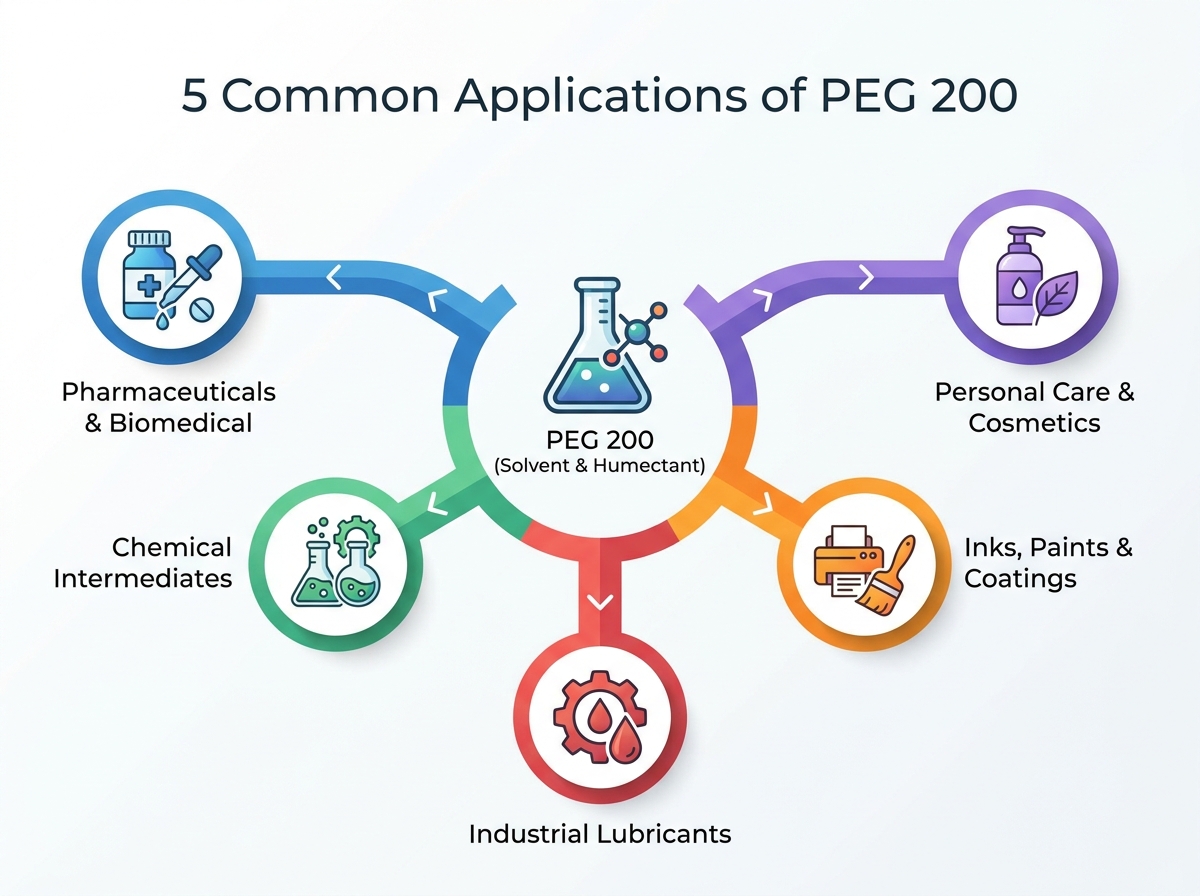
Cosmetic chemists constantly seek safe, effective bases. They need ingredients performing multiple functions simultaneously. This fluid serves primarily as a powerful humectant. It attracts and retains moisture effectively. It also acts as an excellent solvent and consistency-adjusting agent. You will find it in premium creams, lotions, and liquid soaps.
Modern consumers demand safe, gentle products. This ingredient offers a non-comedogenic profile. It will not clog pores or cause acne breakouts. It also remains non-irritating for sensitive skin applications. Manufacturers use it to replace older, volatile solvents. It successfully substitutes more toxic alternatives. The final cosmetic product feels smooth and remains stable across various climates.
Comparison Chart: Solvent Profiles in Cosmetics
| Solvent Type | Volatility | Skin Irritation Risk | Moisture Retention |
|---|---|---|---|
| Standard Ethanol | Very High | High (Drying) | Poor |
| Propylene Glycol | Moderate | Moderate | Good |
| Low-MW Polyethylene Glycol | Very Low | Very Low | Excellent |
Regulatory bodies classify this ingredient as Generally Recognized as Safe (GRAS). However, modern clean-beauty standards require deeper scrutiny. Formulations must undergo rigorous testing. You must check for trace impurities. The chemical 1,4-dioxane is a known potential byproduct. Regional regulatory standards strictly limit these impurities. The EU Cosmetics Regulation mandates parts-per-million testing. Ensuring high-purity procurement mitigates this compliance risk entirely.
Architectural coatings and commercial inks require precise flow dynamics. The liquid state of this ingredient offers unique advantages here. It functions primarily as an effective plasticizer. It acts as a superior moisture-retaining agent. It is a proven dye carrier in water-based ink systems.
Printer nozzles dry out quickly using inferior solvents. Low volatility prevents premature drying issues entirely. The ink remains fluid inside the micro-nozzles. Once applied, the ink dries at a controlled rate. Furthermore, high solvency improves overall color dispersion. Pigments spread uniformly across the medium. This uniformity prevents streaking in architectural paints. It ensures vibrant, consistent colors in commercial printing applications.
You must balance the formulation carefully. The chemical is highly water-soluble. Over-application in architectural coatings creates severe problems. It can compromise the overall water resistance of the dried film. If you add too much, the paint becomes vulnerable to rain. It may wash away or blister under humid conditions. Formulators must calculate the exact minimum percentage required. This precise calculation maintains both dye dispersion and final weather resistance.
Heavy machinery operates under extreme stress and heat. Traditional petroleum products often fall short or pose environmental hazards. Polyethylene Glycol 200 provides a modern, high-performance alternative. Formulators utilize it as a versatile base fluid. They also deploy it as an additive in synthetic lubricants. It excels in heat transfer fluids. Rubber manufacturing facilities use it as a clean mold release agent.
Industrial applications demand robust thermal stability. This chemical resists breaking down under high operating temperatures. When evaporation or burn-off occurs, it leaves a very low residue. Clean burn-off prevents machinery sludge buildup. It also remains non-corrosive to most industrial metals. Your expensive tooling and gears remain protected from rust and pitting.
Many facilities are looking to transition away from petroleum-based lubricants. Environmental regulations push for cleaner alternatives. This chemical is ideal for these transitional phases. It offers a more environmentally stable profile. It allows for water-washable synthetic alternatives. Workers can clean parts using standard aqueous solutions. You eliminate the need for harsh, toxic degreasing solvents on the factory floor.
Procurement teams often make a critical error. They treat all low-molecular-weight glycols as standard commodities. This assumption leads directly to manufacturing defects. It also causes severe regulatory breaches. You must establish a rigid evaluation framework. Sourcing the correct grade dictates the success of your entire production run.
You must first verify the precise chemical grade. Distinguish clearly between industrial grades and USP/FCC grades. Assess your supplier's facility certifications. Ensure they hold current ISO and cGMP credentials. Proper certifications guarantee manufacturing consistency.
Next, initiate a strict TDS and MSDS review. You must standardize acceptable ranges for your incoming materials. The pH typically sits between 4.5 and 7.5 in a 5% aqueous solution. Monitor the color using APHA limits to ensure clarity. The maximum water content usually must remain below 0.2%. Any deviation signals a compromised batch.
Standard Specifications for PEG 200 Evaluation
| Parameter | Acceptable Range | Testing Method |
|---|---|---|
| Appearance | Clear, viscous liquid | Visual Inspection |
| pH (5% Solution) | 4.5 – 7.5 | Standard pH Meter |
| Water Content | < 0.2% | Karl Fischer Titration |
| Color (APHA) | < 15 | Colorimeter |
Due to its hygroscopic nature, you must assess vendor packaging options. Vendors must supply tightly sealed drums or bulk totes. Internal facility climate controls are mandatory. You must prevent ambient moisture ingress. A humid warehouse will ruin an unsealed drum within days.
Never enter a volume contract blindly. Always request a full Certificate of Analysis (CoA) first. Obtain a small-batch sample for internal compatibility testing. Run this sample through your specific production equipment. Verify the final product meets your baseline quality metrics before scaling up.
This low-molecular-weight glycol offers incredible versatility across multiple sectors. Its clear liquid state and excellent solvent properties solve complex formulation problems. It enhances pharmaceutical bioavailability and improves cosmetic textures. It prevents ink nozzle clogs and provides clean industrial lubrication. However, treating it as a simple commodity guarantees failure.
Successful implementation relies heavily on strict grade matching. You must rigorously control moisture during storage and handling. Environmental factors will degrade the material if left unchecked. Your procurement and formulation teams must collaborate closely. They must ensure the chemical meets all physical and regulatory benchmarks.
Take immediate action to secure your supply chain. Download a Technical Data Sheet (TDS) to verify exact specifications. Review the current pricing structures for your required purity grades. Contact a technical sales representative today to secure small-batch samples and formulation assistance.
A: The primary difference is molecular weight. PEG 200 has a lower molecular weight, making it less viscous and more fluid at room temperature. It also exhibits slightly higher vapor pressure. PEG 400 is thicker. Formulators choose between them based on the required flow characteristics and solvency needs of the final product.
A: It exhibits very low toxicity for industrial handling. Standard industrial contact poses minimal risks. However, you must follow all Safety Data Sheet (SDS) requirements. Use proper PPE to prevent eye irritation or prolonged skin exposure. Note that industrial handling differs entirely from human ingestion, which requires strictly regulated medical grades.
A: It is highly hygroscopic and absorbs moisture from the air. You must store it in tightly sealed containers. Keep the containers in a cool, dry, well-ventilated environment. For pharmaceutical and high-purity grades, experts strongly recommend utilizing nitrogen blanketing to prevent oxidation and moisture ingress over time.
A: No. Industrial grades often contain trace impurities like 1,4-dioxane or heavy metals. These impurities pose severe health risks. Cosmetic applications require high-purity, compliant grades that meet specific regional regulations. Using industrial grades for human contact violates clean-beauty standards and global cosmetic safety laws.


