
English
Views: 0 Author: Site Editor Publish Time: 2026-07-24 Origin: Site


The chemical manufacturing sector faces immense pressure today. You must replace legacy surfactants like NPEs quickly. Doing so without sacrificing formulation stability is difficult. Finding high-performance, environmentally compliant alternatives often stalls production lines. This specific formulation challenge is where exploring modern chemistry becomes absolutely critical for your success.
Utilizing a C8-C10 alcohol ethoxy compound offers a versatile, fast-wetting nonionic surfactant option. It works exceptionally well for both industrial and consumer formulations. It actively bridges the widening gap between strict environmental mandates and demanding everyday applications. Formulators rely on this chemistry to maintain premium cleaning standards.
This comprehensive guide will break down the exact technical properties you need to master. We will examine critical performance benchmarks alongside necessary procurement criteria. Ultimately, you will discover how to evaluate if this unique chemical compound fits your specific product architecture perfectly.
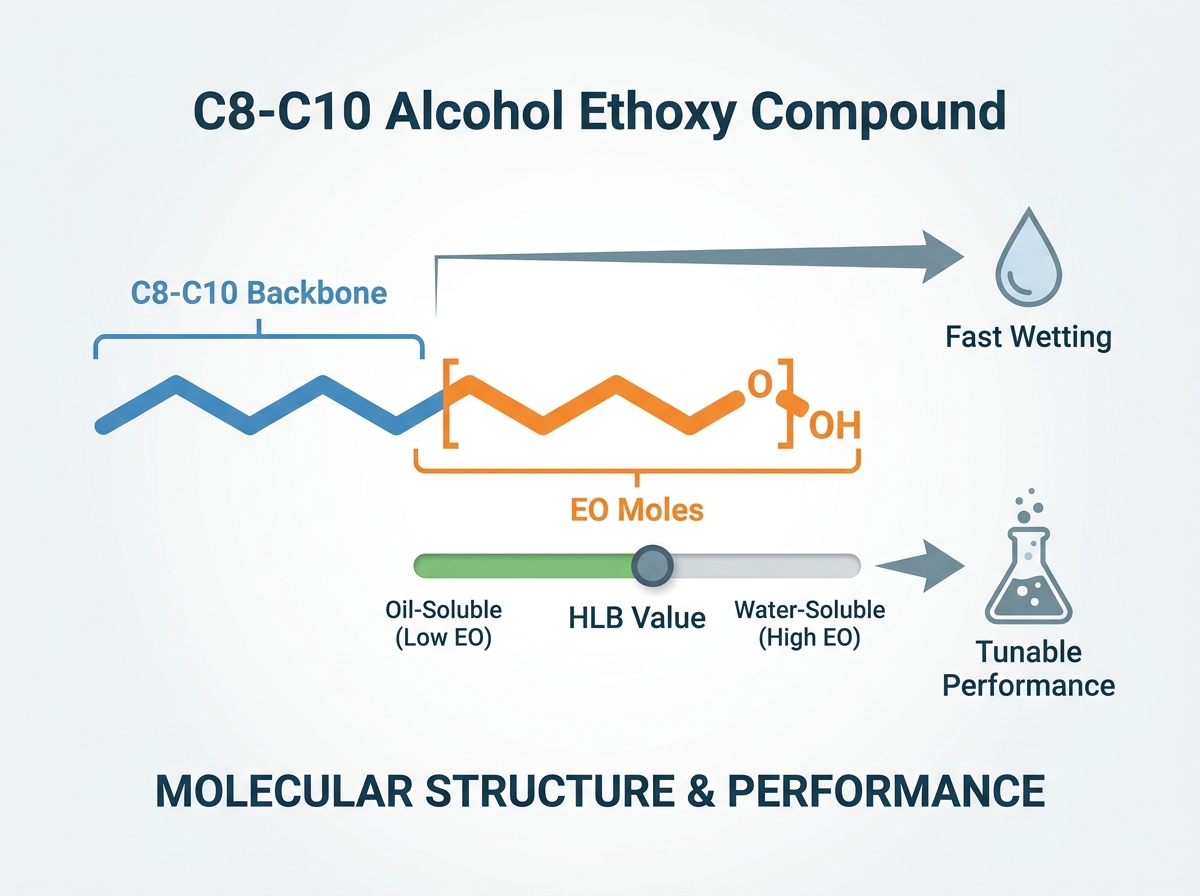
Understanding surfactant behavior begins at the molecular level. The unique structure of these ethoxylates dictates their rapid action. You must balance the carbon backbone length against the degree of ethoxylation. This balance controls entirely how the surfactant behaves in your mixing tanks.
The carbon chain length acts as the hydrophobic tail of the surfactant. In a C8-C10 alcohol ethoxy compound, this backbone is relatively short. You can source it from either synthetic petrochemical routes or natural fatty alcohols. The shortened chain drastically reduces steric hindrance.
Steric hindrance occurs when bulky molecules struggle to arrange themselves quickly. Because the C8-C10 tail is compact, the molecules migrate rapidly to the air-water interface. This rapid migration results in exceptionally fast surface wetting. Longer chains, like C12-C14, move much slower. If your formulation requires instantaneous spreading, the shorter C8-C10 backbone is superior.
The hydrophilic head of the surfactant is created by adding Ethylene Oxide (EO) to the alcohol. Varying the moles of EO changes the water solubility dramatically. Most commercially viable C8-C10 ethoxylates feature between 3 and 8 moles of EO.
By adjusting these moles, you directly control the Hydrophilic-Lipophilic Balance (HLB). The HLB value dictates the primary function of your surfactant. We can map out a distinct decision framework for formulators based on these EO additions.
Here is an EO Mole Decision Chart outlining expected performance behaviors:
| EO Mole Count | Estimated HLB Range | Solubility Profile | Primary Formulation Function |
|---|---|---|---|
| 3 - 4 Moles | 8.0 - 10.5 | Oil-soluble, water-dispersible | Defoaming, w/o emulsification |
| 5 - 6 Moles | 11.0 - 12.5 | Moderately water-soluble | General purpose wetting, light detergency |
| 7 - 8 Moles | 13.0 - 14.5 | Highly water-soluble | Strong detergency, o/w emulsification |
The manufacturing process determines the distribution of the ethoxy groups. Standard base-catalyzed reactions produce a broad range of ethoxylation. Some molecules might have 2 moles, while others have 10 moles. This broad distribution often leaves a higher percentage of unreacted free alcohol. Free alcohols carry a distinct, sharp odor.
Alternatively, narrow range ethoxylation uses specialized catalysts to tighten this distribution. Narrow range products contain significantly less free alcohol. This precise chemistry is crucial for consumer-facing personal care products. Odor neutrality matters immensely there. Industrial cleaners, however, often tolerate broad-range products easily to keep raw material expenses optimized.
The versatility of these surfactants allows them to perform across diverse industries. They thrive in environments requiring rapid surface tension reduction. Let us explore three distinct sectors relying heavily on this chemical profile.
Facility management requires efficient cleaning chemicals. The primary success criteria here is high soil removal efficacy using very low mechanical action. Workers need the chemical to do the heavy lifting. The surfactant works brilliantly because it offers excellent lipid and grease emulsification. It penetrates oily soils rapidly. Furthermore, it maintains a controlled foam profile. This prevents overflowing in floor scrubbing machines. You get rapid cleaning without blinding the equipment sensors.
Farmers use adjuvants to maximize the efficacy of herbicides and pesticides. The success criteria involve improved leaf penetration and superior active ingredient delivery. Waxy plant leaves naturally repel water. These specific ethoxylates reduce dynamic surface tension almost instantly. The spray droplet flattens upon impact instead of bouncing off the leaf. It achieves this coverage without causing phytotoxicity, meaning it will not chemically burn the crops.
Fabric manufacturing involves harsh chemical environments. The success criteria demand high-speed scouring and rapid wetting under extreme pH conditions. Textiles must absorb dyes uniformly. The nonionic nature of this surfactant shines here. It delivers robust chemical stability in both acidic dye baths and highly alkaline scouring tanks. Unlike anionic surfactants, it will not precipitate out of solution when exposed to hard water ions.
Transitioning chemical raw materials requires serious business justification. You cannot simply swap ingredients without evaluating the broader impact. Formulators must understand the historical context and the performance metrics driving this shift.
Nonylphenol Ethoxylates (NPEs) dominated industrial formulations for decades. They were cheap, robust, and highly effective. However, heavy regulatory and consumer pushback changed the landscape. NPEs degrade into toxic byproducts persisting in aquatic environments. Regulatory bodies worldwide have strictly limited or banned their use in many applications. Modern formulations must pivot away from NPEs to survive market audits.
When replacing NPEs, formulators demand performance parity at minimum. A well-formulated C8-C10 alcohol ethoxy compound often exceeds baseline expectations. We can directly compare dynamic wetting times and detergency efficiency.
Because the C8-C10 carbon chain mitigates steric hindrance, it wets faster than a standard NPE-9. You often require significantly lower active concentrations of the newer ethoxylate to achieve identical wetting times. This concentration drop provides a massive advantage for compact or hyper-concentrated product lines.
Evaluating raw material prices directly can be misleading. You must address the baseline cost assumptions carefully. The per-pound unit cost of specialized ethoxylates may slightly exceed legacy commodity surfactants. However, your overall formulation expenses can actually decrease.
Because you achieve better wetting speeds, you lower the required dosing amounts. Furthermore, the rapid-breaking foam profile reduces your need for expensive secondary defoamers. You streamline your inventory by stocking fewer corrective additives.
Comparative Surfactant Metrics Table:
| Metric | Legacy NPE-9 | C8-C10 Ethoxylate (6 Moles) |
|---|---|---|
| Wetting Speed (Draves Test) | Moderate | Exceptionally Fast |
| Foam Profile | High, stable | Moderate, fast-breaking |
| Required Formulation Dosage | Standard baseline | Often 10-15% lower |
| Need for Secondary Defoamers | High | Low to None |
Today, a chemical must perform well and protect the environment simultaneously. Corporate sustainability goals require strict adherence to green chemistry principles. The environmental profile of your surfactant package heavily influences your market positioning.
Chemical persistence is a primary regulatory target. You must verify classification under global environmental frameworks. The C8-C10 ethoxylate class typically meets stringent OECD criteria. They test as both inherently and readily biodegradable. Once they enter wastewater treatment facilities, microbial action breaks them down quickly. They do not leave harmful endocrine-disrupting metabolites behind.
Securing eco-labels boosts consumer trust significantly. You should prioritize selecting an ethoxylate pre-cleared for these programs. Many C8-C10 surfactants appear on the CleanGredients database. This inclusion streamlines your path toward achieving EPA Safer Choice certification for your finished goods. It removes the heavy burden of conducting independent, highly expensive toxicity assays.
Modern regulatory audits closely monitor atmospheric and aquatic impact. These surfactants highlight an excellent low aquatic toxicity profile. They pose significantly less danger to marine life compared to older alkylphenol chemistries. Additionally, they offer zero-to-low Volatile Organic Compound (VOC) contributions. Keeping VOCs low helps you comply with strict regional air quality regulations, like those enforced by CARB in California.
Every chemical transition carries inherent manufacturing risks. Theoretical lab performance does not always translate smoothly to the factory floor. You must prepare for specific handling realities before scaling up production.
Selecting the optimal surfactant architecture transforms your final product quality. You now understand how a shorter carbon chain combined with precise ethoxylation delivers unparalleled dynamic wetting. Formulators can replace outdated chemistries confidently while maintaining rigorous cleaning performance.
Your shortlisting logic depends entirely on balancing your target HLB, strict regulatory requirements, and specific wetting speed needs. Narrow down your options by deciding if you need oil solubility or heavy-duty detergency.
As immediate next steps, we advise taking action today. Calculate your exact required HLB for the target formulation. Audit your current mixing tank temperature capabilities to prevent winter handling issues. Finally, request technical data sheets, safety data sheets, and liquid samples from vetted chemical suppliers to begin your benchtop pilot testing.
A: The Hydrophilic-Lipophilic Balance usually ranges from 10 to 14. This value depends entirely on whether it is a 4-mole, 6-mole, or 8-mole ethoxylate. Lower moles push the HLB closer to 10, favoring oil dispersion. Higher moles push it toward 14, providing excellent water solubility and detergency.
A: Often yes, but you cannot simply swap them blindly. Formulators must match the exact HLB. You may also need to adjust your existing hydrotrope levels carefully. This adjustment ensures you match the precise phase stability and clarity of your legacy formulation.
A: Yes. Because they are nonionic surfactants, they do not carry a functional charge. They generally demonstrate excellent chemical stability across a remarkably broad pH range. They resist hydrolyzing in harsh industrial degreasers or acidic aluminum brighteners.
A: Relative to longer chain (C12-C14) or traditional anionic surfactants, yes. They provide extremely rapid wetting alongside a fast-breaking foam profile. However, you should note the precise foam height still depends heavily on the specific EO mole count you select.


