
English
Views: 0 Author: Site Editor Publish Time: 2026-07-22 Origin: Site


Sourcing the right chemical ingredients requires balancing strict specification tolerances against volatile petrochemical pricing realities. As supply chains tighten globally, procurement managers face constant pressure to optimize costs. They must achieve this without sacrificing formulation integrity or end-product performance. Navigating this complex landscape demands a clear understanding of chemical grades, market drivers, and vendor reliability.
We created this comprehensive guide to provide procurement managers and chemical formulators an objective breakdown of Polyethylene Glycol 200. You will discover exactly how different grades impact your manufacturing process. We also examine current pricing drivers and outline crucial vendor evaluation criteria. By the end, you will have a streamlined, actionable framework to make informed purchasing decisions and secure highly reliable supply chains for your organization.
You must understand the foundational chemistry before evaluating suppliers. Polyethylene Glycol 200 is a versatile polymer of ethylene oxide. The "200" designates its average molecular weight, which ranges strictly between 190 and 210 g/mol. This specific molecular weight dictates its physical state. At room temperature, it exists as a clear, colorless, and viscous liquid. It possesses a mildly sweet odor and remains completely miscible in water. It also dissolves readily in many organic solvents like acetone and ethanol. These baseline properties make it an exceptional solvent, coupling agent, and humectant.
Manufacturers process technical-grade variations specifically for broad industrial use. This grade focuses on functional performance rather than absolute chemical purity. It serves as an essential raw material across various sectors.
Certain industries cannot tolerate trace impurities. Pharmaceutical and personal care manufacturers require High-Purity or USP/NF (United States Pharmacopeia/National Formulary) grades. Processing these grades requires intense purification steps.
The core cost structure traces directly back to petrochemical feedstocks. Refineries crack crude oil and natural gas liquids to produce ethylene. Manufacturers then oxidize ethylene to create ethylene oxide. Finally, they polymerize ethylene oxide with water to synthesize the final product. Any supply shock in global crude markets immediately ripples down this chain. You should monitor ethylene oxide indices closely. When feedstock prices spike due to refinery outages or geopolitical tensions, your quoted prices will inevitably rise within a few weeks.
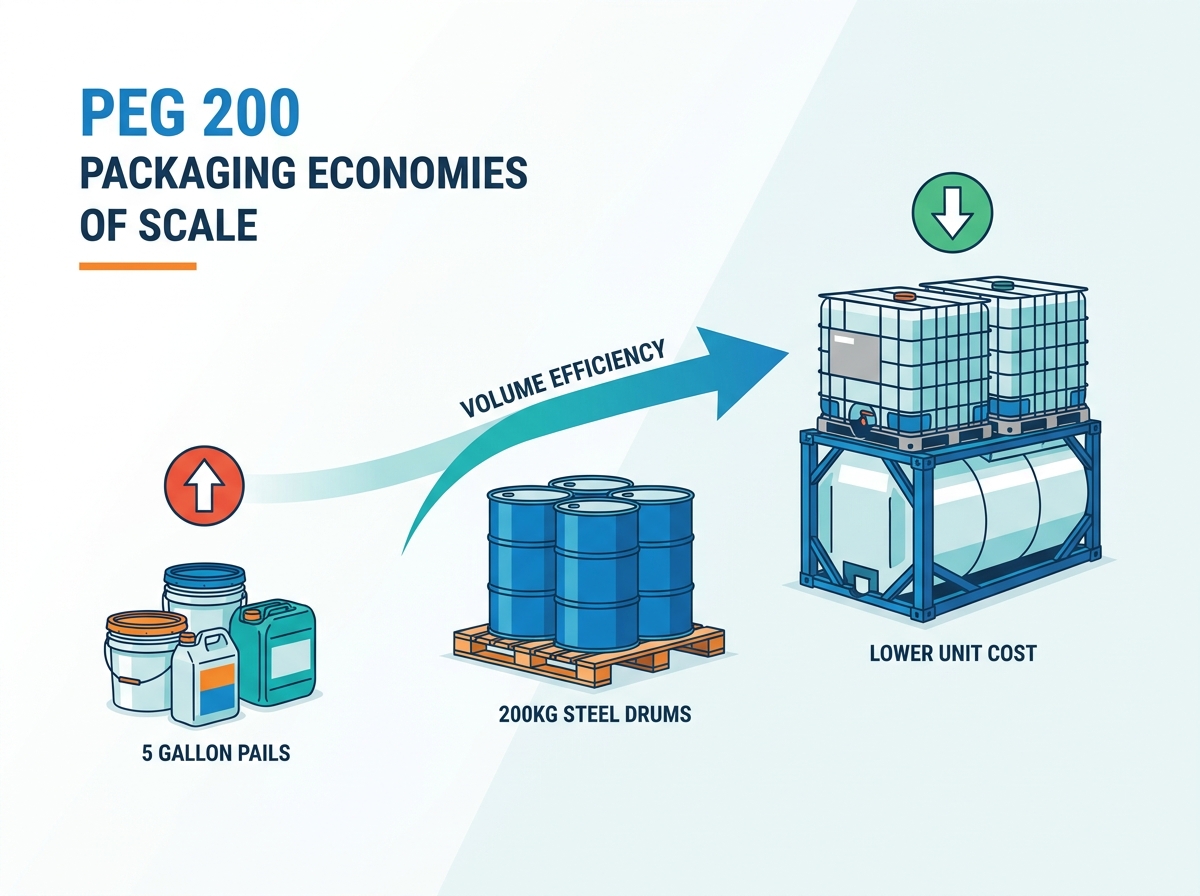
How you buy matters just as much as what you buy. Packaging formats drastically alter your final per-kilogram price. Procurement must balance actual consumption rates against volume discounts.
| Packaging Format | Typical Volume | Cost Efficiency Profile | Best Suited For |
|---|---|---|---|
| Pails / Jugs | 20 kg | Low (High premium) | Lab testing, pilot runs |
| HDPE / Steel Drums | 200 kg | Moderate | Batch manufacturing |
| IBC Totes | 1,000 kg | High | Large scale production |
| ISO Tanks | 20,000+ kg | Maximum | Continuous industrial processes |
Factory-gate pricing rarely reflects what you actually pay. Localized supply chains often dictate the final quoted price. If you source internationally, you must factor in import tariffs, customs clearance fees, and ocean freight volatility. Domestic sourcing might present a higher factory-gate price but can yield lower overall expenditure due to cheaper truck freight and faster lead times. Always evaluate quotes on a delivered basis rather than just the raw chemical cost.
Procurement teams constantly seek cost-reduction opportunities. Because standard Ethylene Glycol (EG) and Diethylene Glycol (DEG) often cost significantly less, formulators sometimes attempt to substitute them into existing recipes. While they share similar solvent properties, making this swap without rigorous safety reviews introduces catastrophic risks to both personnel and end-users.
The most critical distinction lies in human toxicity.
Industrial environments push chemicals to their thermal limits. Standard glycols exhibit higher volatility, meaning they evaporate faster and create potentially hazardous vapors in hot factories. Conversely, a polymer with a 200 molecular weight boasts exceptionally low volatility and a high flash point (typically above 170°C). It remains stable and safe in high-temperature industrial environments. Switching to a cheaper, lighter glycol often requires expensive facility upgrades for explosion-proof ventilation.
You cannot trust a vendor blindly. The Certificate of Analysis serves as your primary defense against substandard materials. Every batch must arrive with a current COA. Train your receiving department to audit three specific metrics immediately.
Evaluate the operational maturity of the supplier. Demand verified ISO 9001 certifications. Ask them to demonstrate their batch-tracking systems. If a contamination event occurs, how quickly can they trace the affected lot? Transparent recall procedures indicate a vendor who takes quality assurance seriously. Avoid brokers who frequently change their underlying manufacturers without notifying you.
High-quality liquid means nothing if it degrades in transit. Evaluate the vendor's container sealing processes. Poorly sealed drums allow ambient moisture to penetrate during ocean voyages or long truck routes. Inspect sample shipments for tamper-evident seals, rust-free drums, and properly torqued bung caps. Strong packaging integrity prevents moisture ingress and protects your investment.
The greatest threat to this material occurs after it reaches your facility. It acts like a chemical sponge. If operators leave drums unsealed or open to ambient factory air, the liquid aggressively absorbs atmospheric moisture. This alters the viscosity. More importantly, it ruins chemical reactivity. In applications like polyurethane production, excess water reacts with isocyanates to create carbon dioxide gas, causing catastrophic foaming and ruined batches. Always reseal containers immediately.
Storage temperature directly impacts chemical longevity. The liquid boasts an impressive low freezing point of roughly -65°C, meaning it will not solidify in standard winter transit. However, you should avoid storing it in extreme heat. Prolonged exposure to high temperatures accelerates oxidative degradation. Store containers in a cool, dry, well-ventilated warehouse. Under optimal, sealed conditions, you can expect a reliable shelf life of 12 to 24 months.
While generally recognized as safe, bulk handling requires professional discipline. Your facility must comply with Material Safety Data Sheet (MSDS) guidelines. Provide operators with standard PPE, including chemical-resistant gloves and safety goggles, to prevent mild mechanical eye irritation. Implement standard spill containment protocols using absorbent materials like sand or vermiculite. Never flush bulk spills into municipal drains. Always adhere to local environmental disposal guidelines for chemical waste.
Your immediate next step is to initiate a controlled vendor qualification process. Advise your purchasing team to request small sample batches and current COAs from at least three different suppliers. Ask them to provide preliminary freight-inclusive quotes based on IBC totes. Compare these delivered costs side-by-side before committing to any long-term bulk contracts.
A: It does not have a single exact molecular weight. The "200" represents an average molecular weight. Commercially acceptable distribution ranges fall strictly between 190 and 210 g/mol. This is determined by testing the hydroxyl value of the batch.
A: Yes, it is completely miscible and soluble in water at room temperature. It also dissolves easily in many organic solvents like alcohols, acetone, and benzene. This excellent dual solubility makes it a highly effective coupling agent in complex formulations.
A: The standard shelf life ranges from 12 to 24 months. However, this depends entirely on strict storage conditions. It must remain in its original, sealed container and be stored in a cool, dry environment away from direct heat and sunlight.
A: No. Using technical or industrial grades in personal care products introduces severe regulatory and safety risks. Technical grades lack the strict purification required to remove trace impurities like heavy metals or 1,4-dioxane. You must use Cosmetic or USP/NF grades for human contact applications.


