
English
Views: 0 Author: Site Editor Publish Time: 2026-07-26 Origin: Site


Selecting the right nonionic surfactant requires moving past generic classifications. Formulators must rigorously evaluate exact carbon chain lengths and ethoxylation levels. Doing so ensures optimal performance in complex chemical matrices.
Formulators often face stability, solubility, or foaming issues when substituting raw materials blindly. These problems usually arise from failing to match precise technical specifications. A slight mismatch can easily derail an entire production batch.
This guide breaks down the critical parameters of a C8-C10 alcohol ethoxy compound. We will help procurement and R&D teams confidently evaluate Technical Data Sheets (TDS). You will learn how to match specifications to formulation needs and mitigate supply chain risks.
A typical C8-C10 alcohol ethoxy compound consists of a synthetic or naturally derived fatty alcohol base reacted directly alongside ethylene oxide gas. This chemical reaction creates an ethoxylate chain. The underlying fatty alcohol contains between 8 and 10 carbon atoms. Manufacturers classify these compounds using various global CAS registry numbers, often referencing generalized categories like "Alcohols, C8-10, ethoxylated." Cross-referencing these registry numbers helps regulatory teams confirm exact chemical identities across different global markets.
The short-to-medium carbon chain provides fundamental hydrophobic characteristics. Because it contains only 8 to 10 carbons, the tail remains relatively short compared to conventional lauryl blends. This unique structural geometry allows the molecule to move rapidly through liquid mediums. It migrates to surfaces and interfaces much faster than heavier molecules. You will notice immediate performance differences when evaluating dynamic surface tension metrics.
Industry experts classify this material primarily as a highly effective nonionic surfactant. It carries no electrical charge on its hydrophilic head. This neutral state makes it incredibly stable across broad pH ranges and highly compatible alongside anionic or cationic co-surfactants. You will frequently find it utilized heavily in hard surface cleaners, textile processing baths, and agrochemical adjuvants. It excels in these areas due to its rapid surface tension reduction and excellent wetting capabilities.
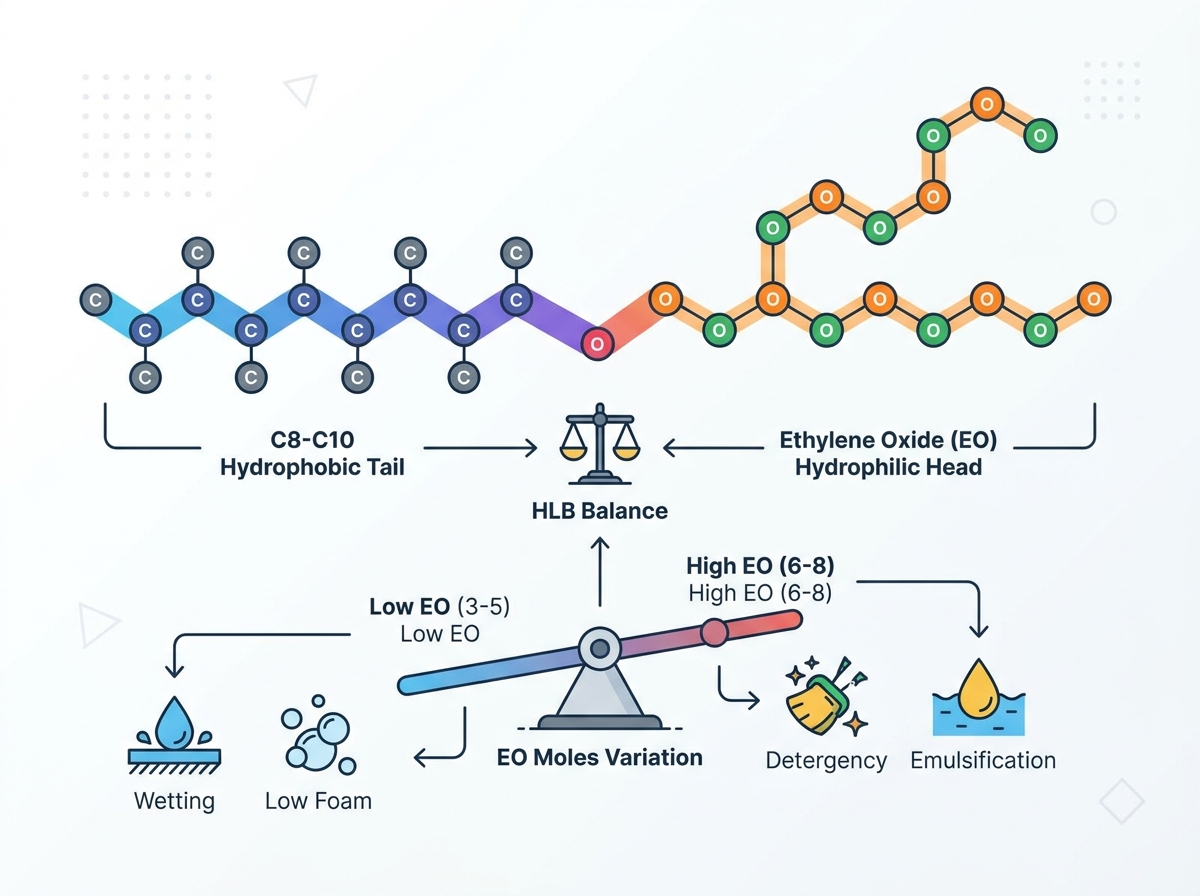
The degree of ethoxylation profoundly changes both the physical and chemical behavior of the compound. Adding more ethylene oxide lengthens the hydrophilic head. This structural change shifts the Hydrophilic-Lipophilic Balance (HLB) higher. Formulators must dictate the exact molar ratio to achieve specific end-use properties.
When manufacturers attach only 3 to 5 moles of ethylene oxide, the resulting product exhibits distinct lipophilic traits.
Increasing the ethylene oxide content shifts the molecule toward hydrophilicity.
Formulators should never accept a generic label from suppliers. You must use specific HLB requirements to short-list the exact EO grade necessary for your project. Emulsions require precise HLB matching to prevent separation. Hard surface cleaners demand a delicate balance between detergency and rapid wetting. By charting the expected HLB against the targeted application, you eliminate guesswork.
Chart: Ethoxylation Impact on Performance Variables
| EO Moles | Approximate HLB Range | Solubility Profile | Primary Application Strengths |
|---|---|---|---|
| 3 to 4 | 8.0 - 10.5 | Oil-soluble / Water-dispersible | Wetting agents, sulfation intermediates |
| 5 to 6 | 11.0 - 12.5 | Water-soluble (low cloud point) | Degreasers, rapid wetting, mild emulsifiers |
| 7 to 8 | 13.0 - 14.5 | Highly water-soluble | Heavy-duty detergency, oil-in-water emulsions |
Formulators frequently question why they should choose an 8-10 carbon chain over heavier ethoxylates like C13 or C12-C14 blends. The answer lies in molecular kinetics. Heavier chains excel at producing dense, stable foams and suspending soils. However, lighter chains prioritize speed and agility in dynamic cleaning environments.
The shorter carbon structure offers generally superior and faster wetting properties. In applications requiring rapid penetration—such as textile scouring or agricultural leaf spreading—time matters. The smaller molecular footprint allows the surfactant to rapidly occupy the air-liquid or liquid-solid interface. Test results consistently show faster Draves wetting times compared to longer-chain analogs.
Dynamic foaming characteristics sharply contrast across different chain lengths. Longer chains create persistent, stable foams. Conversely, the shorter chain typically offers quicker foam collapse. This rapid defoaming action proves critical for industrial mechanical cleaning applications. Clean-In-Place (CIP) systems, automatic dishwashing liquids, and spray washers require low foam to maintain pump efficiency and prevent overflow.
Shorter chain ethoxylates often boast lower pour points. They remain fluid at much lower ambient temperatures compared to their longer-chain counterparts. This physical trait makes them significantly easier to pump, transfer, and handle in unheated warehouses. You expend less energy heating drums or iso-tanks during winter months, streamlining the manufacturing process.
Technical procurement teams should demand comprehensive transparency from a supplier’s Certificate of Analysis (CoA) and TDS. Accepting a broad specification range opens the door to batch-to-batch inconsistency. You must scrutinize specific quality metrics to ensure reliable formulation outcomes.
Table: Standard Quality Parameters for Routine Evaluation
| Parameter | Testing Methodology | Significance in Formulation |
|---|---|---|
| Hydroxyl Value (OHV) | Titration | Determines average molecular weight and exact EO distribution. |
| Cloud Point | Visual phase separation (1% aq) | Dictates upper temperature limits before surfactant separates. |
| Moisture Content | Karl Fischer | Ensures active content purity; limits undesirable water intrusion. |
| Color (APHA) | Pt-Co Scale | Maintains visual clarity for aesthetic consumer products. |
The hydroxyl value represents a critical analytical measurement. It verifies the actual molecular weight of the surfactant batch. Because ethoxylation produces a bell-curve distribution of EO chains, the hydroxyl value ensures the average matches your required specification. Strict adherence to tight OHV ranges guarantees predictable viscosity and solubility.
You must match the cloud point to your intended application temperature. If the formulated cleaner operates above the established cloud point, the surfactant will drop out of solution. Phase separation drastically reduces detergency and creates unsightly haziness. Always verify cloud point metrics using the specific solvent system (e.g., 1% aqueous or 10% NaCl) noted on the TDS.
Review the limits on moisture using the Karl Fischer method. Also, monitor levels of free polyethylene glycol (PEG) and unreacted raw alcohol. High levels of unreacted alcohol increase unwanted odor and lower the flash point. Excess PEG can alter the expected HLB and reduce overall cleaning efficiency.
Low APHA color scores indicate high purity and careful processing. Clear household formulations and high-end cosmetic products require water-white ingredients. If a batch exhibits a yellow tinge, it might indicate localized overheating during the ethoxylation reactor phase.
Navigating global chemical inventories protects your product lifecycle. Procurement teams must verify TSCA compliance for the US market and REACH registration for European distribution. If you formulate personal care items, confirm the correct INCI naming conventions. Proper documentation prevents costly border delays and regulatory fines.
Safety Data Sheets provide operational blueprints for plant operators. Ignoring them introduces severe physical and environmental hazards into your facility.
Examine standard GHS classifications carefully. These compounds often carry warnings for severe eye irritation potential. Formulators must mandate proper personal protective equipment (PPE) during handling. Furthermore, shorter chain ethoxylates can present specific aquatic toxicity risks. Facilities must implement rigorous disposal protocols and wastewater planning to prevent environmental contamination.
Evaluate manufacturers versus mere distributors. Direct manufacturers usually possess better capabilities for providing narrow-range ethoxylates if your project requires tighter specifications. Distributors offer logistical convenience but may lack deep technical support when complex formulation anomalies arise.
Always request pre-shipment samples before authorizing bulk purchases. Bench chemists must verify the cloud point and solubility directly within the specific formulation matrix. Lab-scale validation prevents massive financial losses resulting from incompatible bulk deliveries.
Assess scalability regarding packaging. Suppliers generally offer 200kg drums, 1000kg IBC totes, or bulk iso-tanks. Your choice heavily impacts material handling based on ambient warehouse temperatures. IBC totes save space but become notoriously difficult to heat uniformly if the surfactant thickens during winter transit.
Set up a structured pilot formulation trial. Request all updated technical documents, including the latest TDS, SDS, and batch CoAs. Establish clear communication channels between your R&D chemists and the supplier’s technical service team to address any unexpected gel phases or foaming discrepancies quickly.
Sourcing the correct C8-C10 alcohol ethoxy compound remains an exact science. Success depends entirely on matching the carbon chain length and EO moles precisely to your formulation targets. Generic assumptions lead to poor wetting, unstable emulsions, or uncontrollable foam.
We advise buyers to prioritize suppliers who provide transparent, batch-specific quality data. Evaluating comprehensive TDS and SDS documents offers far more value than chasing the lowest per-kilo price. Formulation failures consistently outweigh any initial raw material savings. By executing rigorous sample testing and understanding the underlying chemistry, your team can secure a robust, high-performing supply chain.
A: The primary difference lies in carbon chain length, which directly impacts dynamic performance. The shorter C8-10 structure generally wets surfaces much faster and produces a less stable, quicker-collapsing foam. Conversely, the longer C12-14 chain excels in heavy soil suspension and creates dense, persistent foam suitable for high-lather detergents.
A: A direct correlation exists between EO moles and cloud point. Higher EO numbers increase the molecule's hydrophilicity and water solubility. Consequently, the temperature at which the solution becomes cloudy—known as the cloud point—rises significantly as you add more ethylene oxide to the chain.
A: Most linear fatty alcohol ethoxylates offer excellent biodegradability profiles. However, exact degradation rates depend on the specific molecular structure and EO distribution. Buyers must always verify specific OECD test results listed on the supplier's Safety Data Sheet to ensure local environmental compliance.
A: You can prevent gel formation by strictly controlling the order of addition. Always pour the concentrated surfactant slowly into warm water while maintaining vigorous mechanical agitation. Never pour water directly into the undiluted surfactant, as this triggers highly viscous gel phases that become incredibly difficult to dissolve.


