
English
Views: 0 Author: Site Editor Publish Time: 2026-10-30 Origin: Site


Formulators and procurement teams face mounting operational pressure today. They must balance raw solvent performance against strictly tightening Environmental, Health, and Safety (EHS) regulations. Finding the perfect chemical match demands intensive scientific rigor. We must introduce CAS 26468-86-0 as a highly specific compound here. It requires careful evaluation against broader classes of legacy ethylene glycol ethers (EGEs). You cannot blindly swap industrial solvents without reviewing their deep technical profiles. This article provides a deeply evidence-based comparison. We benchmark CAS 26468-86-0 against common alternative glycol ethers on the market. You will learn how to properly evaluate solvency power. You will also learn to navigate complex safety profiles and handle harsh implementation realities.
You must identify operational triggers before evaluating any new chemical. Regulatory bodies routinely phase out toxic legacy solvents. This action forces companies to adapt quickly. You might need to reformulate an entire product line. Process efficiency also drives this evaluation. Outdated solvents often cause slow drying times. They can also create hazardous workplace conditions. Teams evaluate CAS 26468-86-0 to solve these specific production bottlenecks. It provides a unique balance of active solvency and controlled evaporation. You cannot ignore these critical operational drivers.
You must establish strict baseline metrics for any chemical evaluation. Evaporation rate serves as a primary indicator. It dictates how quickly a coating or cleaner dries. You also need to measure the hydrophilic-lipophilic balance (HLB). HLB determines how well the solvent emulsifies different ingredients. Safety thresholds represent another non-negotiable metric. You must map exposure limits against your current facility capabilities. A successful evaluation means the chemical meets all three criteria simultaneously. It must evaporate correctly, mix well, and remain safe for workers.
Supply chain stability remains crucial for industrial manufacturing. You cannot rely on a solvent if it frequently goes out of stock. We must consider the commercial availability of CAS 26468-86-0. It often competes against heavily commoditized ethylene glycol ethers. Commoditized solvents have massive global production volumes. However, specialized ethers offer more targeted performance benefits. You must verify consistent supplier output before committing to a reformulation. Secure multiple sourcing avenues to protect your production schedule. Consistent availability ensures your production lines never unexpectedly halt.
Solvency power dictates a chemical's effectiveness in any formulation. We measure this using Hansen Solubility Parameters (HSP). HSP breaks solvency into dispersion forces, polar forces, and hydrogen bonding. You must compare the HSP of CAS 26468-86-0 against standard EGEs. Ethylene Glycol Monobutyl Ether (EB) serves as a common benchmark. CAS 26468-86-0 often displays a different hydrogen bonding profile. This difference affects resin compatibility directly.
Industrial formulations use various resin systems. Acrylics require specific polar interactions to remain stable. Epoxies demand strong dispersion forces for proper curing. Polyurethanes react poorly to excess moisture or incorrect solvent polarity. You must test CAS 26468-86-0 against your specific resin backbone. Mismatched solubility parameters cause immediate phase separation. They can also create cloudy films in clear coatings. Always run lab-scale compatibility tests before scaling up.
Physical properties govern how a solvent behaves in the real world. Boiling point dictates the temperature required for phase change. Flash point determines fire risk during handling and storage. Vapor pressure indicates how readily the liquid becomes a gas at room temperature. You must analyze these metrics carefully. They impact drying times and final film formation significantly.
High vapor pressure means faster evaporation. This speeds up production lines. However, drying too quickly causes film defects like blushing or orange peel. Lower vapor pressure keeps the solvent in the film longer. This promotes better leveling and a smoother finish. You must balance these properties based on your application method. Spray coatings need different evaporation curves than dip coatings.
Table: Standard Physical Property Evaluation Metrics
| Property Category | Metric | Formulation Impact |
|---|---|---|
| Thermal Behavior | Boiling Point (°C) | Determines the maximum processing temperature before vaporization. |
| Safety & Storage | Flash Point (°C) | Dictates required storage conditions and flammability ratings. |
| Volatility | Vapor Pressure (mmHg) | Controls the evaporation rate and open-time of the coating. |
| Miscibility | Water Solubility (%) | Affects phase stability in waterborne formulations. |
Switching solvents always introduces formulation trade-offs. Viscosity reduction is a primary goal for many chemists. You need the fluid thin enough to spray or spread easily. CAS 26468-86-0 handles viscosity reduction effectively. However, it alters surface tension simultaneously. Surface tension modifications change how the liquid wets a substrate. Poor wetting leads to crawling or cratering defects. You might need to adjust your surfactant packages to compensate. Transparently mapping these trade-offs prevents costly production failures later.
Safety always precedes performance in industrial chemistry. You must rigorously compare Permissible Exposure Limits (PELs). OSHA establishes these strict legal limits for workplace air quality. Threshold Limit Values (TLVs) provide another critical benchmark. The American Conference of Governmental Industrial Hygienists (ACGIH) issues TLVs. You must evaluate the exposure profile of CAS 26468-86-0 against alternative ethers. Some legacy ethers have dangerously low PELs. They require extreme precautions.
Workplace engineering controls are mandatory. You cannot rely solely on open windows or fans. Local exhaust ventilation (LEV) systems capture vapors at the source. They prevent chemicals from entering the worker's breathing zone. Upgrading to a new ether might trigger new ventilation requirements. You must assess your current airflow capacities. Ensure they meet the specific volume turnover rates required by the safety data sheet.
Toxicological profiles guide our understanding of chemical risks. We must assess both acute and chronic toxicity markers. Acute toxicity happens immediately after high exposure. Symptoms include dizziness, nausea, or respiratory irritation. Chronic toxicity develops slowly over years of repeated low-level exposure. It often manifests as liver, kidney, or neurological damage. You must consult standard toxicological frameworks to verify these risks.
Absorption routes complicate glycol ether safety significantly. Inhalation poses a massive risk due to vapor pressure. Dermal contact presents an equally severe threat. Many ethers penetrate human skin rapidly. They bypass the liver's initial filtration system. They enter the bloodstream directly. Therefore, strict Personal Protective Equipment (PPE) is non-negotiable. Standard latex gloves often fail against solvents. You usually need heavy-duty butyl rubber or specialized nitrile gloves. Always verify glove degradation charts before assigning PPE to workers.
Regulatory frameworks dictate where and how you sell your products. You must evaluate the compound's status carefully. The EPA strictly enforces Volatile Organic Compound (VOC) limits. High-VOC solvents contribute to smog formation. Many architectural coatings must adhere to strict VOC ceilings. You need to know exactly how this chemical affects your VOC calculations.
California Proposition 65 adds another layer of complexity. It mandates warning labels for chemicals known to cause cancer or reproductive harm. If your alternative solvent triggers a Prop 65 warning, consumer sales will plummet. You must also check hazardous air pollutant (HAP) definitions. Utilizing HAP-listed chemicals requires extensive air permitting and reporting. Avoid regulatory roadblocks by choosing chemicals that naturally clear these compliance hurdles.
The "drop-in" replacement remains a dangerous industry myth. Sales representatives often claim you can easily swap one solvent for another. Formulators sometimes believe a 1:1 volumetric substitution will work. It almost never succeeds. Switching to or from CAS 26468-86-0 alters the entire system dynamics. The evaporation curve shifts instantly. The new solvent might trap moisture differently. It can dissolve resins faster or slower. This imbalance ruins the final product. You must rebalance the entire formulation to accommodate the new chemical parameters.
Rigorous quality assurance prevents disastrous product launches. You must perform extensive lab testing. Consider the following crucial evaluation protocols:
Skipping these tests guarantees eventual failure. You must validate the new formulation under stress before full-scale production begins.
Bulk storage introduces completely different challenges than benchtop formulation. Storage stability is your first concern. Glycol ethers face auto-oxidation risks over time. They react with oxygen to form explosive peroxides. You must test the solvent for peroxide formation regularly. Implementing nitrogen blanketing inside storage tanks mitigates this risk effectively. It displaces oxygen and keeps the chemical inert.
Tank material selection matters immensely. You must compare requirements for CAS 26468-86-0 against competing solvents. Carbon steel tanks rust quickly if the solvent absorbs ambient moisture. This rust contaminates the entire batch. Stainless steel prevents corrosion but requires a larger initial infrastructure setup. You must map these handling realities before accepting a bulk delivery.
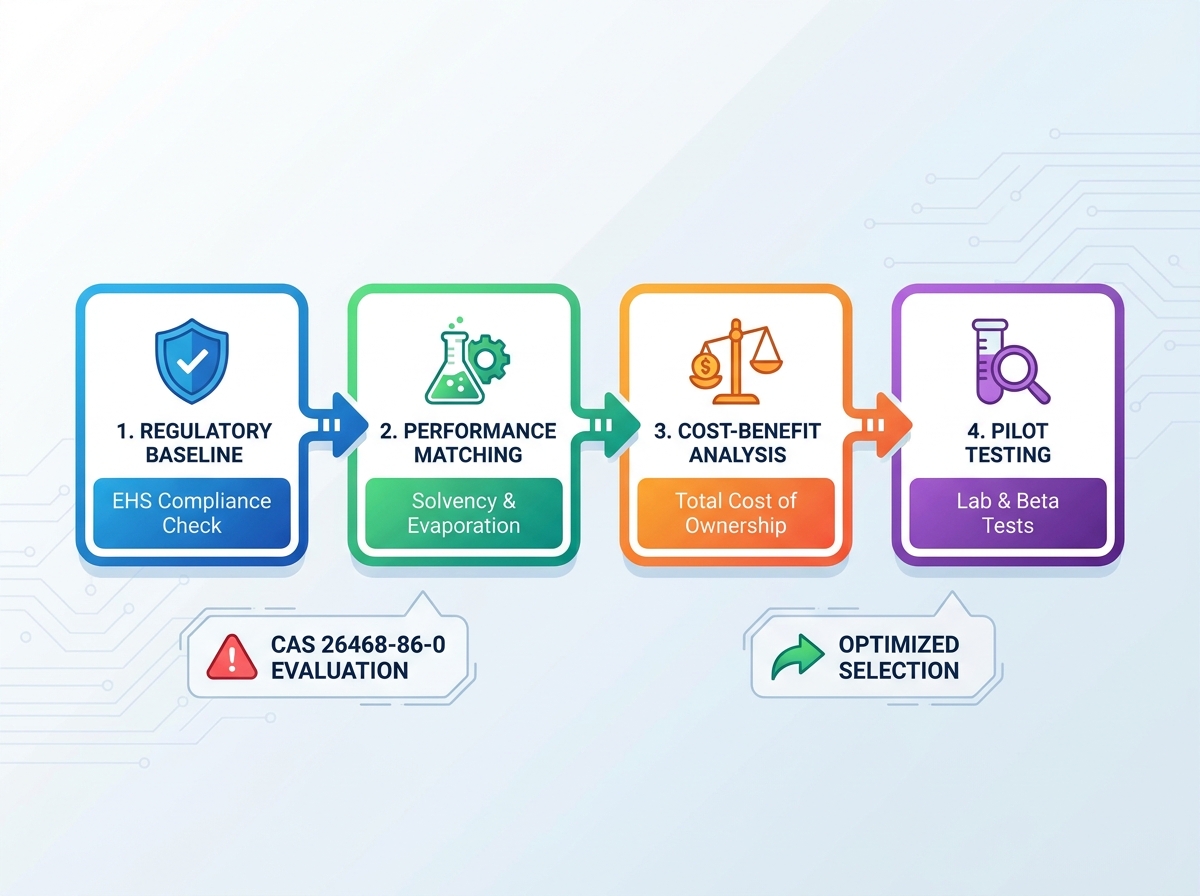
Start your evaluation by filtering out illegal options. You must eliminate solvents that violate your target market's EHS compliance rules. Consumer products face stricter regulations than industrial end-uses. Do not formulate with a chemical if local laws restrict it. Establish this firm baseline immediately to save time.
Next, align the physical properties to your specific needs. Match the evaporation curve of CAS 26468-86-0 with your ideal drying time. Compare the solvency parameters against your resin system. Ensure the HLB values support your emulsion stability. The chemical must perform its primary function flawlessly.
You must carefully assess internal facility constraints. Introducing a new chemical requires systemic adjustments. Weigh the performance benefits against required facility upgrades. You might need to install stronger local exhaust ventilation. You may have to upgrade all worker PPE to heavier-duty materials. Additionally, evaluate chemical disposal routes. Certain solvents demand specialized hazardous waste handling. Ensure your facility can safely support these new operational burdens.
Finally, transition from the lab to the factory floor. Define a strict protocol for pilot testing. Start with a small lab-scale formulation. If successful, move to beta-testing in the actual production environment. Factory conditions introduce humidity, temperature swings, and mechanical shear. The solvent must survive these real-world stresses. Monitor the pilot batch closely before authorizing full commercial release.
Our final verdict on CAS 26468-86-0 is clear. It represents a highly capable solvent option today. However, you must utilize it strictly within its specific performance envelope. You must also respect its defined regulatory boundaries. Do not rely on assumptions. Selection should always be driven by empirical testing. Strict adherence to updated EHS guidelines ensures workplace safety and product compliance. Take action now by reviewing the official Safety Data Sheets. You should consult a formulation chemist immediately to begin laboratory sample testing.
A: Yes, in many jurisdictions, it qualifies as a VOC. You must clarify its exact status based on current EPA and specific regional definitions. Vapor pressure metrics usually dictate VOC classification. Always review your local air quality management guidelines before utilizing it in high-volume architectural coatings or cleaners.
A: Strict PPE is mandatory. You should use specialized butyl rubber gloves, as standard latex degrades rapidly against ethers. OSHA guidelines also dictate respiratory protection. You must wear a NIOSH-approved organic vapor respirator if handling the chemical in areas lacking adequate local exhaust ventilation. Always protect your eyes with chemical splash goggles.
A: No, direct 1:1 replacement rarely works. They possess different evaporation rates and distinct water solubility profiles. A volumetric swap will likely cause phase separation or drastically alter drying times. You must rebalance the entire surfactant and co-solvent package to accommodate these physical differences properly.
A: Propylene glycol ethers generally exhibit lower systemic toxicity than traditional ethylene-series ethers. Ethylene ethers often pose higher risks for dermal absorption and reproductive toxicity. While specific compound profiles vary, PGEs are frequently chosen to improve occupational safety margins when reformulating away from older legacy chemistries.


