
English
Views: 0 Author: Site Editor Publish Time: 2026-11-01 Origin: Site


Sourcing specialty chemicals requires navigating strict purity requirements, regulatory frameworks, and application-specific variations. When you utilize compounds like CAS 26468-86-0, procuring the correct grade becomes critical to success. Industry professionals commonly know this substance as 2-(n-Hexyloxy)ethanol or ethylene glycol monohexyl ether. You might use it as a high-boiling solvent, a fragrance component, or a sensitive parenteral excipient. In every scenario, formulation stability relies entirely on precise compliance and quality control protocols. Poor sourcing often leads to expensive batch failures, delayed production timelines, and severe regulatory violations. This comprehensive guide outlines the baseline technical specifications, safety data frameworks, and supplier evaluation criteria you need. You will discover exactly how to make an informed, risk-mitigated purchasing decision. We carefully break down physical properties, essential application nuances, and necessary regulatory documentation steps.
Understanding the technical foundation of this chemical prevents costly procurement errors. Professionals widely identify it as 2-(n-Hexyloxy)ethanol. You may also see it listed as ethylene glycol monohexyl ether or hexyl cellosolve. It features a unique amphiphilic molecular structure. This structure combines a hydrophobic hexyl tail and a hydrophilic ether-alcohol head. This dual nature grants it exceptional coupling characteristics. It seamlessly bridges water and organic phases in complex formulations. Recognizing these primary synonyms helps you avoid procurement confusion across different global markets.
Baseline physical and chemical specifications dictate its performance. You must verify these metrics against your formulation requirements. The boiling point typically ranges near 208°C. This high boiling point ensures slow evaporation in coating applications. The specific gravity generally sits around 0.888 at room temperature. The refractive index measures approximately 1.428. These baseline metrics confirm the fundamental identity of the solvent. Its solubility profile allows it to dissolve diverse resins, oils, and waxes efficiently.
Target Specifications Summary
| Property | Typical Target Range | Formulation Impact |
|---|---|---|
| Boiling Point | 208°C - 210°C | Controls evaporation rate in coatings |
| Specific Gravity | 0.887 - 0.889 | Ensures proper volumetric blending |
| Refractive Index | 1.427 - 1.429 | Validates baseline chemical purity |
Evaluating purity grades remains your most critical purchasing decision. Industrial or technical grade focuses on bulk solvent efficacy. Buyers prioritize cost-efficiency here. You accept minor impurities if they do not hinder basic solvency. Reagent or analytical grade demands higher scrutiny. Laboratories require purity exceeding 99 percent. Trace impurities can severely skew analytical results. Specialty and excipient grades demand the strictest controls. Manufacturers must tightly limit residual impurities. Heavy metals and peroxides must remain undetectable. Pharmacopeial compliance is mandatory for parenteral applications.
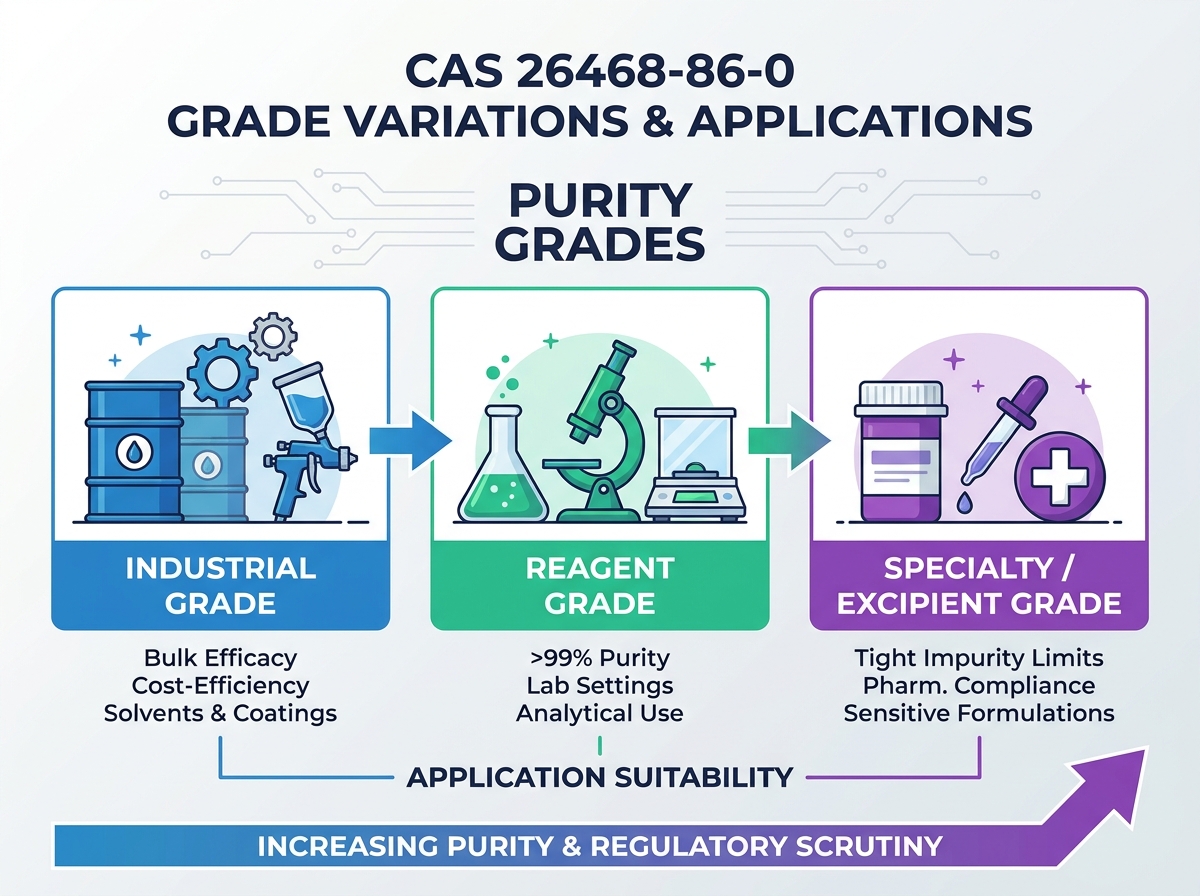
Formulators use this versatile solvent across vastly different industries. Each application dictates specific evaluation criteria. You cannot apply a universal standard. A specification suitable for industrial paint might ruin a sensitive pharmaceutical formulation.
Consider industrial solvents and coatings first. It serves as an excellent coalescing aid. It optimizes evaporation rates in water-borne coatings. It promotes smooth, continuous film formation. It efficiently reduces resin viscosity. You must verify its compatibility with your specific polymers. Evaluating viscosity reduction capabilities helps optimize your final paint formulation. Proper coupling prevents phase separation in the can.
Fragrance and sensory applications present unique challenges. Odor profiles matter heavily here. The solvent must remain olfactorily neutral. Trace impurities easily alter delicate scent characteristics. You should demand strict sensory data from your supplier. Olfactory panel testing ensures batch neutrality. Even parts-per-million levels of unreacted alcohols can destroy a high-end fragrance profile. Careful evaluation prevents costly sensory defects.
Pharmaceutical and excipient use requires absolute precision. Parenteral excipient formulations demand extreme purity. You must ensure formulations meet stringent toxicity limits. Stability testing is absolutely non-negotiable. Excipient grades undergo rigorous endotoxin and bioburden testing. This maps direct chemical features to patient safety outcomes. Any deviation in the purity profile risks severe regulatory action.
You must define what acceptable performance looks like. We recommend a structured framework. This prevents over-speccing or under-speccing.
Compliance requires comprehensive regulatory mapping. Global frameworks heavily regulate chemical registries. You must assess substance registry status first. The EPA mandates TSCA listing in the United States. The European Union requires strict REACH registration obligations. Failing these checks halts production immediately. You must ensure your supplier actively maintains these critical registrations. They should provide registration numbers upon request.
You must translate standard MSDS warnings into facility protocols. The safety data sheet outlines specific hazard statements. It often carries warnings for eye and skin irritation. Flammability thresholds require careful facility planning. Standard hazard codes dictate proper ventilation engineering. Facility managers must review these documents before receiving any bulk shipments. Understanding the handling risks protects your workforce.
You must implement appropriate personal protective equipment. Facility managers should mandate chemical-resistant nitrile gloves. Splash-proof safety goggles are essential during transfer operations. Engineering controls minimize inhalation risks. Local exhaust ventilation systems capture vapors effectively at the source. Regular safety training ensures operators understand the specific hazards associated with CAS 26468-86-0 handling.
Buyers must demand updated safety data sheets. Never accept outdated safety files. Regulatory classifications update frequently. You should also request RoHS declarations for electronics manufacturing applications. Other regulatory conformity certificates remain crucial prior to sampling. This proactive approach prevents future supply chain disruptions. Compliance documentation serves as your first line of defense.
Supplier evaluation requires deep analytical scrutiny. You cannot rely on baseline pricing alone. Cheap materials often hide inconsistent purity profiles. Quality assurance prevents downstream formulation failures. You must vet potential partners rigorously.
You must rigorously check key parameters on the Certificate of Analysis.
Reliable suppliers utilize statistical process control. You should evaluate their historical lot data. Consistent manufacturing yields tight bell curves on purity graphs. Wide variations signal poor reactor control. This directly impacts your product quality. Ask potential suppliers for a year of historical batch data. Reviewing this data reveals their true manufacturing capability. It separates premium manufacturers from inconsistent brokers.
You need readily available Technical Data Sheets. Suppliers must provide clear compliance statements. You should look for BSE/TSE free declarations for sensitive applications. Non-GMO certifications often matter for specialty personal care formulations. Transparent supply chain origins build procurement trust. You should know exactly where the material originates. Obscured supply chains often mask inconsistent sourcing practices.
You must determine facility compliance levels. The manufacturer should hold relevant ISO 9001 certifications. Sensitive applications require alignment with GMP standards. EXCiPACT certification provides excellent assurance for pharmaceutical uses. We recommend conducting virtual or physical audits for critical suppliers. Audit readiness indicates a mature quality management system. Reluctant suppliers usually hide systemic quality control issues.
Implementation carries inherent logistical risks. You must mitigate these through careful planning. Material handling impacts chemical integrity directly. A flawless chemical loses its value if mishandled during transit. You must control the physical logistics tightly.
You must evaluate acceptable packaging materials. Many suppliers use lined steel drums. High-density polyethylene (HDPE) totes work well for certain technical grades. You must prevent leaching or chemical degradation during transit. Improper packaging introduces unwanted trace contaminants. Stainless steel bulk tanks offer the best protection for high-purity grades. Verify compatibility before approving any new packaging format.
Environmental requirements dictate long-term stability. You must control temperature fluctuations in your warehouse. Minimize direct light exposure to prevent auto-oxidation. Strict moisture control preserves coupling efficiency. Proper inventory turnover management prevents stock expiration. Implement strict First-In, First-Out (FIFO) inventory practices. Regularly inspect drums for seal integrity and minor leaks.
Relying on a single source creates massive vulnerabilities. You must assess single-source risks proactively. Establishing secondary suppliers secures your production timeline. You must ensure secondary materials demonstrate exact chemical equivalency. Do not wait for a supply chain crisis to qualify a backup.
Secondary Supplier Evaluation Chart
| Risk Category | Primary Supplier Protocol | Secondary Supplier Protocol |
|---|---|---|
| Quality Equivalency | Establish baseline GC purity profile | Match GC profile within 0.1% variance |
| Lead Time Shock | Maintain 4-week regular safety stock | Negotiate rapid 2-week emergency delivery |
| Regulatory Gaps | Hold full REACH/TSCA technical dossier | Verify minimum regional compliance status |
We recommend a structured workflow for implementation. Request small sample lots first. Analyze prototype batches in your laboratory. Compare these directly against your current standard. You can then move confidently to a pilot-scale trial. This sequential testing validates commercial viability safely. It protects your larger production runs from unexpected chemical behaviors.
Successful sourcing requires a strategic balance. You must align purity grades with specific application demands. Procuring the highest purity is not always necessary for industrial applications, but it remains vital for pharmaceutical use. Rigorous compliance checks ensure long-term formulation stability. Carefully vetting suppliers prevents costly production halts and maintains your product reputation.
We strongly encourage buyers to consult technical sales engineers early. You should request application-specific sample lots today. Conduct your internal analytical verifications immediately upon receipt. Do this before you finalize any commercial supply agreements. Proactive testing and stringent supplier audits remain your best tools for risk-free procurement.
A: The standard shelf life typically ranges from 12 to 24 months. You must store it in a cool, well-ventilated area away from direct sunlight. Optimal storage requires tightly sealed, inert containers. You should maintain ambient temperatures and avoid exposure to strong oxidizing agents. Strict moisture control prevents premature degradation.
A: It features a longer hexyl carbon chain compared to butyl or propyl ethers. This structure significantly decreases its evaporation rate. It also enhances its hydrophobicity. These unique traits provide superior coupling efficiency between water and highly non-polar organic resins. This makes it exceptionally effective in advanced coalescing applications.
A: Excipient compliance demands specialized, comprehensive documentation. You must obtain an excipient-grade Certificate of Analysis. The supplier must provide detailed impurity profiles confirming the absence of heavy metals and residual solvents. You also need formal regulatory compliance letters, including BSE/TSE-free, non-GMO, and REACH declarations, alongside GMP alignment certificates.
A: We strongly advise against this substitution. Technical grades contain variable trace impurities. These impurities can skew pilot results, alter viscosity, or cause unexpected side reactions. Scale-up consistency relies entirely on using the exact same chemical grade. Substituting grades introduces uncontrolled variables that compromise the integrity of your formulation trials.


