
English
Views: 0 Author: Site Editor Publish Time: 2026-10-31 Origin: Site


The chemical compound CAS 26468-86-0, commonly known as 2-Ethylhexyl thioglycolate or 2-EHTG, serves as a critical intermediate chemical in industrial formulations. It quietly drives thermal stability and precise molecular control across global heavy manufacturing sectors. Modern production lines simply cannot function efficiently without reliable chemical intermediates regulating complex reactions.
Manufacturing engineers and procurement teams face mounting pressure today. They must balance strict material performance demands, such as long-term polymer durability, against stringent regulatory compliance. Additionally, they navigate volatile sourcing costs constantly. Finding a reliable molecular control agent remains a daily struggle for plant operators aiming to minimize defective batches.
This article provides a transparent, evidence-based breakdown of the top five applications for this versatile chemical. We outline core evaluation criteria, serious implementation risks, and actionable supplier shortlisting logic. You will gain the insights needed to support confident and safe procurement decisions across your supply chain.
Production floors demand predictable reaction kinetics to maintain tight delivery schedules. You need low impurity profiles to ensure final product clarity and structural integrity. A stable shelf life is equally important for long-term inventory management. High-performance intermediates must deliver on all three of these success criteria consistently. If a chemical fails just one parameter, entire manufacturing runs face severe disruption.
Inconsistent molecular weights during polymerization processes cause major production headaches. Poor thermal stability in plastics often leads to unacceptably high scrap rates on the factory floor. Sudden product failures in the field usually trace back to these early-stage production flaws. Manufacturers cannot afford these physical breakdowns, especially when operating under tight profit margins.
This chemical acts as a highly targeted solution to these operational bottlenecks. It controls molecular chain lengths precisely during volatile synthesis phases. It actively prevents polymer degradation during intense, high-temperature processing cycles. Plant managers rely on it heavily to maintain structural integrity and color hold across diverse product batches.
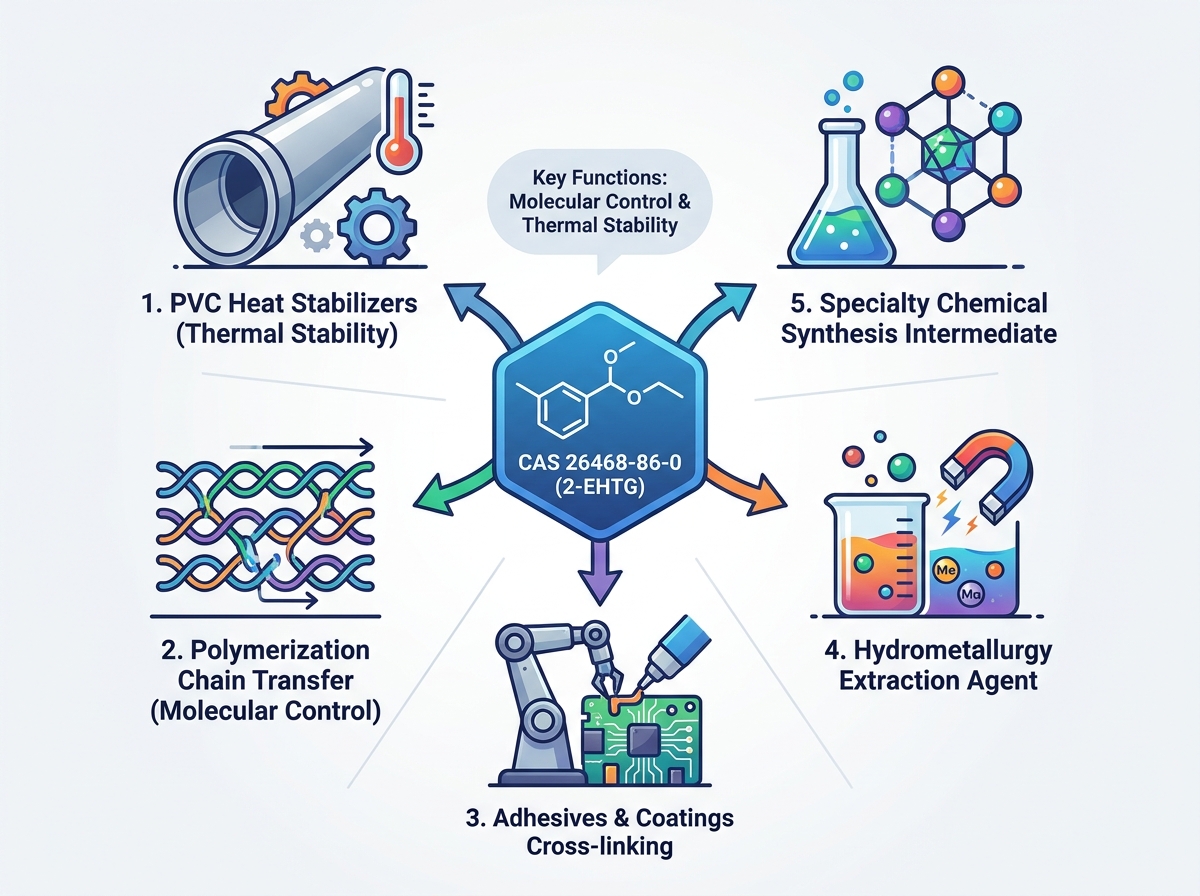
In the plastics industry, this chemical reacts aggressively to form organotin thioglycolates. These unique compounds are absolutely essential for rigid PVC processing. The reactive thiol group bonds efficiently during the compounding phase. You will frequently find it utilized in the manufacturing of PVC pipes, window profiles, and siding materials.
The primary outcome is the total prevention of thermal degradation. It completely stops the discoloration of PVC during high-friction extrusion and injection molding. By utilizing this precursor, manufacturers achieve excellent early color hold and superior long-term clarity in transparent PVC applications.
This compound acts as a powerful chain transfer agent. It regulates molecular weight during the complex production of acrylics, styrene-butadiene, and advanced synthetic rubbers. By transferring the active radical during polymerization, it stops polymer chains from growing uncontrollably.
This regulation ensures a very narrow molecular weight distribution. A narrow distribution drastically improves the mechanical properties of the final polymer. Furthermore, it greatly enhances processability, allowing engineers to extrude or mold the synthetic rubber smoothly without generating excessive shear heat.
Industrial adhesives require rapid curing without compromising bond strength. Here, the chemical acts as a dedicated hardener. It serves as a potent cross-linker in specialty epoxy and polyurethane systems. Formulators add it to high-performance coatings destined for marine or aerospace applications.
It accelerates curing times significantly, even at lower ambient temperatures. Furthermore, it enhances chemical resistance once the coating fully cures. The resulting cross-linked network protects underlying metal substrates from harsh operational environments and corrosive chemical spills.
Mining and metal recovery sectors continually seek safer processing chemicals. This compound serves as a highly selective solvent. It works as an efficient complexing agent for heavy metal recovery from acidic leach solutions. Engineers apply it specifically to separate valuable metals from complex ore mixtures.
This targeted extraction improves overall yield significantly. It boosts the purity of extracted metals derived from notoriously low-grade ores. Crucially, it offers a viable, safer alternative to the highly toxic legacy extractants historically used in the hydrometallurgical industry.
The broader chemical industry utilizes this compound for its highly reactive thiol group. This group is crucial for synthesizing complex agrochemicals, life-saving pharmaceuticals, and high-temperature industrial lubricants. Its consistent reactivity makes it a favorite among synthetic chemists designing multi-step reactions.
Using it enables the scalable, commercial production of complex sulfur-containing organic molecules. It maintains exceptionally high conversion rates, minimizing expensive raw material waste. This reliability guarantees steady production volumes for vital agricultural and pharmaceutical downstream products.
Commercial-grade options often look attractive initially due to lower baseline pricing. However, high-purity grades—typically exceeding 99%—demand a higher upfront premium for good reason. Choosing lower purity often results in steep downstream purification expenses. We must analyze this trade-off carefully. Unwanted side reactions stemming from trace impurities destroy yield efficiency and ruin product clarity.
This specific chemical boasts low volatility and a highly consistent specific gravity. How do these technical features translate on the factory floor? Low volatility dramatically improves handling safety by minimizing vapor emissions. A consistent specific gravity dictates blending efficiency, ensuring homogenous mixtures. These physical features directly drive reaction predictability across consecutive batches.
Modern industrial plants prioritize sustainable chemical manufacturing trends heavily. Optimizing dosing parameters reduces overall chemical waste directly at the source. You can achieve leaner, cleaner operations without overpromising dubious "green" benefits to your stakeholders. Efficient consumption inherently supports broader corporate sustainability targets.
Table 1: Feature to Outcome Mapping for CAS 26468-86-0
| Chemical Feature | Direct Operational Impact | Final Product Outcome |
|---|---|---|
| High Purity (>99%) | Eliminates competitive side reactions | Superior optical clarity in plastics |
| Low Volatility | Reduces airborne particulate loss | Safer working environments |
| Reactive Thiol Group | Accelerates cross-linking speed | Faster production cycle times |
| Consistent Specific Gravity | Improves automated dosing accuracy | Zero batch-to-batch variance |
Thioglycolates carry a notoriously strong, pungent odor. Facility managers must address this aggressively before bulk adoption. You need engineered closed-loop processing systems to prevent fugitive emissions. Powerful vapor recovery mechanisms are absolutely non-negotiable. Protecting frontline workers from olfactory fatigue and respiratory irritation remains your highest operational priority.
Proper storage directly dictates chemical longevity. You must store these drums or intermediate bulk containers (IBCs) in cool, dry areas away from direct sunlight. Ensure well-ventilated environments equipped with spill containment bunds. This careful storage prevents rapid oxidation and unwanted degradation, which would otherwise ruin the chemical's reactivity.
You must reference localized Safety Data Sheets (SDS) constantly when updating standard operating procedures. European markets require strict REACH compliance documentation from suppliers. Managers must monitor worker exposure limits rigorously using active air sampling. Skipping compliance checks invites costly regulatory fines and abrupt operational shutdowns.
Table 2: Storage and Compliance Summary Chart
| Requirement Category | Actionable Protocol | Risk of Non-Compliance |
|---|---|---|
| Ventilation | Install Local Exhaust Ventilation (LEV) systems. | Severe worker discomfort and odor complaints. |
| Storage Temperature | Maintain ambient temperatures below 30°C. | Accelerated chemical oxidation and potency loss. |
| Transfer Mechanisms | Use sealed pumps and closed piping networks. | Spill hazards and vapor release incidents. |
| Regulatory | Verify REACH registration and local SDS. | Import blockages and facility audits. |
Never accept a single Certificate of Analysis (CoA) blindly during supplier evaluations. Require a comprehensive stack of historical CoAs from potential manufacturing partners. Audit the batch-to-batch variance strictly. Pay special attention to acid value and moisture content fluctuations. High moisture content severely disrupts cross-linking efficiency in adhesive applications.
Supply chain transparency matters immensely in today's volatile market. Prioritize suppliers offering complete visibility into their operations. You need to know exactly where they source precursor raw materials, such as thioglycolic acid and 2-ethylhexanol. Traceability guarantees final synthesis quality and protects you from sudden raw material shortages.
Move cautiously before committing to bulk tonnage contracts. Request pilot-scale samples immediately upon initial vendor qualification. Typically, a 5kg to 20kg sample suffices for laboratory testing. Run rigorous compatibility tests within your existing manufacturing setups. Using CAS 26468-86-0 strategically in these pilot runs uncovers hidden processing incompatibilities early.
We recommend following a structured supplier audit checklist. Evaluate the following key areas before signing procurement contracts:
The specialized compound CAS 26468-86-0 is clearly not a standard commodity chemical. Sourcing it solely on price is a dangerous mistake that threatens production quality. Its massive impact on molecular polymerization and structural thermal stability demands immense respect. Procurement teams must adopt a highly nuanced, value-driven approach.
Engineering teams must align their internal EHS capabilities quickly. Match your facility infrastructure to the chemical's strict handling and odor-control requirements. Initiate dialogue with trusted, transparent suppliers today. Always request comprehensive technical data sheets (TDS) alongside full safety dossiers before moving forward with any new integration project.
A: Most industrial polymerization applications require a minimum purity of 98% to 99%. This high standard is necessary to prevent unwanted side reactions caused by trace impurities, which can negatively alter the final polymer's physical properties.
A: Yes, alternatives include mixed metal stabilizers (Ca-Zn) or other mercaptans. However, organotins derived from this specific chemical typically offer superior optical clarity and excellent early color hold in demanding rigid PVC applications.
A: Facilities must utilize active local exhaust ventilation (LEV). They should install appropriate vapor scrubbing systems and mandate sealed transfer mechanisms. These engineering controls successfully mitigate worker exposure and eliminate surrounding nuisance odors.


