
English
Views: 0 Author: Site Editor Publish Time: 2026-07-31 Origin: Site


Industrial chemical processes demand absolute precision. A single surfactant formulation often determines the difference between seamless production and catastrophic batch failure. Engineers rely on highly effective, nonionic surfactants to anchor heavy industry operations and critical biomanufacturing. This deep reliance creates a distinct tension in today's global market. While chemical performance in wetting, detergency, and cell lysis remains unmatched, shifting environmental regulations force teams to adapt quickly. Frameworks like the EU REACH directive push procurement and engineering units to aggressively evaluate continued usage, validation constraints, and sourcing strategies. You need a reliable roadmap to navigate these changes without compromising output quality. We provide process engineers, procurement managers, and compliance officers a clear framework to evaluate applications, assess compliance risks, and verify sourcing requirements for CAS 9002-93-1.
To understand the high demand for this chemical, we must first look at its chemical identity. It is formally known as a nonionic polyoxyethylene octyl phenyl ether. Being nonionic means it carries no electrical charge when dissolved in aqueous solutions. This neutrality proves essential for sensitive chemical environments. Unlike cationic or anionic alternatives, it does not interfere or bond aggressively with active pharmaceutical ingredients. It protects delicate protein structures during processing. It mixes smoothly into complex formulations.
Engineers evaluate specific physical properties to ensure reliable performance. These metrics dictate how well the chemical will perform under stress. The three most critical performance indicators are Critical Micelle Concentration (CMC), Cloud Point, and Hydrophilic-Lipophilic Balance (HLB).
Critical Micelle Concentration defines the exact point where surfactant molecules group together to form micelles. Micelles trap oils and impurities. A lower CMC means you need less chemical to achieve the desired effect. Cloud Point indicates the temperature at which the solution separates and becomes cloudy. Operating above this temperature reduces cleaning efficiency. The HLB value measures the balance between the water-loving and oil-loving parts of the molecule. A specific HLB value directly translates to superior surface tension reduction. It guarantees stable emulsions across varying pH levels.
Key Physical Parameters
| Property | Typical Value / Range | Industrial Significance |
|---|---|---|
| Critical Micelle Concentration (CMC) | 0.2 to 0.9 mM | Determines the minimum dosage required to trap target oils and proteins. |
| Cloud Point (1% aqueous) | 63°C to 69°C | Establishes the upper temperature limit before the emulsion breaks down. |
| Hydrophilic-Lipophilic Balance (HLB) | 13.5 | Perfectly suited for creating stable oil-in-water industrial emulsions. |
| Charge Type | Nonionic | Prevents unwanted reactions in electrically sensitive biological environments. |
Common Mistakes: Formulators sometimes ignore the Cloud Point when scaling up production. Running high-temperature cleaning baths above 65°C causes the surfactant to separate. This completely negates its emulsification properties.
Industries hesitate to replace it because it offers immense reliability. We have decades of validated, highly predictable performance data. Attempting to replicate this exact physical profile using alternative surfactants takes significant time. It forces companies to spend heavily on testing and re-validation.
Industrial water systems and cooling towers constantly battle microbial growth. Microbes form thick, protective biofilms on interior pipes. These biofilms block standard biocides from working properly. CAS 9002-93-1 actively breaks this barrier. It aggressively reduces the surface tension of the water. This allows the biocide to penetrate deep into the microbial layers.
This mechanism of action creates highly favorable outcomes. Facilities use much lower volumes of expensive biocides. Reducing total chemical usage lowers operational expenses. It also minimizes long-term equipment corrosion caused by harsh biological treatments.
Modern biomanufacturing relies heavily on Good Manufacturing Practice (GMP) standards. Extracting intracellular proteins requires precise cell membrane disruption. You must break the cell wall without damaging the valuable molecules inside. This surfactant excels at this exact task. It gently dissolves lipid barriers.
Process validation in biopharma sets rigorous benchmarks. Manufacturers use this chemical during downstream processing to ensure viral inactivation. It neutralizes lipid-enveloped viruses in plasma derivatives and specialized biopharmaceuticals. These GMP-critical applications demand ultra-high purity grades. Even trace impurities can ruin a multimillion-dollar batch.
Heavy manufacturing environments require robust cleaning solutions. Industrial detergents and metalworking fluids must maintain strict formulation stability. CAS 9002-93-1 emulsifies dense heavy oils, stubborn greases, and synthetic lubricants effortlessly. It lifts these contaminants away from metal surfaces and suspends them in water.
Compatibility plays a major role in its popularity. You can blend it easily into complex formulas.
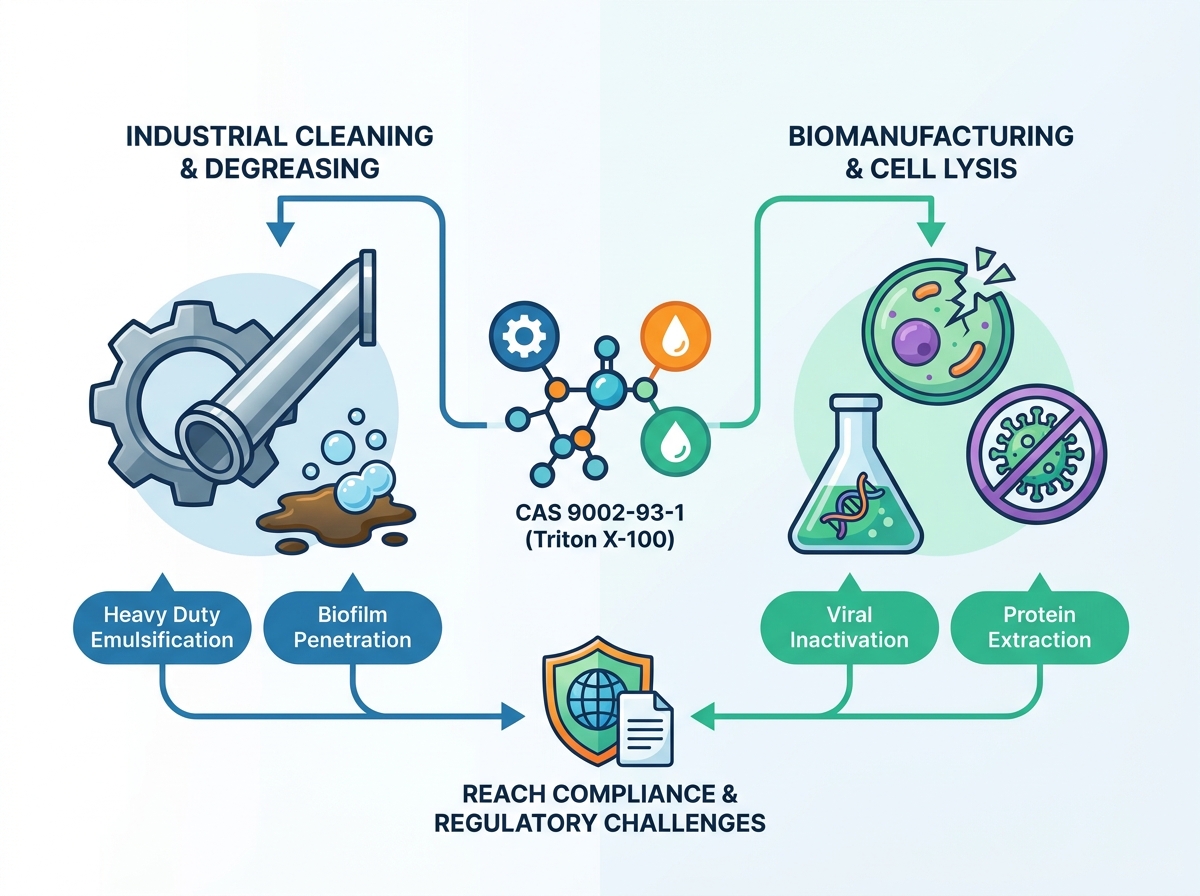
The industrial landscape faces a massive compliance challenge today. Global environmental bodies heavily scrutinize octylphenol ethoxylates. They included these compounds in the REACH Authorization List (Annex XIV). The primary concern involves their environmental degradation pathway. In aquatic environments, they break down into specific endocrine-disrupting compounds. These compounds interfere with aquatic ecosystems over time.
This regulatory shift creates a fragmented geographic impact. If you operate within the European Union, the chemical is heavily restricted. You must secure specific authorization for continued use. However, it remains actively utilized in other major global markets. Facilities in North America and Asia face different rules. Multinational companies must now navigate a complex web of varying compliance standards across different borders.
Toxicology and environmental thresholds govern its large-scale use outside the EU. Facilities handling bulk volumes must reference standard environmental guidelines. They carefully monitor the Initial Threshold Screening Levels (ITSL). Plant operators also track strict wastewater discharge limits. You cannot release high concentrations into municipal water systems. Engineering teams often install specialized filtration or chemical breakdown tanks to manage the runoff responsibly.
When regulations tighten, businesses must decide their next steps. We call this the "Stick or Switch" framework. Retaining the current process makes sense under specific scenarios. If you run heavily locked-in FDA-validated processes, changing a single chemical triggers massive regulatory audits. Facilities operating exclusively outside European jurisdictions also frequently choose to stick with the proven formula.
To navigate this framework, teams should follow a structured evaluation:
If switching becomes necessary, engineers must demand exact performance matching. Evaluating sustainable, compendial-grade GMP substitutes requires rigorous laboratory testing. A viable substitute must match the target HLB value perfectly. In bioprocessing, it must ensure identical protein recovery rates. Procurement teams must also confirm the new chemical maintains ultra-low peroxide levels to prevent target oxidation.
Stick vs. Switch Decision Matrix
| Scenario | Action Required | Primary Business Impact |
|---|---|---|
| Non-EU Manufacturing | Retain current processes. | Maintains operational continuity and high efficiency. |
| FDA-Validated Biopharma | Retain unless mandated otherwise. | Avoids multi-year regulatory re-validation costs. |
| EU-Bound Export Products | Switch to sustainable alternatives. | Ensures market access but requires intense R&D testing. |
| New Product Development | Design with REACH-compliant substitutes. | Future-proofs the product lifecycle immediately. |
Substitution carries significant implementation risks. You must account for extended operational downtime during the transition. The cost of re-validation drains resources. You also risk temporary formulation instability. A new surfactant might clean effectively but foam uncontrollably in the mixing tank.
Not all batches are manufactured equally. Procurement teams must clearly differentiate between available purity grades. Technical Grade works perfectly for industrial degreasing, wastewater treatment, and heavy metalworking. It is cost-effective but contains trace impurities. High-Purity or GMP Grade serves the biopharma sector. These specialized batches undergo extra purification. They guarantee low peroxides and low carbonyls to protect sensitive biological extractions.
Rigorous supplier vetting prevents disastrous manufacturing errors. You cannot afford inconsistent chemical behavior. Procurement officers must demand comprehensive documentation.
Best Practices for Supplier Audits:
Handling and storage at an industrial scale require strict protocols. Bulk storage tanks must prevent environmental degradation. You must implement temperature control systems. If the storage area drops below freezing, the surfactant crystallizes. If exposed to intense UV light or excessive heat over time, oxidation occurs. Managing these variables guarantees the chemical performs exactly as expected when it finally enters the production line.
Navigating the complexities of modern industrial surfactants requires both technical knowledge and strategic foresight. CAS 9002-93-1 offers historically unmatched performance in heavy emulsification and delicate cell lysis. However, its changing environmental profile demands careful management.
A: It is most widely recognized in the industry under the trade name Triton X-100. Various chemical manufacturers also sell it under different proprietary brand equivalents, but it always shares the identical chemical structure of polyoxyethylene octyl phenyl ether.
A: No. It is heavily restricted under the EU REACH Authorization List due to environmental concerns regarding endocrine disruption. However, it remains widely available and legally utilized in many other global markets, including parts of North America and Asia.
A: Its nonionic nature is the key. It easily forms micelles to disrupt cell membranes and extract intracellular materials. Crucially, it accomplishes this without denaturing delicate target proteins, ensuring high recovery rates during viral clearance and lysis.
A: You must store it in a temperature-controlled environment to prevent freezing and crystallization. Keep bulk containers sealed tightly to reduce oxidation risks, and shield the storage tanks from direct light exposure to maintain long-term chemical stability.


