
English
Views: 0 Author: Site Editor Publish Time: 2026-11-02 Origin: Site


Sourcing industrial or specialty chemicals demands far more than merely comparing price tags. The stakes of chemical procurement run exceptionally high for modern manufacturing lines. A single sourcing error can cascade through your entire operation.
You face specific, unforgiving supply chain realities when dealing with CAS 26468-86-0. Batch inconsistency or sudden compliance failures will immediately stall your production. These sudden disruptions often trigger costly regulatory penalties. They also severely erode your hard-earned market trust. Consumers and B2B partners alike demand reliable, consistent product quality.
This article provides a strictly objective, evidence-based framework for your procurement process. You will learn exactly how to evaluate your options effectively. We will show you how to shortlist candidates and secure a reliable supplier for this specific compound safely. Applying these methods will protect your facility from unexpected downtime and guarantee your final product quality.
Choosing a low-tier supplier often looks attractive initially. However, the operational fallout from poor chemical procurement quickly devours any upfront savings. You must recognize these hidden threats before signing a contract.
Delayed shipments destroy carefully planned manufacturing timelines. When a critical chemical arrives three days late, your entire production schedule shifts. Shift workers sit idle on the factory floor. Machine calibration cycles must restart. Rejected batches force your facility to pause operations entirely. This sudden pause heavily spikes your daily overhead costs. Idle machinery and paying inactive staff will drain your operational budget incredibly fast.
Failing regional chemical classifications brings severe legal and financial liabilities. If your raw materials violate REACH, EPA, or specific Pharmacopeia/FCC standards, you face massive fines. Regulatory bodies will halt your distribution immediately. They can seize non-compliant cargo at customs checkpoints. Financial liabilities stemming from mandatory product recalls easily bankrupt smaller operations. You cannot afford to gamble on compliance.
End-product failures almost always stem from raw material contamination. A tainted batch of CAS 26468-86-0 ultimately harms your market credibility. When finished goods fail in the field, customers lose trust quickly. Competitors gladly absorb your frustrated client base.
The sequence of reputational damage usually follows four distinct phases:
Impact Severity of Substandard Procurement
| Risk Category | Immediate Consequence | Long-Term Business Impact |
|---|---|---|
| Supply Delays | Paused manufacturing lines | Lost B2B contracts |
| Purity Failures | Rejected internal batches | Expensive product recalls |
| Compliance Breaches | Fines and seized cargo | Revoked operating licenses |
Every vendor presents a perfect specification sheet during the sales pitch. Real evaluation happens when you look past marketing materials. You must dig into the operational data.
Demand exact purity percentages from every candidate. You must know the acceptable threshold limits for all impurities. Do not rely entirely on in-house supplier data. You must require third-party analytical testing reports. Independent labs validate the exact composition. This ensures no hidden contaminants exist inside the drums.
When reviewing testing data, focus on these critical metrics:
Best Practice: Always cross-reference the external testing laboratory. Ensure they hold active ISO 17025 accreditation for chemical testing.
Real-time access to documents separates average suppliers from elite partners. Look for instant access to lot-specific CoAs. Demand regularly updated SDS files. You need full supply chain traceability. Track everything from the raw precursor chemical down to the finished compound you purchase. This complete traceability secures your internal quality control loop. It also simplifies your own regulatory audits.
Evaluate how the supplier handles unexpected technical troubleshooting. Determine if they offer custom blending capabilities. See if they eagerly support formulation adjustments. Your business use-case will likely evolve over the next five years. Your supplier must adapt alongside your engineering team. Fast response times prevent minor formulation issues from becoming major production bottlenecks.
A supplier producing high-quality chemicals means nothing if they cannot deliver them reliably. You must stress-test their logistical framework before committing.
Ensure the supplier’s Minimum Order Quantities (MOQ) align closely with your current reality. High MOQs trap your operating cash in excess inventory. Low MOQs from a small vendor might signal limited capacity. Verify their total production volume carefully. Can they handle your projected growth next year? A supplier maxing out their reactor lines today cannot support your future expansion.
Assess the daily risk of cross-border shipping delays. Calculate potential tariff impacts on your profit margins. Analyze the supplier’s reliance on single-origin raw materials. Geopolitical shifts can disrupt single-source operations overnight. Diversified origin points heavily reduce your vulnerability to global shocks.
Favor suppliers who actively maintain dedicated safety stock. Regional warehousing acts as a massive operational shield. It actively mitigates global shipping disruptions. Ask potential vendors about their local warehousing footprint. A domestic warehouse bypassing customs clearance protects your continuous manufacturing cycles perfectly.
Single Sourcing vs. Dual Sourcing Strategies
| Strategy Model | Core Advantage | Primary Vulnerability |
|---|---|---|
| Single Sourcing | Maximizes bulk volume discounts | High risk of total supply failure |
| Dual Sourcing | Provides immediate operational backup | Splits purchasing power and leverage |
Regulatory compliance is a strict pass-or-fail metric. Do not compromise on facility standards to secure a cheaper per-kilo price.
Filter your prospective suppliers by foundational quality systems. Look for active ISO 9001 certifications. Check for cGMP adherence if your end-use requires it. These frameworks prove they document their errors. It shows they fix internal problems systematically rather than ignoring them.
Common Mistake: Never assume a parent company's certification covers a distant subsidiary facility. Always check the exact physical address printed on the ISO certificate.
Verify their actual track record in the industry. Review their standing with international chemical registries. Audit their specific handling protocols for CAS 26468-86-0. Consistent regulatory adherence prevents sudden legal roadblocks from halting your shipments.
A trustworthy supplier transparently welcomes site audits. They will readily disclose internal QA/QC corrective action plans. Secretive vendors pose a massive operational risk. Transparency indicates supreme confidence in their daily operational standards. During a physical audit, always inspect their raw material quarantine zone. Elite suppliers physically separate untested materials from approved inventory.
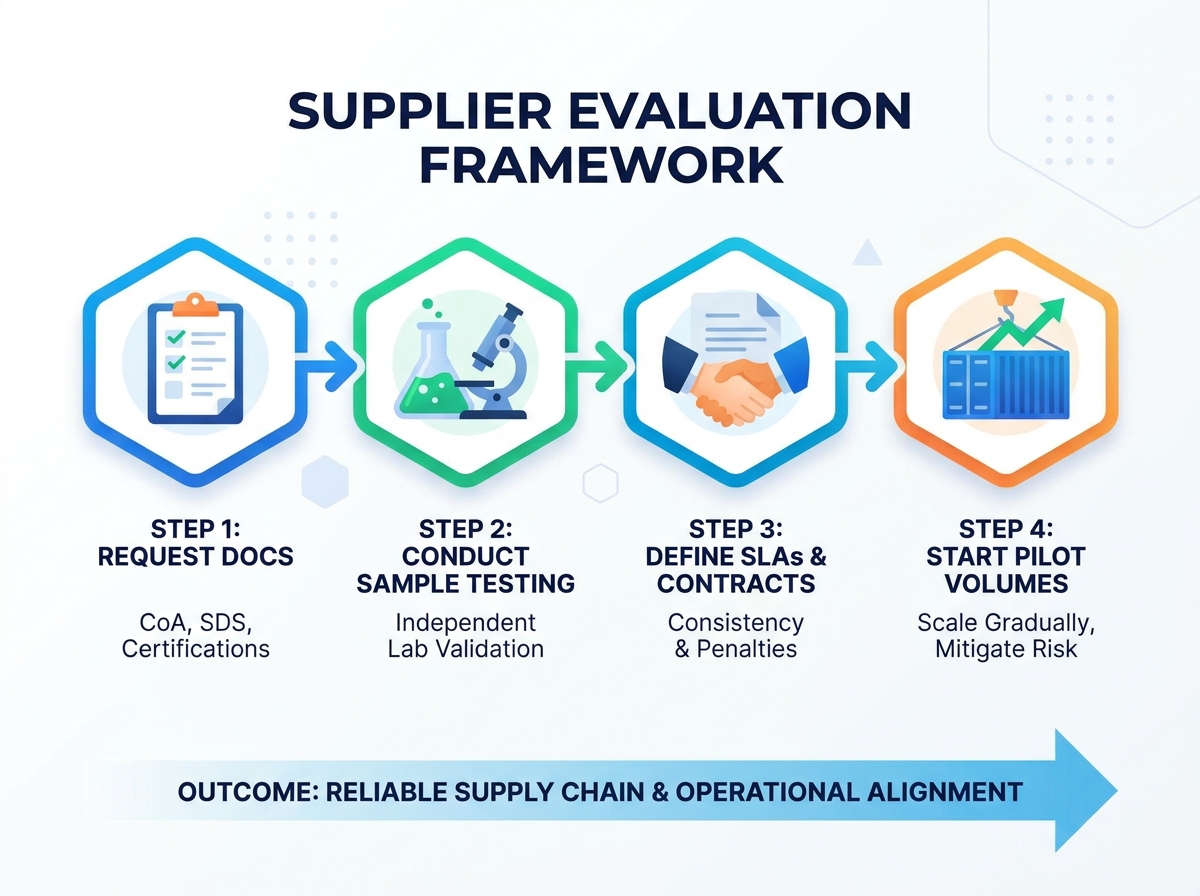
Use a rigid, standardized process to narrow down your vendor options. This removes emotional bias from your procurement decisions.
Screen out hesitant vendors immediately. They must readily provide standard compliance documentation upon request. Ask for historical batch data early in the conversation. Reluctance here signals deep operational flaws. If a vendor takes two weeks to send a basic SDS, abandon the negotiation.
Procure pilot samples for internal lab validation. Test them for actual performance. Monitor consistency under your specific manufacturing conditions. Expose the pilot sample to your factory's typical heat and humidity. A flawless spec sheet cannot replace brutal, real-world physical testing.
Draft aggressive but fair service agreements. Explicitly penalize late deliveries to keep logistics teams honest. Outline strict return policies for out-of-spec batches. Ensure the supplier covers return freight costs. Lock in your pricing structures for a defined period to prevent sudden invoice spikes.
Mitigate your risk by scaling order volumes gradually. Do this before committing to an exclusive purchasing contract. Start by awarding them 10% of your total volume. Scale to 50% upon successful delivery, then eventually 100%. A long-term purchasing agreement requires proven reliability. Pilot runs confirm this reliability safely.
Choosing a chemical supplier remains fundamentally an exercise in strict risk management. It requires tight operational alignment between your facility and their production lines. You cannot treat specialty chemicals like basic office supplies.
Upfront due diligence remains absolutely non-negotiable. Independent testing, facility audits, and strict documentation requirements form your baseline defenses against disaster. A proactive procurement strategy shields your business from massive financial liabilities.
Initiate your vendor evaluation today. Request a standardized capability checklist from your prospective shortlist immediately. Force them to prove their reliability before you issue your first purchase order.
A: You must secure a lot-specific Certificate of Analysis (CoA) for every single batch. Demand an updated Safety Data Sheet (SDS) reflecting the most current regional regulations. Always request proof of relevant ISO or regulatory certifications to validate their facility compliance.
A: Start by requesting historical variance reports directly from the supplier. Next, conduct independent lab assays on multiple samples pulled from different lot numbers. Finally, establish strict tolerance parameters directly inside your purchasing contract to enforce consistency legally.
A: Typical timelines range from four to twelve weeks depending on the geographic origin. You can mitigate shipping delays by negotiating dedicated safety stock agreements. Alternatively, utilize suppliers who operate localized warehousing near your manufacturing facilities to bypass customs bottlenecks.
A: Both approaches carry distinct trade-offs. Single-sourcing often secures valuable volume discounts and simplifies logistics. However, qualifying a secondary vendor serves as a critical contingency plan. It heavily mitigates sudden supply chain disruptions caused by unexpected geopolitical or logistical failures.


