
English
Views: 0 Author: Site Editor Publish Time: 2026-11-03 Origin: Site


Polypropylene glycol monobutyl ether, officially recognized as CAS 9003-13-8, operates as a highly versatile synthetic fluid. Formulators across the globe utilize this robust compound across demanding industrial, commercial, and cosmetic applications. However, procurement managers and chemical formulators often face significant hurdles when sourcing this material. They routinely struggle to secure consistent, compliant batches tailored to strict viscosity and purity requirements. Unreliable supply chains often compromise final product performance and cause frustrating manufacturing delays. This guide delivers a rigorous, evaluation-focused breakdown of this essential compound. We will explore its functional formulation benefits, navigate critical compliance realities, and define essential supplier vetting criteria. You will learn exactly how to optimize your sourcing strategy for long-term production stability and commercial success.
Chemists classify this substance as a polyether alcohol or a glycol ether. Manufacturers synthesize it by reacting butanol as an initiator alongside propylene oxide. This specific polymerization process creates a unique molecular structure. The resulting molecule features a lipophilic butyl tail attached to a hydrophilic polyether backbone. This dual nature drives its remarkable performance across various chemical systems. The balance between hydrophilic and lipophilic segments allows it to bridge incompatible phases in complex formulations.
In its standard state, this chemical presents as a clear, colorless liquid. It emits a very mild, characteristic ether odor. Formulators rely heavily on its impressive physical parameters. It boasts a high viscosity index, meaning its flow characteristics remain stable across fluctuating temperature ranges. The compound also exhibits a notably low pour point. This specific trait ensures it remains fluid and pumpable even in freezing industrial environments. Furthermore, its high boiling point prevents rapid evaporation during high-heat manufacturing processes.
Standard Physical Parameters of Polypropylene Glycol Monobutyl Ether
| Parameter | Typical Range / Description | Formulation Relevance |
|---|---|---|
| Physical Appearance | Clear, colorless liquid | Ensures aesthetic stability in consumer products |
| Viscosity Index | High (>100 depending on molecular weight) | Maintains film thickness across temperature changes |
| Pour Point | Typically below -20°C | Allows winter operations and cold-weather storage |
| Boiling Point | Exceeds 200°C | Prevents premature flash-off in hot manufacturing |
This synthetic fluid possesses a fascinating solubility profile. It displays inverse aqueous solubility. At colder temperatures, it dissolves readily in water. As temperatures rise, the hydrogen bonds between the polyether oxygen atoms and water molecules break. This disruption causes the chemical to separate out of the aqueous phase. This phenomenon is known as the cloud point. Conversely, it remains highly soluble in most organic solvents regardless of temperature. Formulators manipulate this inverse solubility to create temperature-sensitive emulsions and smart aqueous systems.
Understanding these baseline physical properties directly dictates formulation predictability. When you know the exact cloud point of your specific molecular weight grade, you can predict exactly when a metalworking fluid will reject water and coat a hot metal tool. Matching the viscosity index to your mechanical system ensures gears remain lubricated under immense stress. Precise knowledge of these parameters eliminates guesswork on the manufacturing floor.
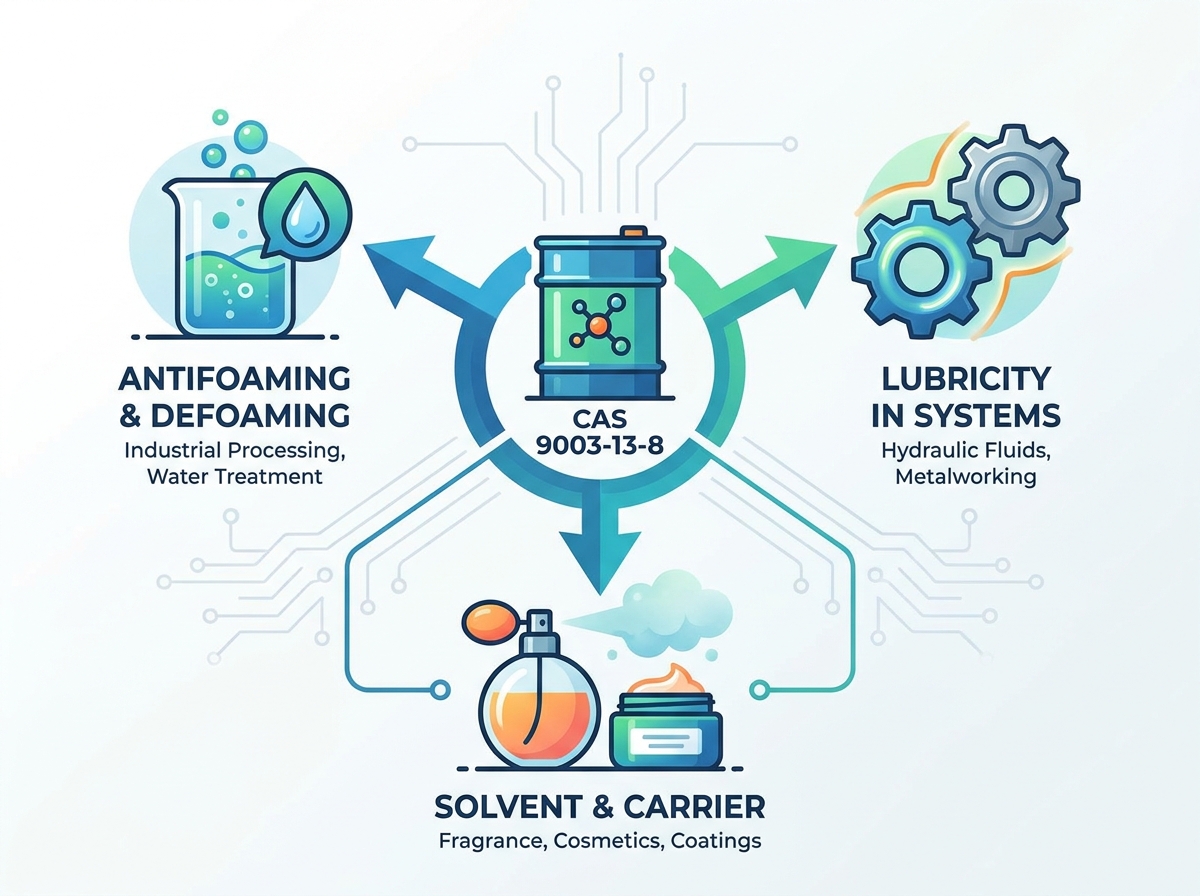
Excessive foam ruins industrial processes. It causes pump cavitation, overflows tanks, and creates surface defects in paints. CAS 9003-13-8 acts as a powerhouse antifoaming agent. Formulators frequently use it in products like Antifoam PE-L. Its surface-active properties allow it to rapidly spread across a liquid interface. Upon reaching the surface, it violently disrupts the localized surface tension holding foam bubbles together. The bubbles quickly coalesce and burst. Industries use it extensively in wastewater treatment facilities, fermentation tanks, and high-speed coating applications.
Mechanical systems demand resilient fluids. Engineers utilize this compound as a primary base stock or a vital additive in synthetic lubricants. It excels in hydraulic fluids and high-shear metalworking fluids. The molecular structure provides an exceptional load-bearing capacity. It forms a durable boundary layer on metal surfaces, reducing friction and preventing catastrophic part wear. Furthermore, its inherent thermal stability ensures it does not degrade into sludge or varnish when exposed to the extreme localized heat of metal cutting and stamping operations.
Beyond heavy industry, this compound serves specialized commercial and cosmetic sectors. It functions as an exceptional solvent and carrier fluid. Fragrance manufacturers use it to craft controlled-release air fresheners and perfumes. Its precise volatility allows scent molecules to evaporate slowly and consistently over time. In cosmetic formulations, it acts as a coupling agent. It forces stubborn oils and water-based ingredients to blend into a stable, aesthetically pleasing cream or serum. It accomplishes this without leaving a greasy residue on the skin.
Achieving formulation success requires matching the specific use case to the required performance outcome. You must select the correct molecular weight variation.
Sourcing the wrong grade ruins entire production runs. Procurement teams must differentiate between industrial-grade bulk supplies and specialty high-purity grades. Industrial grades focus on cost efficiency and volume. They work perfectly for hydraulic fluids and wastewater defoamers, where minor trace impurities do not impact performance. Specialty grades undergo extra distillation steps. They strip out residual catalysts and unreacted monomers. Fragrance houses and cosmetic formulators require these high-purity versions to prevent unwanted odors and skin irritation.
Formulation stability relies entirely on batch-to-batch consistency. A slight shift in the molecular weight distribution alters the cloud point and viscosity. This causes a previously stable emulsion to split. Rigorous Quality Assurance (QA) documentation remains non-negotiable. You must demand a comprehensive Certificate of Analysis (CoA) for every single delivery. The CoA should explicitly list the viscosity, moisture content, acid value, and color index. If a supplier balks at providing lot-specific CoAs, find a new supplier immediately.
Modern manufacturing requires resilient supply chains. Procurement managers must carefully assess their sourcing networks. You have two primary options: regional distributor networks or direct global manufacturers. Direct manufacturers often offer better pricing on massive bulk orders. However, regional distributors usually provide superior lead-time reliability and scalable safety stock. They can buffer your production against global shipping delays. Evaluate your own storage capacity and production cadence before choosing a supply model.
Navigating chemical procurement requires a sharp eye for red flags. Avoid vendors displaying the following warning signs:
A grounded assessment of occupational safety prevents workplace accidents. Generally, this polyether fluid presents a low acute oral toxicity profile. However, it is not completely harmless. Direct contact often causes mild to moderate eye irritation and can defat the skin upon prolonged exposure. Inhalation of vapors at ambient temperatures poses minimal risk due to its low vapor pressure. However, heating the fluid generates mists requiring mechanical extraction. Facilities must enforce the use of standard Personal Protective Equipment (PPE), including chemical-resistant nitrile gloves and splash goggles.
Proper environmental controls prevent premature chemical degradation. Facilities must outline strict storage protocols to maintain product efficacy.
Integrating this chemical into your product requires strict regulatory alignment. Environmental agencies heavily monitor industrial discharges. You must understand how your specific formulation usage aligns with regional chemical inventory regulations. Ensure the compound appears on approved national inventories before commercializing a new product. Furthermore, while it boasts relatively low aquatic toxicity compared to older solvents, facilities must still adhere to local environmental discharge limits. Prevent raw material from entering municipal sewers or natural waterways without prior authorization.
Never commit to purchasing bulk drums or totes without rigorous preliminary testing. A structured, phased evaluation protocol mitigates formulation risk. Follow these sequential steps:
Finalizing a vendor requires a methodical approach. Build a comprehensive shortlisting checklist to evaluate potential partners objectively. Prioritize suppliers exhibiting rapid technical support responsiveness. When a formulation issue arises, you need a vendor who can provide immediate troubleshooting assistance. Analyze their Minimum Order Quantities (MOQs). Ensure their MOQs align with your projected production volumes to avoid tying up capital in excessive inventory. Finally, audit their logistics capabilities. Verify they use dedicated, clean transport vessels to prevent cross-contamination during transit.
CAS 9003-13-8 delivers exceptional strategic value across diverse manufacturing sectors. By mastering its physical properties—such as inverse solubility and superior viscosity indexes—formulators can dramatically optimize final product performance. Whether suppressing foam in wastewater or stabilizing complex cosmetic emulsions, this compound proves indispensable. However, successful deployment relies heavily on meticulous supplier vetting. You must align the chemical's specific purity grade directly with your end-use application. To move forward, contact verified chemical distribution specialists today. Request updated technical data sheets and initiate a sample testing protocol to guarantee seamless integration into your current formulations.
A: Industry professionals frequently refer to this compound by several alternate names. Common synonyms include polypropylene glycol monobutyl ether, PPG monobutyl ether, and butoxypolypropylene glycol. Always verify the CAS registry number on documentation to ensure you are sourcing the exact correct chemical regardless of the trade name used.
A: Yes, but it exhibits unique inverse solubility. At lower temperatures, it dissolves readily in aqueous systems. However, as the temperature increases and surpasses its specific cloud point, the chemical becomes insoluble and separates from the water. Its exact solubility depends heavily on the specific molecular weight of the grade you purchase.
A: Industrial grades focus on bulk performance for lubricants and defoamers, allowing for minor trace impurities. Cosmetic grades undergo rigorous secondary distillation. This extra processing removes residual catalysts, unreacted monomers, and trace odorants, making it safe and aesthetically acceptable for skin contact and fragrance applications.
A: Store the fluid in tightly sealed containers within a cool, dry, and well-ventilated environment. Keep it away from direct sunlight, extreme heat, and incompatible materials like strong oxidizers. Ensuring an airtight seal prevents atmospheric oxygen from slowly forming undesirable peroxides over extended storage periods.
A: You should request a localized, GHS-compliant Safety Data Sheet directly from your chemical supplier or distributor. For baseline hazard data and general toxicological profiles, you can also consult institutional scientific databases such as PubChem or the ECHA (European Chemicals Agency) registry.


