
English
Views: 0 Author: Site Editor Publish Time: 2026-08-11 Origin: Site


Selecting the right nonionic surfactant defines your formulation stability. It impacts manufacturing scalability. It also dictates final product efficacy. Formulators often face a critical crossroads when choosing essential ingredients. Enter CAS 69011-36-5, widely known as isotridecanol ethoxylated. This prominent synthetic, branched-chain alcohol ethoxylate stands out in the chemical industry. But is it the right choice for your specific application?
Formulators and procurement teams must carefully weigh the specific wetting and emulsification benefits of isotridecanol. You need to compare it against natural, linear, or Ziegler-process ethoxylated alcohols. The ultimate goal requires balancing high performance with regulatory compliance. In this comprehensive guide, we explore the distinct structural advantages of branched ethoxylates. We will benchmark their performance against linear alternatives. You will learn how to navigate safety profiles, overcome formulation bottlenecks, and establish rigorous supplier selection criteria.
Surfactant performance originates at the molecular level. Isotridecanol is a synthetic alcohol produced via the oxo synthesis process. This method reacts olefins with carbon monoxide and hydrogen. It yields a highly branched hydrocarbon chain. This branched nature contrasts sharply against natural fatty alcohols. Natural alcohols, derived from palm kernel or coconut oil (like lauryl or myristyl alcohols), feature straight carbon chains. Ziegler alcohols, synthesized from ethylene, also produce predominantly linear, even-numbered carbon chains. The branching in the oxo-process dictates fundamentally different physical properties.
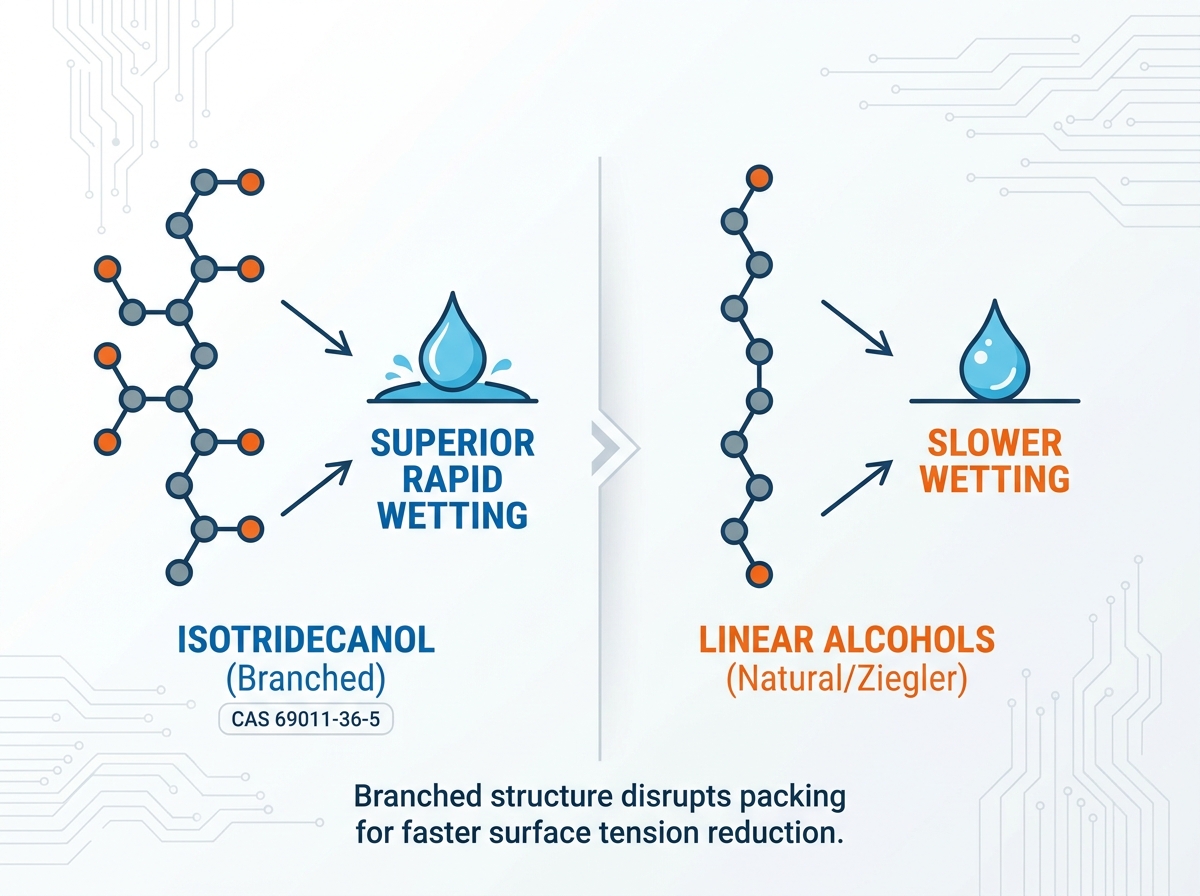
Structural branching disrupts tight molecular packing. Linear alcohols align closely together. They easily form highly ordered, crystalline structures. Branched alcohols cannot pack tightly. This looser arrangement dramatically lowers the pour point of the resulting ethoxylates. Consequently, these branched surfactants remain fluid at much lower temperatures. Furthermore, branching alters micelle formation dynamics. Branched hydrophobes create bulkier micelle cores. This geometry influences how the surfactant interacts at oil-water interfaces, enhancing specific functional traits like dynamic wetting.
| Alcohol Type | Synthesis Origin | Chain Structure | Typical Pour Point Profile |
|---|---|---|---|
| Isotridecanol (Oxo) | Petrochemical (Olefins) | Highly Branched | Low (Remains liquid at cooler temps) |
| Natural Fatty Alcohols | Agricultural (Seed Oils) | Strictly Linear | Higher (Prone to solidification) |
| Ziegler Alcohols | Petrochemical (Ethylene) | Linear (Even carbon numbers) | Moderate to High |
You modify the functionality of isotridecanol by varying the degree of ethoxylation. Adding moles of ethylene oxide (EO) adjusts the Hydrophilic-Lipophilic Balance (HLB). A low degree of ethoxylation (e.g., 3 to 5 EO) creates a highly lipophilic molecule. This functions perfectly as a water-in-oil (W/O) emulsifier. Increasing the EO chain length (e.g., 7 to 12 EO moles) shifts the HLB upward. The molecule becomes highly water-soluble. It transforms into a robust detergent and a highly effective oil-in-water (O/W) emulsifier. Selecting the correct EO mole ratio remains crucial for formulation success.
In high-speed manufacturing environments, standard static surface tension measurements tell an incomplete story. Dynamic surface tension matters far more. CAS 69011-36-5 excels in this metric. Branched isotridecyl ethoxylates migrate to new interfaces rapidly. They reduce dynamic surface tension much faster than linear equivalents. This makes them exceptional for high-speed wetting applications. Industries like textile processing, leather finishing, and hard surface cleaning rely heavily on this rapid action. Linear surfactants simply cannot wet surfaces fast enough under intense mechanical shear.
Isotridecanol ethoxylates possess exceptional degreasing power. They effectively cut through heavy industrial soils, synthetic lubricants, and stubborn oils. This robust performance provides a key differentiator from lighter, natural-alcohol-based surfactants. Linear natural alcohols often struggle to solubilize heavy petroleum-based greases. The bulky, branched tail of the oxo-alcohol penetrates dirt matrices aggressively. Formulators frequently use them in heavy-duty industrial cleaners, metalworking fluids, and engine degreasers.
Excessive foam creates costly bottlenecks in modern industrial processes. Branched ethoxylates inherently demonstrate moderate-to-low foaming characteristics. Their bulky structure prevents the formation of tightly packed, stable foam lamellae. This represents a critical evaluation metric for automated systems. High-shear applications, such as clean-in-place (CIP) operations or textile scouring, mandate strict foam control. Where natural lauryl alcohol ethoxylates generate high, stable foam, isotridecyl variants collapse quickly.
Best Practice: Always test dynamic surface tension at your specific application speed. A surfactant may look great on a static test but fail on a high-speed production line.
Common Mistake: Relying on isotridecanol ethoxylates as high-foaming agents. If your consumer product requires a rich, luxurious lather, pivot to linear anionic or linear nonionic blends instead.
Scaling up a bench formulation to production tanks introduces unique handling challenges. The "gel phase" phenomenon represents a notorious hurdle. When you dilute ethoxylated alcohols with water, they pass through specific concentration ranges where they form highly viscous, immobile gels. This severely delays batch times. It can also damage mixing equipment.
Consider these mitigation strategies for large-scale blending:
You must evaluate cold-water solubility and cloud point variations. The cloud point is the temperature where hydrogen bonds between water and the EO chain break. The surfactant becomes insoluble, and the solution turns cloudy. This directly depends on the EO chain length. Grades with lower EO moles exhibit lower cloud points. Ensure your chosen grade aligns with your intended storage and usage environments. If an end-user applies your cleaner outdoors in winter, you need an ethoxylate tailored for cold temperature stability.
Isotridecanol ethoxylates provide remarkable formulation flexibility. Because they are non-ionic, they carry no electrical charge. This ensures they will not precipitate when formulated alongside high-electrolyte loads. You can blend them effortlessly with anionic, cationic, and amphoteric surfactants. Furthermore, they demonstrate robust stability in aggressive chemical environments. They resist hydrolysis in strongly acidic solutions and highly alkaline heavy-duty degreasers.
Skepticism frequently surrounds synthetic branched alcohols in today's eco-conscious market. You must address environmental fate transparently. Compare the biodegradation rates referencing OECD testing frameworks, particularly OECD 301. Purely linear fatty alcohol ethoxylates degrade very rapidly. They easily pass "readily biodegradable" thresholds. The branched structure of CAS 69011-36-5 causes it to degrade slightly slower. Microorganisms take longer to break down the tertiary carbon bonds. However, most standard isotridecanol ethoxylates still meet the criteria for ultimate biodegradability under EU Detergent Regulations. Always verify specific OECD 301 pass rates with your manufacturer.
Reviewing standard Safety Data Sheet (SDS) requirements remains non-negotiable. Concentrated technical grades of ethoxylated alcohols present distinct safety hazards. They often cause severe eye damage and significant skin irritation upon direct contact. Operators must utilize appropriate personal protective equipment (PPE) during bulk handling. Additionally, observe aquatic toxicity limits. Certain mid-range EO isotridecanol ethoxylates exhibit high acute toxicity to aquatic life. Ensure your final diluted formulation complies with regional wastewater discharge regulations.
If formulating for personal care, strict usage constraints apply. Ethoxylation processes inherently carry the risk of trace 1,4-dioxane contamination. This byproduct is a recognized potential carcinogen. Cosmetic regulations strictly cap permissible 1,4-dioxane levels. While industrial degreasers tolerate higher trace impurities, personal care applications demand vacuum-stripped grades. If your cosmetic brand relies on stringent "natural origin" claims, you may need to map out safety ratings against naturally derived alternatives.
Not all commercially available isotridecanol ethoxylates offer identical quality. You must define acceptable thresholds for trace impurities. The ethoxylation process leaves behind unreacted isotridecanol and free polyethylene glycols (PEGs). High levels of unreacted alcohol cause strong, objectionable chemical odors. Free PEGs do not act as surfactants; they act as thickeners or dead weight. They impact formulation clarity and alter desired viscosity profiles. Demand strict specification sheets detailing these specific impurities.
Guide your buyers toward suppliers capable of narrow-range ethoxylation. Traditional alkaline catalysts produce a broad homolog distribution. If you order a 7-mole ethoxylate, you receive a bell curve containing everything from 2-mole to 14-mole species. Narrow-range ethoxylates (NRE), produced using specialized catalysts, peak much tighter around the target EO mole. NREs yield tighter performance tolerances, fewer byproducts, lower odor, and significantly faster wetting speeds. They offer a tangible performance upgrade over broad-range alternatives.
Procurement must evaluate long-term market stability. Natural fatty alcohols rely on agricultural feedstocks. They face severe price volatility driven by crop yields, weather events, and geopolitical agricultural shifts. Isotridecanol relies on petrochemical feedstocks. While tied to global oil and gas markets, oxo-alcohol production generally offers greater supply chain resiliency and forecasting predictability. Weigh these factors when securing long-term supply contracts.
Selecting the optimal nonionic surfactant requires a strategic balance of performance, chemistry, and compliance. Choose isotridecanol ethoxylates when rapid dynamic wetting, cold-temperature handling, and aggressive industrial degreasing are paramount. Their branched structure uniquely positions them for high-shear, low-foam industrial environments. Conversely, we recommend pivoting to linear or natural ethoxylates if your primary evaluation criteria mandate maximum aerobic biodegradability or strict "green" label certifications.
Your immediate next step involves practical evaluation. Request sample grades across specific HLB targets from reputable manufacturers. Conduct dynamic surface tension testing mirroring your actual production speeds. Finally, demand detailed impurity profiles to ensure your final formulation remains clear, stable, and odor-free.
A: The core difference lies in their carbon chain origin and structure. CAS 69011-36-5 utilizes a branched synthetic carbon chain (Isotridecanol). Laureth-7 uses a linear natural or synthetic chain (Lauryl alcohol). Isotridecanol provides significantly faster dynamic wetting and better cold-temperature fluidity. However, Laureth-7 degrades slightly faster, giving it a preferred environmental profile in strictly "green" formulations.
A: There is a direct correlation between the degree of ethoxylation and the cloud point. Adding higher moles of ethylene oxide (EO) increases the molecule's hydrophilicity. This strengthens its hydrogen bonding with water. Consequently, higher EO molar ratios result in increased water solubility and higher cloud points, keeping solutions clear at higher temperatures.
A: They are generally classified as biodegradable under specific OECD criteria (like OECD 301). However, their highly branched structure means they typically degrade slower than completely linear fatty alcohol ethoxylates. Microbes take longer to process the tertiary carbon bonds. Always verify the specific biodegradation pass rate for the exact EO grade you select.
A: High-concentration grades require temperature-controlled storage environments. Lower EO-mole variants can exhibit phase separation or stratify in extreme cold. Additionally, if exposed to moisture, they can form high-viscosity gels. Keep drums tightly sealed and store them in moderately warm, dry facilities to ensure consistent pumping and blending performance.


