
English
Views: 0 Author: Site Editor Publish Time: 2026-08-13 Origin: Site


Chemical formulators and procurement teams face a constant, difficult balancing act. You need high-performance surfactancy. However, you cannot sacrifice environmental compliance. You must also maintain strict workplace safety standards. Finding a single ingredient to meet these conflicting demands often delays product development. Modern formulations require stable, efficient ingredients. They ensure long-term viability and ease regulatory approval.
We look to CAS 69011-36-5 as a highly reliable, foundational non-ionic surfactant. Industry experts widely evaluate it for heavy industrial cleaning. They also use it for advanced lubrication and specialized agrochemical formulations. This highly versatile molecule solves multiple formulation challenges at once.
This article provides evidence-based guidelines. You will learn how to properly evaluate essential technical specifications. We explain how to manage safety protocols by strictly aligning with safety data sheets. Furthermore, we explore practical ways to mitigate procurement risks. You can apply these precise strategies before integrating this chemical into your manufacturing lines.
Manufacturers struggle to find one surfactant to do everything. You need rapid surface wetting. You also require highly effective degreasing capabilities. The final formulation must remain completely stable across diverse pH ranges. Crucially, it must achieve all this without generating excessive, unmanageable foam. Many traditional chemicals fail at least one of these criteria. This failure forces formulators to mix multiple surfactants, complicating the production process.
The specific chemical structure of CAS 69011-36-5 solves many of these common issues. It features a branched isotridecyl alcohol base. This base pairs excellently with a flexible ethylene oxide chain. This unique branched architecture prevents the surfactant from forming thick, problematic gel phases when mixed into water. Gel phases frequently block transfer pumps. They also cause uneven mixing in large manufacturing vats. Consequently, this branched structure routinely outperforms standard linear alcohol ethoxylates during complex manufacturing processes.
We see this chemical shine in several specific end-use categories. Formulators map it to targeted applications based on its robust performance profile:
Using one highly adaptable ingredient streamlines your inventory. It allows your procurement team to consolidate raw material purchases. This consolidation simplifies your overall supply chain management.
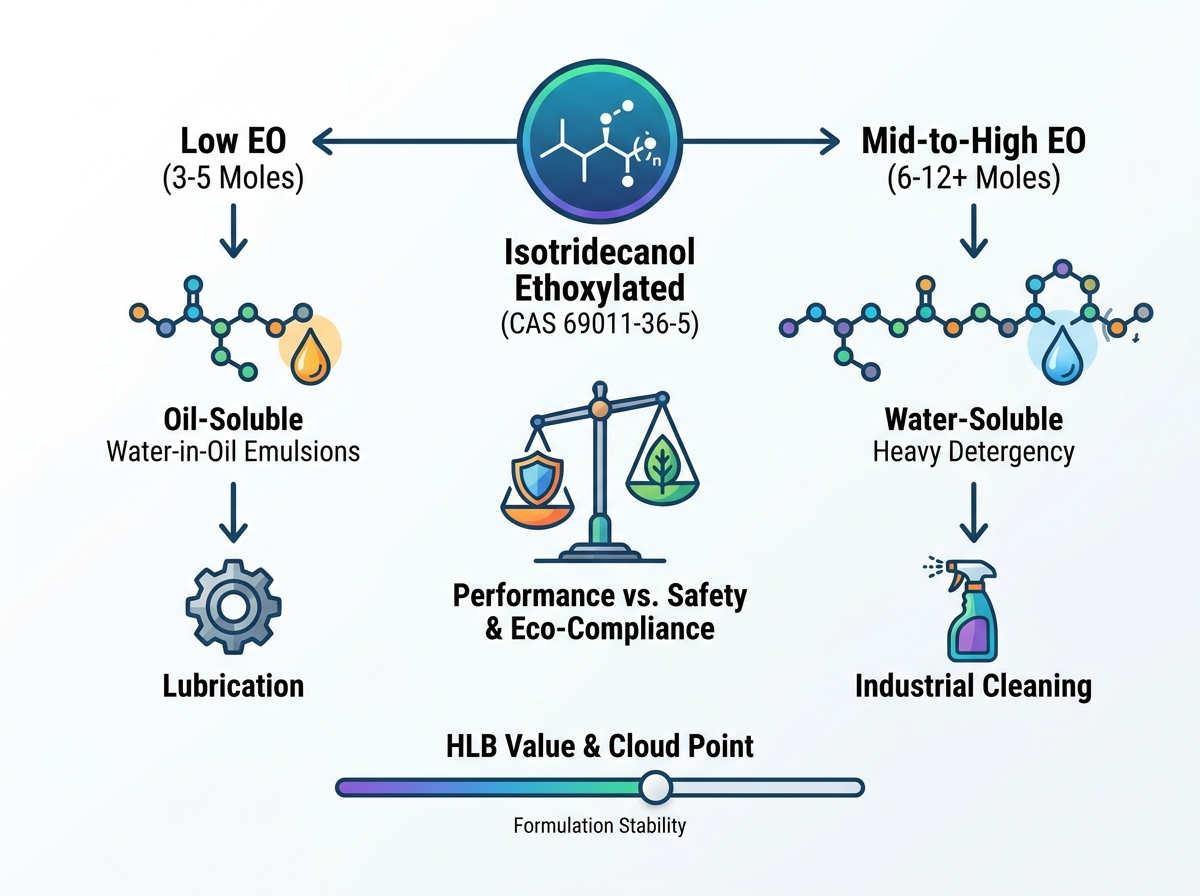
You cannot treat this chemical as a single, uniform product. Varying the ethylene oxide (EO) moles drastically changes its physical state. It also transforms its functional performance. Procurement and technical teams must evaluate the specific ethoxylation degree carefully.
Different EO levels serve entirely different formulation purposes. Low EO variants contain 3 to 5 moles of ethylene oxide. These specific versions remain highly oil-soluble. Formulators utilize them heavily to create stable water-in-oil emulsions. They work perfectly in specialized degreasers. Conversely, mid-to-high EO variants contain 6 to 12 or more moles. These grades are highly water-soluble. They become the primary choice for heavy-duty detergency. You will use them for rapid surface wetting.
Procurement teams must match two critical parameters exactly. First, you must align the Hydrophilic-Lipophilic Balance (HLB) value against your desired emulsion type. Second, you must test the cloud point against actual application temperatures. If the operational temperature exceeds the chemical cloud point, the surfactant separates. It drops out of the solution. This separation immediately destroys cleaning efficiency.
Because CAS 69011-36-5 is strictly non-ionic, it plays well with others. You can safely blend it alongside anionic surfactants. It mixes easily with cationic and amphoteric surfactants. This broad formulation compatibility provides immense flexibility for chemical engineers.
Watch out for high-electrolyte formulations. Excessive salts can severely depress the expected cloud point. Formulators often forget to account for dissolved minerals in industrial water supplies. This oversight causes unexpected phase separation in the final commercial product. Always test your formulas using the actual water source planned for bulk production.
| EO Moles Range | Solubility Profile | Typical HLB Range | Primary Target Application |
|---|---|---|---|
| 3 - 5 Moles | Oil-soluble (Lipophilic) | 8.0 - 10.5 | Water-in-oil emulsions, degreasers |
| 6 - 8 Moles | Dispersible to Water-soluble | 11.0 - 13.0 | General purpose wetting, textiles |
| 9 - 12+ Moles | Highly Water-soluble | 13.5 - 15.0+ | Heavy-duty detergency, solubilizers |
Handling industrial chemicals demands strict, non-negotiable safety standards. Industry experts base these protocols on authoritative Tier 2 risk assessments. We must strictly adhere to standard Globally Harmonized System (GHS) classifications. Neglecting these rules exposes workers to severe health risks. It also invites heavy regulatory fines.
You must address primary health hazards immediately upon receiving the chemical. This substance poses a severe risk of eye damage. GHS classifies it under Category 1 for eye irritation. Facility managers must mandate the use of tight-fitting chemical safety goggles. Face shields are absolutely essential during any fluid transfer. Operators must wear them during all open mixing procedures.
Direct contact also irritates the skin. Operators must wear appropriate personal protective equipment (PPE) at all times. Nitrile or neoprene gloves offer excellent chemical resistance. Additionally, you must install certified emergency eyewash and shower stations. Place them directly adjacent to all active mixing zones.
Always consult the specific supplier SDS before altering any handling procedures. The data sheet provides the ultimate legal framework for workplace safety.
We must address environmental considerations transparently. Regulators generally classify CAS 69011-36-5 as toxic to aquatic life. Depending on the exact composition and EO chain length, it can have long-lasting aquatic effects. Facility managers cannot ignore this ecological risk profile. You must build active mitigation strategies into your daily operations.
To comply with modern detergent regulations, your materials must meet strict biodegradability standards. High-quality isotridecanol ethoxylates should pass primary biodegradability benchmarks. Authorities outline these tests in standard OECD guidelines. Products passing OECD 301 tests degrade rapidly in natural environments. Rapid degradation minimizes long-term ecological damage. It prevents the chemical from accumulating in local waterways.
Manufacturers should aggressively employ closed-loop manufacturing systems. We highly recommend implementing strict onsite wastewater treatment protocols. These proactive steps reliably prevent accidental environmental release. You must control every drop of liquid during your daily formulation processes.
Always audit your site drainage plans annually. Keep storm drains strictly isolated from indoor production zones. If a bulk container ruptures, the chemical must flow into a dedicated retention basin. It must never reach a natural river or municipal water treatment facility untreated. By prioritizing environmental safety, you protect local ecosystems and secure your operational licenses.
Small raw material variations easily ruin large commercial formulations. Buyers must routinely request detailed Certificates of Analysis (CoA). You need to see narrow specification bands on every document. Look closely at the specified water content. Check the standard solution pH. Review the visual color grading, typically measured in Hazen or APHA units. Inconsistent pH levels indicate poor manufacturing controls at the supplier level.
An authorized supplier must provide a locally compliant 16-section Safety Data Sheet. Ensure this critical document remains up-to-date. Chemical regulations change frequently. You should actively look for explicit declarations regarding REACH registrations. If operating outside Europe, verify regional chemical inventory compliance. Suppliers hiding regulatory statuses often ship sub-standard materials.
Finally, assess how the supplier actually delivers the material. Can they reliably provide drums, IBCs, or bulk tankers? Consider your specific facility limitations. If your chosen EO grade is highly viscous at room temperature, check their packaging options. They must equip bulk containers with necessary heating coils. Heated jackets facilitate safe, efficient unloading during cold winter months. A supplier failing to provide appropriate logistics will disrupt your entire production schedule.
Do not rely solely on unit pricing. Evaluate the supplier based on their technical support capabilities. A strong partner will help you troubleshoot unexpected formulation issues quickly.
Successful integration of this versatile non-ionic surfactant heavily depends on technical precision. You must match the exact ethoxylation grade to your specific formulation need. Using the wrong EO mole count guarantees product failure. You must also aggressively manage workplace handling risks. Strict adherence to eye protection protocols is non-negotiable. Furthermore, your facility must control its aquatic toxicity profiles through smart wastewater management.
Take the next proactive step today. Review your current formulation specifications carefully against the guidelines discussed. Request comprehensive technical data sheets (TDS) from your vetted suppliers. Verify their REACH and standard regulatory compliance documentation. Finally, solicit multiple sample batches. Conduct rigorous lab-scale stability testing before approving any ingredient for full-scale commercial production.
A: The formal nomenclature for this substance is Poly(oxy-1,2-ethanediyl), α-tridecyl-ω-hydroxy-, branched. It describes a branched isotridecyl alcohol core linked to a repeating ethylene oxide chain. This specific structure creates a highly effective, versatile non-ionic surfactant used globally in industrial chemistry.
A: Yes, provided it meets specific testing criteria. High-quality grades of this surfactant class typically pass standard OECD 301 testing for ultimate biodegradability. This ensures it breaks down quickly in modern wastewater treatment plants. Passing this test keeps formulas compliant with stringent global detergent regulations.
A: It serves as a significantly safer, more environmentally acceptable alternative to NPEs. Regulatory bodies heavily restrict NPEs due to their harmful, endocrine-disrupting breakdown products. Isotridecanol ethoxylates provide equivalent or superior wetting and emulsification without triggering these severe regulatory and ecological penalties.
A: The typical shelf life ranges between 12 and 24 months. To achieve this maximum lifespan, you must store the chemical in its original, tightly sealed packaging. Keep it in a dry, well-ventilated area. Always protect the containers from extreme temperatures and direct moisture contamination.


