
English
Views: 0 Author: Site Editor Publish Time: 2026-08-08 Origin: Site


Polyethylene Glycol (PEG) drives innovation across countless industries today. Formulators rely on this versatile polymer for pharmaceuticals, cosmetics, and industrial manufacturing. However, leveraging these functional benefits requires a delicate balance. Procurement managers and EHS officers face strict regulatory compliance demands. You must also manage occupational safety and end-user risk effectively. Misunderstanding the safety profile of CAS 25322-68-3 can lead to costly formulation failures or compliance breaches. This article delivers an evidence-based evaluation of PEG’s toxicity. We provide a skeptical-friendly breakdown of its safety profile. You will learn how to assess contamination risks and molecular weight impacts. We will also equip you with practical guidelines to guide your secure sourcing decisions.
Evaluating chemical safety begins by examining the foundational hazard baseline. Toxicologists rely on lethal dose (LD50) values to quantify acute risks. In animal models, PEG demonstrates incredibly high LD50 values. Oral LD50 figures in rats frequently exceed 20,000 mg/kg. Dermal exposure yields similarly reassuring results. This indicates very low acute toxicity via both oral and dermal routes. You can handle the pure polymer confidently in most industrial settings. Chronic toxicity evaluations also show favorable results. Long-term ingestion studies reveal no significant organ damage or metabolic disruption. Mammals rapidly excrete unabsorbed PEG through feces and urine. The compound resists breaking down into harmful metabolites inside the body. This inert nature makes CAS 25322-68-3 highly suitable for continuous consumer contact.
Extensive toxicological databases confirm the systemic safety of pure PEG. Standard governmental bodies recognize it as non-mutagenic and non-carcinogenic. Cellular studies show no evidence of DNA alteration. Furthermore, it generally lacks reproductive toxicity. Pregnant animal models exposed to high doses showed no teratogenic effects. The fetus develops normally without chemical interference. This scientific consensus allows formulators to use PEG safely in sensitive applications. Regulatory agencies consistently classify it as a low-concern substance for systemic health. However, you must ensure the material remains unadulterated. The safety data applies specifically to the pure, uncontaminated polymer backbone.
While fundamentally safe, PEG is not entirely immune to allergenic concerns. We must transparently address rare instances of hypersensitivity. Documented allergic reactions exist in clinical literature. These reactions typically occur during high-exposure or parenteral pharmaceutical applications. Some patients develop anti-PEG antibodies after receiving specific intravenous drugs or vaccines. Symptoms can range from mild skin rashes to severe anaphylaxis. In topical cosmetics, sensitization remains exceedingly uncommon but possible. Formulators should monitor customer feedback closely.
Best Practice: Always patch-test new cosmetic formulations. If your product targets hypersensitive skin types, consider evaluating the specific chain length. You might also consult dermatologists during the R&D phase.
The primary hazard associated with PEG stems from its manufacturing process. Manufacturers produce PEG through ethoxylation. This chemical reaction uses ethylene oxide to build the polymer chain. Unfortunately, this synthesis can leave behind harmful trace by-products. The two main culprits are unreacted ethylene oxide and 1,4-dioxane. Both substances carry significant health warnings. Ethylene oxide is a known human carcinogen and respiratory irritant. 1,4-dioxane is a probable human carcinogen capable of penetrating the skin. 1,4-dioxane also resists biodegradation, creating environmental persistence issues. Therefore, the risk profile of CAS 25322-68-3 shifts dramatically based on impurity levels. A poorly manufactured batch presents severe compliance and health risks.
To protect consumers, global regulators enforce strict compliance lenses for these impurities. You must evaluate these thresholds before sourcing materials.
| Application Sector | Regulatory Body | Typical 1,4-Dioxane Limit | Ethylene Oxide Limit |
|---|---|---|---|
| Pharmaceuticals | FDA / USP | < 10 ppm | < 1 ppm |
| Cosmetics & Personal Care | EU Cosmetics Regulation | Trace (Often < 10 ppm) | Strictly Prohibited |
| Food Additives (FCC) | FDA | < 10 ppm | < 0.2 ppm |
| Industrial / Technical | EPA / REACH | Monitored (Often < 30 ppm) | Monitored |
These limits represent legal minimums. Many forward-thinking consumer brands demand even stricter tolerances. California’s Proposition 65 also requires warning labels if 1,4-dioxane exceeds specific safety harbor levels. EHS officers must cross-reference local laws against supplier documentation continuously.
Product safety relies entirely on a supplier's purification processes. You cannot filter out 1,4-dioxane easily once formulated into a final product. Top-tier manufacturers employ vacuum stripping to mitigate this threat. Vacuum stripping applies heat and reduced pressure to volatilize and extract trapped impurities. Formulators must demand verified impurity limits from their vendors.
Common Mistake: Never assume a technical-grade PEG meets cosmetic standards. Always specify the required purification method during contract negotiations. Relying on generic safety data sheets without batch-specific impurity testing invites regulatory disaster.
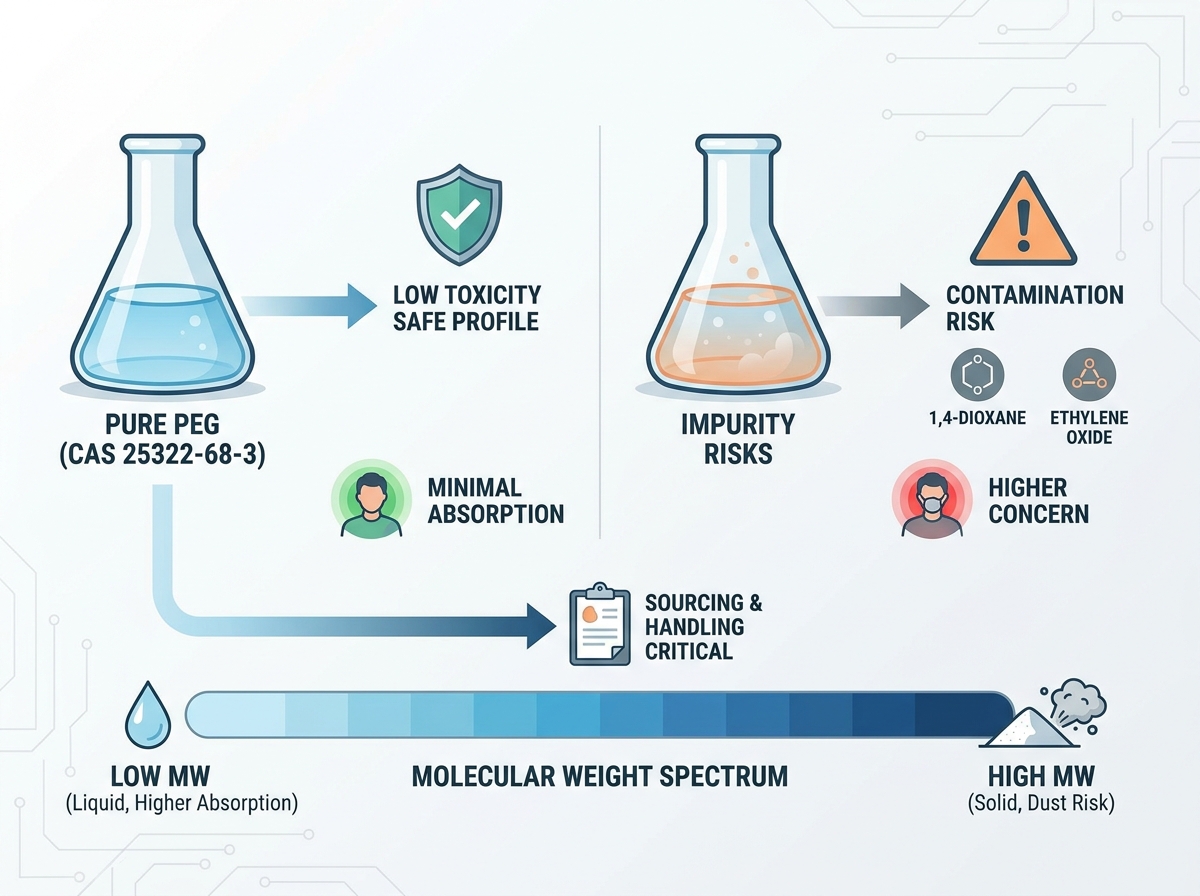
Molecular weight fundamentally alters the physical state and biological behavior of PEG. The number succeeding "PEG" indicates the average molecular weight in daltons. This metric dictates viscosity, melting point, and absorption rates.
Biological absorption closely mirrors these physical states. The body absorbs smaller molecules more readily than larger, bulky chains.
Low Molecular Weight PEGs (like PEG 400) possess slightly higher dermal penetration capabilities. The smaller molecular size allows them to navigate the stratum corneum more easily. This trait makes them excellent solvents for topical drug delivery. However, it also requires tighter scrutiny in cosmetic formulations. If applied to broken or severely burned skin, LMW PEGs can enter the bloodstream. Historically, applying PEG-based antimicrobial creams to severe burn victims caused kidney stress. Intact skin provides a robust barrier, rendering cosmetic use safe. Yet, formulators must evaluate the condition of the target application area. Always assess whether enhanced skin penetration might drag other active ingredients deeper than intended.
High Molecular Weight PEGs (like PEG 3350 or PEG 8000) show negligible absorption. They are simply too large to cross cellular membranes. This leads to their common use in oral laxatives. The polymer travels through the digestive tract intact, drawing in water osmotically. They also serve robust industrial applications as thickeners and lubricants. While systemic toxicity remains effectively zero, handling HMW PEGs introduces different risks. The powdered or flake forms generate nuisance dust. EHS teams must highlight the occupational dust-inhalation risks during handling. Inhaling fine polymer dust can cause mechanical irritation in the respiratory tract. We must manage these physical hazards proactively on the factory floor.
Standard Safety Data Sheet (SDS) profiles generally classify CAS 25322-68-3 as non-hazardous. It does not fall under aggressive hazard categories like flammability, corrosivity, or severe toxicity. However, specific protocols remain necessary for safe workplace operations. Liquid PEGs can create extreme slip hazards if spilled. Solid PEGs can form combustible dust mixtures in enclosed spaces under specific conditions. EHS teams must document these nuanced physical hazards accurately. Relying solely on the "non-toxic" label breeds complacency. Workers must understand that even benign chemicals require disciplined handling.
Implementation realities for EHS teams focus on standard industrial hygiene. You should mandate the following Personal Protective Equipment (PPE):
Engineering controls also play a vital role. Install local exhaust ventilation near powder dumping stations. Maintain spill kits equipped with absorbent materials for liquid grades. Dry sweeping powdered PEG can aerosolize the material; use HEPA vacuums instead.
Maintaining shelf-life integrity requires precise storage conditions. You must store PEG in cool, dry, well-ventilated areas. The polymer is hygroscopic, meaning it absorbs moisture from the air. Excessive moisture degrades the product and alters formulation math. Keep containers tightly sealed when not in active use. You must also avoid proximity to strong oxidizing agents, strong acids, and strong bases. Exposure to high heat and oxygen over time can cause auto-oxidation. This process generates peroxides, which alter the pH and introduce unwanted odors. Many manufacturers add trace antioxidants to prevent this degradation. Always verify the stability timeline listed on your specific product lot.
Briefly examining environmental profiles reveals low aquatic toxicity. PEG does not pose severe threats to fish, daphnia, or algae. It is highly water-soluble and generally biodegradable over time. However, large localized spills can temporarily increase the Biochemical Oxygen Demand (BOD) in waterways. This can harm local aquatic life by depleting available oxygen. You must follow standard disposal compliance procedures to support ESG and environmental reporting. Never dump industrial quantities down the drain. Route waste materials through approved chemical disposal facilities or industrial wastewater treatment plants. Proper disposal ensures your facility meets local environmental agency guidelines.
A "safe" procurement decision balances multiple critical factors. You cannot focus on price alone. Success requires harmonizing purity, cost efficiency, and supply chain reliability. Cheaper, low-grade PEG often hides elevated impurity levels. Resolving a contaminated product recall costs significantly more than purchasing premium raw materials initially. Procurement teams must align with EHS and R&D departments to define acceptable specifications. You ensure success by purchasing precisely the grade your application demands. Building a resilient supply chain means partnering with vendors who prioritize transparency and consistency.
Auditing potential suppliers requires a methodical approach. Focus your evaluation on three primary dimensions:
Advise your buying team to audit top suppliers rigorously. Request transparent safety summaries similar to SAICM (Strategic Approach to International Chemicals Management) frameworks. Reputable manufacturers publish their environmental and health data willingly. Always request sample testing before committing to a bulk purchase. Send the sample to an independent third-party laboratory. Verify that the impurity levels match the supplier's claims. Once you confirm the quality, establish a secondary supplier to prevent production bottlenecks. A diversified, fully vetted procurement strategy guarantees long-term manufacturing stability.
Our thorough evaluation confirms that CAS 25322-68-3 is highly safe and effective when evaluated correctly. It boasts an excellent toxicological profile with negligible acute or chronic risks. We minimize risk not by avoiding the chemical, but by understanding its physical properties deeply. You must manage manufacturing impurities proactively and strictly enforce quality control during procurement. Remember that molecular weight dictates both formulation behavior and specific handling requirements. We prompt you to review your current supplier's COAs today. Update your internal handling protocols based on the specific PEG grade utilized in your facility. Taking these deliberate steps ensures compliance, protects your workforce, and secures your product's market reputation.
A: Yes. Specific grades of PEG are approved as inactive ingredients in pharmaceuticals. They also function as safe additives in food (FCC grade) and cosmetics. However, this approval remains contingent upon meeting strict impurity thresholds, particularly regarding 1,4-dioxane and ethylene oxide levels.
A: Polyethylene Glycol (PEG) and Propylene Glycol differ in chemical structure and scale. Propylene glycol is a small, single molecule used primarily as a solvent and humectant. PEG is a polymer chain available in various molecular weights. While both demonstrate low toxicity, PEG offers broader versatility across solid and liquid states.
A: Liquid forms pose little to no inhalation risk due to low vapor pressure. However, solid or powdered forms (higher molecular weights) can create nuisance dust. Handling these powders requires adequate ventilation and standard respiratory PPE to prevent mechanical irritation of the lungs.
A: You must explicitly require 1,4-dioxane testing results on the manufacturer's Certificate of Analysis (COA) for every batch. During contracting, specify the need for "vacuum-stripped" or highly purified grades to guarantee the by-product has been actively removed during manufacturing.


