
English
Views: 0 Author: Site Editor Publish Time: 2026-07-30 Origin: Site


Laboratories and biomanufacturing facilities face an urgent operational challenge today. The industry is rapidly phasing out CAS 9002-93-1, widely recognized in labs as Triton™ X-100. Regulatory bodies have banned its endocrine-disrupting degradation products under stringent frameworks like REACH Annex XIV.
Replacing this cornerstone non-ionic surfactant often feels daunting. You likely worry about compromising historical assay data. You might fear damaging protein viability or reducing overall bioprocessing yields. Finding an alternative remains critical, but a poor choice can disrupt established workflows and invalidate years of rigorous research.
We created this guide to help you navigate this transition safely. You will discover an evidence-based, application-specific framework for evaluating chemical alternatives. We will show you how to shortlist, test, and validate the right substitute for your specific manufacturing protocols.
Chemical compliance landscapes shift rapidly. You can no longer ignore the regulatory pressures surrounding traditional non-ionic surfactants. The European Chemicals Agency took decisive action against these legacy detergents. They classified CAS 9002-93-1 as a Substance of Very High Concern (SVHC). This strict classification stems from its environmental breakdown cycle. In wastewater, environmental microbes degrade the surfactant into 4-tert-octylphenol. This highly toxic compound acts as a severe endocrine disruptor in aquatic environments. Regulators placed it on the REACH Annex XIV authorization list to force an industry-wide phase-out.
You might think non-EU facilities can safely ignore this mandate. This assumption carries immense operational risk. Global supply chains interconnectedness means European bans ripple outward globally. Major chemical manufacturers continually streamline their portfolios. They actively discontinue legacy products to align their catalogs with corporate Environmental, Social, and Governance (ESG) mandates. These powerful ESG initiatives prioritize green chemistry over legacy manufacturing. Consequently, sourcing the original chemical outside of Europe becomes increasingly difficult and expensive.
Delaying this inevitable substitution invites severe operational hazards. Your procurement team will face sudden supply bottlenecks as distributors deplete their remaining stock. Forced, reactive protocol changes often lead to catastrophic production delays. You risk sudden non-compliance events in commercialized bioprocessing workflows. Such events can halt entire production lines. Proactive replacement ensures your laboratory maintains continuous operation. It protects your critical research pipelines from unpredictable global supply shocks.
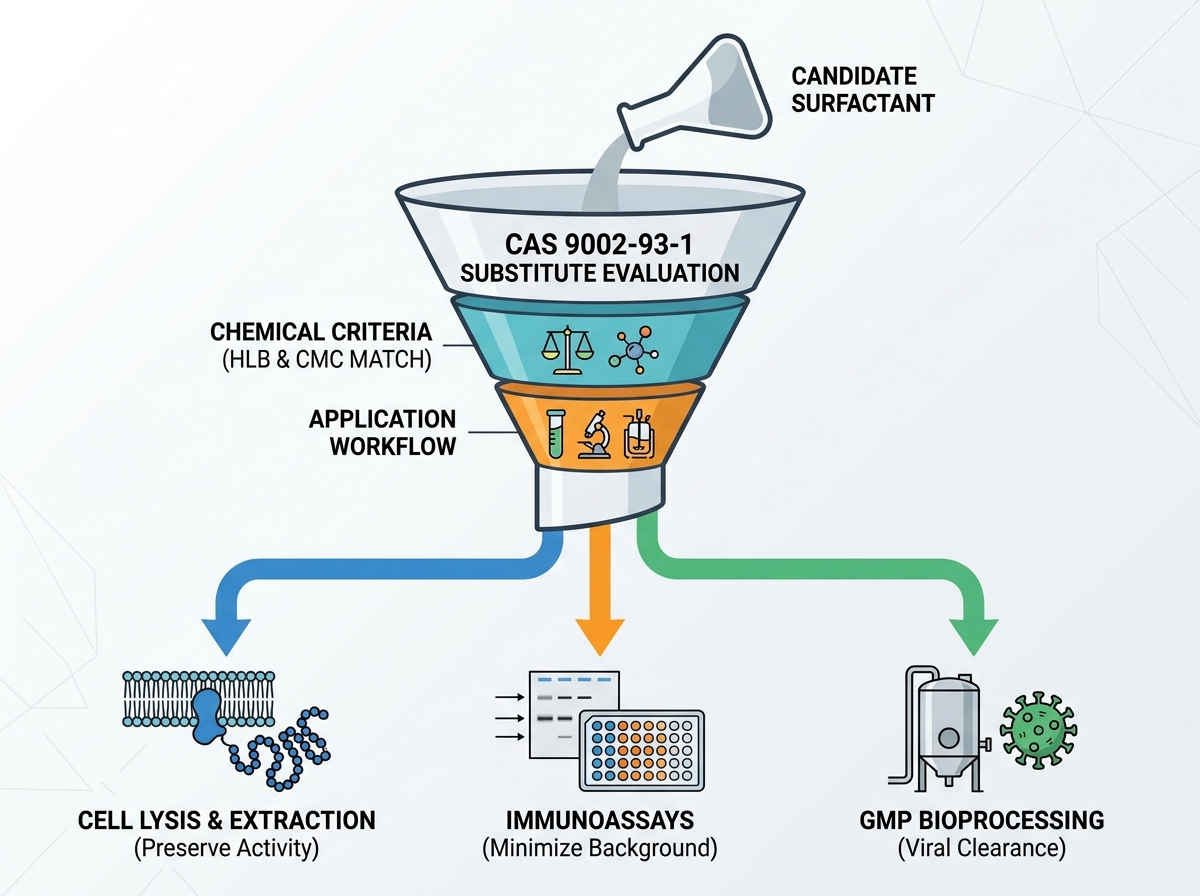
Selecting an effective alternative requires strict attention to physical chemistry. You cannot simply swap one detergent for another based on volume. You must closely match several fundamental properties to replicate your original experimental conditions.
Hydrophilic-Lipophilic Balance (HLB) serves as your primary screening metric. The legacy surfactant possesses an HLB value of approximately 13.5. This specific balance allows it to disrupt lipid membranes efficiently. It extracts proteins without causing irreversible denaturation. If you choose an alternative with a significantly higher HLB, it may prove too harsh. Harsh detergents routinely destroy delicate enzymatic activity. Conversely, an HLB too low will fail to solubilize target membranes completely.
Critical Micelle Concentration (CMC) determines your working concentration. The original chemical features a CMC of roughly 0.24 mM. At this precise concentration, surfactant monomers spontaneously aggregate into micelles. These micelles encapsulate and suspend hydrophobic proteins in aqueous solutions. Aligning CMC values ensures your new substitute forms micelles under identical buffer conditions. It dictates the exact concentration required for efficient membrane solubilization.
You must also evaluate the cloud point and UV absorbance profiles. Thermal stability relies heavily on the cloud point.
| Chemical Property | Target Benchmark | Impact on Application |
|---|---|---|
| HLB Value | ~13.5 | Determines protein solubilization vs. denaturation risk. |
| CMC (mM) | ~0.24 mM | Dictates the minimal effective detergent concentration. |
| Cloud Point | ~65°C | Indicates maximum operating temperature before phase separation. |
| UV Absorbance | High at 280nm | Impacts direct spectrophotometric protein quantification. |
Your specific laboratory application dictates your ideal substitute. No single chemical excels across every biological discipline. You must tailor your choice to the unique demands of your protocol.
Cell lysis and protein extraction demand a delicate balance. You need options capable of maintaining native protein conformation. The detergent must liberate intracellular contents while preserving vital enzymatic activity. Alkyl glycosides often excel in this specific domain. Certain tailored polyoxyethylene ethers also perform admirably. They penetrate the lipid bilayer effectively. They gently separate functional membrane proteins from the lipid matrix. We recommend prioritizing candidates proven to protect fragile kinase or phosphatase activities during extraction.
Immunoassays present entirely different challenges. Western Blots (WB), Immunohistochemistry (IHC), and Immunofluorescence (IF) rely heavily on signal clarity. You must focus on alternatives known to minimize background noise. The detergent must prevent non-specific antibody binding effectively. However, it cannot be so aggressive that it strips membrane-bound target proteins from your nitrocellulose or PVDF membranes. Researchers routinely discover a need for precise titration adjustments here. You will likely need to tweak your washing buffer concentrations slightly to achieve pristine signal-to-noise ratios.
GMP Bioprocessing and viral clearance operations face the strictest constraints. These industrial workflows demand compendial-grade, sustainably sourced substitutes. Regulatory agencies scrutinize these ingredients heavily. You must secure comprehensive safety profiles from your supplier. Lot-to-lot consistency remains absolutely non-negotiable for large-scale biomanufacturing. Scalability is equally critical. You must ensure your chosen alternative remains readily available in bulk quantities. Viral inactivation steps, such as solvent/detergent (S/D) treatments, require immense validation data. Your substitute must reliably dismantle viral lipid envelopes without harming the therapeutic biologic.
The market offers several distinct classes of replacement surfactants. Each category brings unique advantages and specific limitations to your workflow. You must evaluate them objectively.
Common Mistake: Avoid swapping volumetric quantities directly without checking the active concentration. Many proprietary green surfactants ship as 70% active solutions, whereas traditional legacy detergents shipped at 100%. Failing to account for this discrepancy will ruin your initial bridging studies.
Validation separates successful transitions from costly failures. You must acknowledge a fundamental truth early in this process. A direct 1:1 volumetric swap rarely yields identical experimental results. Minor structural differences between molecules alter micelle dynamics.
You must design and execute a comprehensive bridging study. This study compares the legacy detergent directly against your new candidate. Outline a standardized titration matrix to discover the new optimal working concentration. Test your candidate across a range of concentrations. Start at 50% of your historical concentration and titrate up to 150%. Evaluate each concentration point at multiple incubation times. This rigorous matrix approach guarantees you find the precise sweet spot for your specific assay.
You must define strict Key Performance Indicators (KPIs) before testing begins. Success metrics keep your validation objective. For extraction workflows, demand identical total protein yield. Measure the enzymatic activity carefully to ensure it remains unchanged. For immunoassays, look for equivalent band intensity on your Western Blots. Ensure the background remains completely clear. If you perform cell viability assays, demand zero alteration in baseline cell toxicity.
Finally, you must aggressively manage potential downstream artifacts. Your new substitute might interfere unexpectedly with standard laboratory analytical methods. Warn your team about potential interference with colorimetric protein assays. The BCA and Bradford assays are notoriously sensitive to detergent changes. You must verify chemical compatibility with your existing lab equipment. Check your spectrophotometers, chromatography columns, and automated liquid handlers. Ensure the new surfactant does not foul expensive analytical sensors or alter established baseline readings.
Successfully navigating the phase-out of CAS 9002-93-1 requires a highly strategic approach. You must base your switch on strict chemical parity, specifically matching HLB and CMC values. You must prioritize regulatory compliance by selecting proven SVHC-free options. Furthermore, you must rely entirely on application-specific empirical testing rather than generic marketing claims.
Proactive replacement serves as your best defense against disruption. It secures your long-term supply chain stability. It ensures uninterrupted global compliance across your entire product portfolio. Delaying this transition only magnifies future operational risks.
Take immediate action to protect your workflows. Instruct your procurement team to consult updated safety data sheets (SDS) today. Request physical trial samples of shortlisted green alternatives from your trusted suppliers. Initiate tightly controlled pilot bridging studies this quarter to secure your transition.
A: No. While several surfactants mimic its HLB and CMC closely, minor structural differences remain. These slight molecular variances require formal bridging studies. You must perform concentration optimization matrices to match performance for your specific biological assays.
A: It degrades in the environment to form 4-tert-octylphenol. Environmental regulators identified this specific compound as a potent endocrine disruptor. It causes severe, long-lasting environmental toxicity, particularly in fragile aquatic ecosystems.
A: Tween 20 operates well during mild washing steps, such as in ELISA or WB protocols. However, it remains far too mild for robust cell lysis. It cannot extract complex membrane proteins as efficiently as the legacy detergent.
A: Validation requires rigorous analytical testing. You must assess viral inactivation efficiency thoroughly. You must also verify the complete clearance of the detergent itself during downstream chromatography steps. Finally, ensure the substitute maintains strict compendial-grade compliance.


