
English
Views: 0 Author: Site Editor Publish Time: 2026-08-14 Origin: Site


Procurement and R&D teams constantly face challenges when sourcing industrial chemicals. You need precise technical data and transparent supply chain insights to make informed decisions. Sourcing CAS 69011-36-5 (Isotridecanol, ethoxylated) is no exception. This high-performance nonionic surfactant dominates modern formulations. Manufacturers heavily utilize it across industrial cleaning, textile processing, and complex emulsification. Small variances in its physical properties can drastically alter your end-product performance. Therefore, understanding its technical nuances is crucial.
This guide provides a highly objective, specification-driven framework. We will help you evaluate suppliers accurately based on verified chemical metrics. You will also uncover real pricing structures and learn how to mitigate common procurement risks. By mastering these exact parameters, you can ensure reliable sourcing and consistent manufacturing outcomes for your operations.
Navigating chemical sourcing begins by establishing strict identity parameters. The industry refers to this compound using several different names. You will frequently encounter common synonyms like Isotridecanol ethoxylated and Polyethylene glycol mono-isotridecyl ether. Formulators must ensure exact raw material matching during procurement. A simple nomenclature mismatch can disrupt your entire production line. Requesting the exact registry number eliminates this confusion entirely.
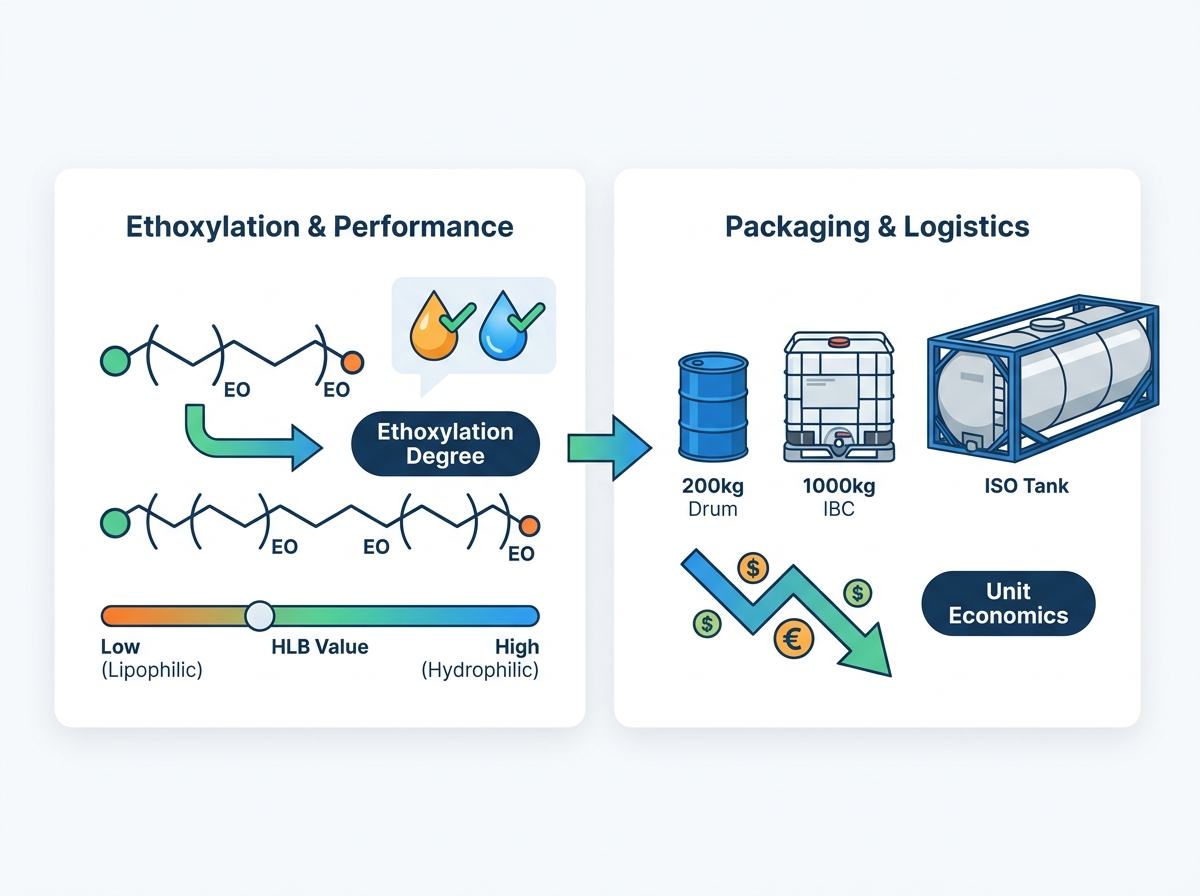
Evaluating the critical technical parameters ensures baseline product viability. Manufacturers rely on standard evaluation metrics to gauge quality. You must analyze HLB values, cloud point, pH levels, and moisture content before approving a batch. The Hydrophilic-Lipophilic Balance (HLB) value dictates how the chemical behaves in solutions. A low HLB indicates oil solubility. A high HLB indicates water solubility. The cloud point measures the exact temperature where the surfactant loses water solubility and becomes cloudy. You must align this metric strictly against your intended operating temperatures.
Variations in the degree of ethoxylation directly impact solubility and foaming characteristics. The ethoxylation process attaches Ethylene Oxide (EO) moles to the base alcohol. Adding more EO moles increases water solubility. It also elevates the foaming profile. Formulators select specific EO mole counts to achieve desired physical states. The table below outlines how different EO levels shift physical properties and target applications.
| Moles of EO (Degree of Ethoxylation) | Approximate HLB Value | Physical State (at 25°C) | Primary Industrial Application |
|---|---|---|---|
| 3 to 5 EO | 8.0 - 10.5 | Clear to slightly hazy liquid | W/O Emulsifiers, degreasers |
| 6 to 9 EO | 11.0 - 13.5 | Clear liquid | Industrial cleaning, wetting agents |
| 10 to 15 EO | 14.0 - 15.5 | Soft paste or viscous liquid | O/W Emulsifiers, detergent bases |
| 16 to 20+ EO | 16.0 - 17.5+ | Solid wax | High-temp dispersants, stabilizers |
Baseline quality standards define acceptable purity requirements for industrial-grade applications. High-quality production demands strict impurity limits. Unreacted alcohols must remain below specific thresholds to prevent odor issues. Water content typically should not exceed 0.5% in anhydrous grades. Free polyethylene glycols (PEGs) act as unwanted byproducts during synthesis. Reputable suppliers control these PEG levels rigorously. We recommend verifying these metrics via batch analysis certificates.
Industrial cleaning and degreasing heavily rely on this specific nonionic surfactant. Success criteria in this sector are highly demanding. You must achieve maximum grease removal efficiency. Formulations must maintain absolute stability in hard water environments. This chemical outperforms traditional anionic alternatives easily. It resists calcium and magnesium ions present in hard water. It penetrates heavy oil deposits rapidly. Micelle formation occurs swiftly, trapping dirt particles and preventing redeposition onto cleaned surfaces.
Textile processing represents another massive application area. Mills utilize this compound as a core wetting agent and emulsifier. Raw textiles repel water naturally due to surface waxes. Adding CAS 69011-36-5 breaks this surface tension instantly. Fast wetting speeds improve processing yield significantly. Dye penetration becomes highly uniform. Processing speeds increase because the fabric absorbs treatment baths faster. This efficiency translates directly into lower energy consumption during textile manufacturing.
Agrochemicals and industrial coatings utilize its unique stabilizing properties. Active ingredients in pesticides require uniform dispersion. If they settle, crop treatment fails. This surfactant acts as an exceptional dispersant. It keeps particles suspended evenly within the liquid matrix. In coatings and paints, it links physical properties to end-product stability. It prevents pigment agglomeration during prolonged storage. The resulting paint applies smoothly and resists separation.
Formulators often compare it against other nonionic surfactants. You must contrast it primarily against NPEs (Nonylphenol ethoxylates) and standard linear alcohol ethoxylates. NPEs deliver strong performance but face severe regulatory bans. They exhibit poor biodegradability and disrupt aquatic endocrine systems. Standard linear alcohol ethoxylates offer good environmental profiles but often lack rapid wetting speeds. Isotridecanol ethoxylates provide the perfect middle ground. They deliver superior branching structures for fast wetting while maintaining excellent biodegradability profiles.
Global regulatory status dictates where you can sell your finished formulations. You must outline REACH compliance expectations clearly. European markets require rigorous REACH registration for imported chemicals. OECD classifications guide hazard assessments universally. Regional market access realities shift constantly based on environmental policies. Using a globally approved surfactant simplifies international supply chains. This chemical enjoys broad acceptance across major jurisdictions, provided suppliers maintain updated regulatory dossiers.
Hazard identification forms the backbone of operational safety. You must summarize standard Section 2 SDS data carefully. Maintain a strict compliance lens without using hyperbole. Standard grades typically classify as eye irritants. High concentrations cause serious eye damage (GHS classification H318). Aquatic toxicity risks also require attention. Spills can harm aquatic life (H412) if they enter waterways directly. Workers must wear appropriate PPE, including splash goggles and chemical-resistant gloves, during transfer operations.
Storage and handling realities determine product longevity. You need evidence-based storage requirements to prevent material degradation. Temperature control prevents phase separation. You should store most liquid grades between 15°C and 30°C. Cold environments cause the surfactant to gel or freeze entirely. If freezing occurs, you must thaw the material slowly and agitate it thoroughly before use. Freezing destroys the internal emulsion matrix temporarily. Operational safety protocols must mandate proper ventilation in bulk storage areas to manage any trace vapors safely.
Procurement teams need a clear cost formulation framework. We must explain how pricing is calculated rather than providing static numbers. Market prices fluctuate daily. Base petrochemical costs drive the fundamental price floor. Ethylene oxide and isotridecanol derive directly from crude oil and natural gas cracking. When energy markets spike, these base costs surge. Next, you must factor in ethoxylation processing fees. Complex reactor time costs money. Finally, logistics and freight finalize the delivered price. Understanding this formula helps you predict market shifts accurately.
Packaging choices and Minimum Order Quantities (MOQ) impact unit economics drastically. You can choose from several standard formats. We can compare them directly to help you optimize procurement.
You must evaluate factory-direct versus distributor models carefully. Factory-direct sourcing offers massive advantages. You retain deep margin control by eliminating middlemen. Direct relationships allow you to negotiate custom ethoxylation levels tailored to your exact formulations. Conversely, regional distributors provide different strategic values. They offer shorter lead times for emergency orders. Local inventory buffers protect your production against global shipping delays. We recommend a hybrid approach. Secure your baseload volume factory-direct. Use regional distributors to cover unexpected demand spikes.
Quality assurance verification separates reliable manufacturing partners from high-risk traders. You must demand strict documentation. Always require batch-specific Certificates of Analysis (COAs) prior to shipment. A generic specification sheet is insufficient. Assess the supplier's analytical capabilities. Independent HPLC or NMR testing capabilities demonstrate robust internal quality control. ISO 9001 and ISO 14001 certifications provide baseline proof of standardized management practices. Reject suppliers unwilling to share their testing methodologies transparently.
Production capacity and scalability require careful auditing. A supplier might deliver a perfect 1-kilogram sample. Can they scale? Assess their ability to maintain consistent lot-to-lot quality during volume scale-ups. Ethoxylation is a highly sensitive exothermic reaction. Poor reactor control leads to wide molecular weight distributions. This variance alters your product's cloud point unpredictably. Ask potential partners about their reactor sizes and annual metric ton capacity. Redundancy in their manufacturing lines prevents delays if one reactor undergoes maintenance.
Take structured next-step procurement actions. We suggest implementing a standardized Request for Quote (RFQ) checklist. This ensures accurate and comparable vendor responses.
Using this exact checklist forces suppliers to respond with precise technical and commercial data. It eliminates vague pricing and highlights vendors who truly understand the chemical specifications.
Successful procurement of CAS 69011-36-5 requires balancing exact technical specifications with supply chain reliability. You cannot evaluate a supplier based on price alone. Ethoxylation levels, purity metrics, and strict safety data govern end-product viability entirely.
We encourage buyers to initiate pilot testing immediately. Request technical samples accompanied by complete Technical Data Sheets (TDS). Run these samples through your lab's specific stress tests. Validate performance in hard water, check emulsification speeds, and confirm shelf stability. Only after verifying these physical properties should you commit to commercial-scale MOQs. Strategic sourcing built on verified chemical data guarantees long-term manufacturing success.
A: The industry frequently refers to this chemical as Isotridecanol ethoxylated. You will also see it listed as Polyethylene glycol mono-isotridecyl ether or Trideceth. Commercial markets often use brand-specific trade names, but verifying the exact registry number ensures you receive the correct raw material.
A: The degree of ethoxylation determines the number of hydrophilic (water-loving) Ethylene Oxide moles attached. Increasing the EO moles raises the HLB value. A higher HLB makes the surfactant more water-soluble, while a lower HLB keeps it oil-soluble. This dictates its final industrial application.
A: Yes, it serves as a highly effective, environmentally friendly alternative. NPEs face severe global restrictions due to poor biodegradability and endocrine disruption risks. Isotridecanol ethoxylates degrade much faster in wastewater treatment facilities and lack these hazardous endocrine-disrupting properties.
A: The standard shelf life is typically 12 to 24 months from the manufacturing date. You must store it in tightly closed containers in a dry, well-ventilated area. Maintain storage temperatures between 15°C and 30°C to prevent freezing or phase separation.
A: You should request a batch-specific Certificate of Analysis (COA) and a detailed Technical Data Sheet (TDS). Additionally, require an updated 16-section Safety Data Sheet (SDS) and a formal statement verifying global regulatory compliance, such as REACH registration status.


