
English
Views: 0 Author: Site Editor Publish Time: 2026-07-28 Origin: Site


Global regulatory bodies are aggressively phasing out legacy surfactants like nonylphenol ethoxylates (NPEs). Consequently, formulators and procurement teams must urgently evaluate viable, compliant alternatives. They need solutions to maintain product efficacy without violating new environmental laws. A prime candidate is the C8-C10 alcohol ethoxy compound. It serves as a high-performance, short-chain nonionic surfactant. Industry experts recognize it highly for rapid wetting capabilities and excellent biodegradability. However, navigating this chemical transition requires more than simply swapping ingredients. You need clear performance data and robust safety protocols to succeed.
This comprehensive guide provides a rigorous, evidence-based framework for evaluating, handling, and sourcing these essential compounds. We explore their strategic role across industrial, agricultural, and commercial applications. You will learn how to bypass exaggerated vendor claims effectively. Ultimately, this knowledge enables you to make data-driven formulation decisions confidently and sustainably.
Formulators face immense pressure in today's chemical manufacturing landscape. They must balance aggressive cleaning efficacy against increasingly strict environmental safety standards. Legacy chemicals often fail modern eco-toxicity tests. This regulatory shift creates a severe business problem. Companies risk steep fines and product recalls if they fail to adapt. The solution often requires adopting specialized short-chain surfactants.
Specifically, a C8-C10 alcohol ethoxy compound acts as a highly efficient emulsifier and wetting agent. Its shorter carbon chain length distinguishes it from traditional C12-C14 variants. This reduced molecular footprint optimizes the surfactant for low-foam generation. It also enables incredibly fast surface penetration. We see these specific traits highly valued in dynamic, high-agitation environments.
Primary use cases span several demanding commercial sectors. Hard surface cleaners utilize these compounds for streak-free drying and rapid soil removal. Textile processing facilities rely on them to wet raw fabrics instantly before dyeing. Agricultural adjuvants incorporate them heavily to enhance the spreadability of organic crop treatments. Furthermore, institutional cleaning products depend on their quick-rinsing profiles to save water and reduce labor costs.
To formulate successfully, you must evaluate critical performance metrics rigorously. A surfactant's physical properties directly dictate its final field performance. Understanding these metrics prevents costly formulation failures.
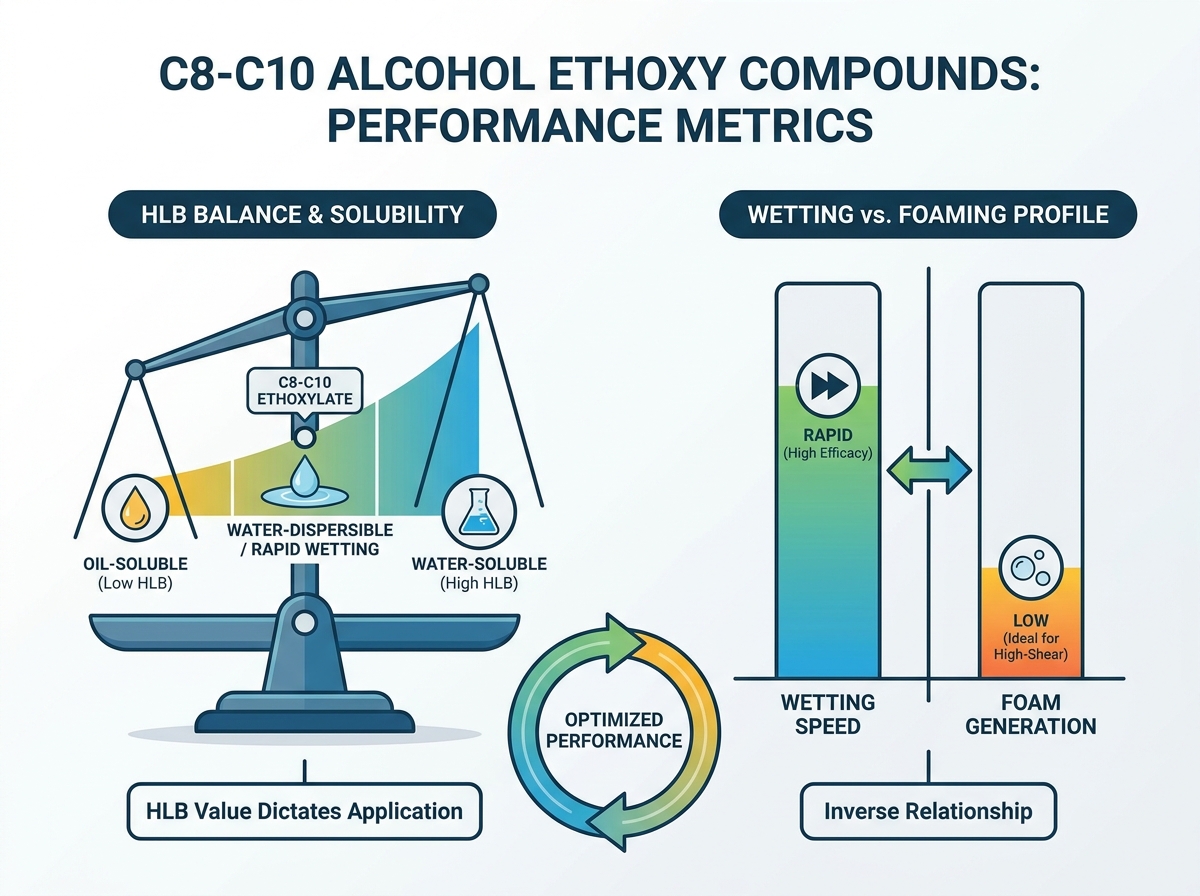
Specific degrees of ethoxylation determine the Hydrophilic-Lipophilic Balance (HLB). The number of ethylene oxide (EO) moles dictates molecular solubility. This specific metric shifts the compound from oil-soluble to completely water-soluble. For example, lower EO additions create excellent oil-based degreasers. Conversely, higher EO additions excel in aqueous cleaning solutions. You must match the HLB precisely to your target soil type.
HLB Application Alignment Guidelines
| EO Moles | Approximate HLB Range | Primary Solubility | Optimal Application Target |
|---|---|---|---|
| 3 - 4 | 8.0 - 10.5 | Oil/Mineral Spirits | Industrial degreasers, defoamers |
| 5 - 6 | 11.0 - 12.5 | Dispersible in Water | Textile wetting, hard surface cleaners |
| 7 - 8 | 13.0 - 14.5 | Highly Water Soluble | General-purpose institutional cleaners |
Establishing accurate stability thresholds is vital for high-temperature formulations. The cloud point indicates the exact temperature where a nonionic surfactant loses its water solubility. The solution becomes visibly cloudy and phase separation begins. High-temperature industrial cleaning requires precise cloud point engineering. If the operating temperature exceeds the cloud point, the surfactant stops cleaning effectively. You must formulate well below this thermal threshold.
You must map the inverse relationship between dynamic surface tension and foam generation. Rapid tension reduction generally facilitates faster wetting speeds. Fortunately, the short carbon chain produces fundamentally unstable foam. The generated foam bubbles collapse quickly under their own weight. This low-foam profile proves critical for automated spray washers and high-pressure industrial systems. Standard C12-C14 ethoxylates create persistent foam, shutting down automated equipment.
Comparison Chart: Short-Chain vs. Mid-Chain Ethoxylates
| Performance Metric | C8-C10 Ethoxylates | C12-C14 Ethoxylates |
|---|---|---|
| Wetting Speed | Extremely Fast | Moderate |
| Foam Stability | Low (Quick Collapsing) | High (Dense and Stable) |
| Detergency (Particulate) | Moderate | Excellent |
| Rinseability | Superior | Requires extra water |
Moving a formulation from a beaker to a mixing tank requires strict scalability checks. You must evaluate how the surfactant interacts alongside builders, caustic solvents, and other active ingredients.
Adopting any chemical requires acknowledging its inherent physical hazards. Transparently addressing these hazards protects your workforce and ensures facility compliance. The C8-C10 alcohol ethoxy compound presents specific acute hazards in its concentrated form.
Concentrated short-chain ethoxylates carry strict Globally Harmonized System (GHS) classifications. Severe eye damage (Category 1) represents the most critical acute hazard. Even a minor splash can cause irreversible ocular tissue damage. Skin irritation (Category 2) also remains a documented reality. Facility managers must never treat these raw materials as benign soaps. They require rigorous handling protocols before dilution into final consumer products.
You must implement mandatory engineering controls immediately. Install local exhaust ventilation near all mixing vats. Utilize automated, closed-loop dosing systems whenever possible to minimize human contact. Direct manual pouring of concentrated drums should be strictly prohibited. Furthermore, provide appropriate personal protective equipment (PPE). Operators must wear chemical splash goggles, full face shields, and heavy-duty nitrile gloves. Ensure emergency eyewash stations remain fully functional and easily accessible within the mixing zone.
Environmental management requires balancing initial aquatic toxicity against eventual degradation. These surfactants exhibit moderate initial toxicity to aquatic life. However, they demonstrate a rapid, verifiable degradation curve. They degrade quickly and completely in standard municipal wastewater treatment systems. This rapid breakdown mitigates long-term ecological damage effectively. They do not persist or bioaccumulate in marine environments.
Urge your procurement and compliance teams to cross-reference all vendor safety claims. Always demand official documentation from independent regulatory bodies. Australian AICIS evaluation statements provide excellent baseline toxicity data. Do not rely solely on glossy marketing brochures. Check empirical test results regarding acute oral toxicity and dermal sensitization. A robust EHS strategy relies exclusively on verifiable laboratory data.
Global regulatory frameworks continuously evolve, demanding proactive compliance strategies. Varying global frameworks govern short-chain ethoxylates differently based on local environmental priorities.
You must understand how regional laws dictate allowable concentrations and reporting requirements. In the United States, TSCA inventory status represents the baseline legal requirement. In Europe, REACH regulations demand extensive dossier submissions outlining safe use scenarios. Failure to secure these regional approvals halts global distribution immediately. Always audit a supplier's compliance status before authorizing large purchase orders.
Niche applications demand highly specialized clearances. For instance, the USDA reviews specific petitions governing chemical usage in organic farming. Applying an ethoxylate to organic tobacco crops requires strict adherence to natural sourcing standards. The feedstock must originate from non-petroleum sources. These agricultural allowances dictate purity levels and mandate zero synthetic contamination.
Criteria for verifying "eco-friendly" claims are becoming increasingly strict. Consumers easily recognize and reject corporate greenwashing. Demand comprehensive analytical documentation from your chemical suppliers. Check maximum limits for hazardous byproducts, particularly 1,4-dioxane. Quantify residual unreacted alcohol percentages, as these contribute to VOC emissions. Insist on recognized eco-label certifications. Validations like the EPA Safer Choice program carry significant market weight.
Best Practice: Always audit third-party eco-certifications directly through the issuing agency's database. Never trust a generic "biodegradable" stamp printed on an outdated Technical Data Sheet.
The global push toward sustainable chemistry significantly reshapes the surfactant supply chain. Formulators must now choose between distinctly different raw material origins.
A massive shift impacts the availability of fatty alcohol feedstocks. Oleochemical (plant-derived) alcohols compete aggressively against petrochemical (synthetic) sources. Oleochemicals derive primarily from palm kernel oil or coconut oil. Synthetic versions derive from ethylene via the Ziegler process. Consumer demand for renewable ingredients drives a steady transition toward natural feedstocks. However, synthetic sources often provide greater supply reliability during agricultural shortages.
You must understand underlying raw material volatility to forecast production costs. Palm kernel oil fluctuations directly contrast crude oil price swings. Weather events and agricultural yields dictate natural feedstock prices. Conversely, geopolitical events and drilling outputs dictate synthetic prices. These diverging dynamics impact the long-term cost stability of your chosen formulation. Diversifying your supplier base mitigates these pricing shocks.
Minor molecular profile variations exist between synthetic and natural routes. Carbon chain distributions might differ slightly depending on the origin. Synthetic alcohols might contain small amounts of branched chains. Natural alcohols remain predominantly linear. You face severe implementation risks if you switch feedstocks blindly mid-production. Rigorous stability testing remains an absolute necessity. Even minor changes in linearity can alter cloud points and foaming behavior.
Procurement teams require a structured methodology to qualify new chemical partners. Selecting the right supplier guarantees batch consistency and regulatory peace of mind.
Mandate comprehensive documentation upfront before accepting any samples. Require accurate, recently updated Technical Data Sheets (TDS). Demand complete 16-part Safety Data Sheets (SDS) authored within the last three years. Insist on transparent origin tracing for all raw materials. You must know whether the alcohol derives from a petrochemical plant or a palm plantation.
Assess a supplier’s internal technical capabilities thoroughly. Can they provide custom ethoxylation ranges to solve exact formulation challenges? Do they possess the engineering capacity to hit a very specific cloud point? A strong supplier acts as an extension of your R&D department. They should offer formulation advice, not just bulk chemical deliveries.
Successful adoption of short-chain ethoxylates transforms industrial formulation efficacy. It requires a balanced approach combining performance engineering, strict safety management, and regulatory foresight.
A: Shorter C8-C10 chains deliver significantly faster wetting speeds and exhibit much lower foaming properties. They suit high-shear, fast-penetration industrial tasks perfectly. Longer C12-C14 chains provide superior particulate detergency and higher foam stabilization, making them ideal for traditional consumer cleaning products.
A: Yes, regulatory bodies generally classify them as readily biodegradable under standard OECD guidelines. However, exact environmental degradation rates depend heavily on the specific degree of ethoxylation. Lower ethoxylation moles typically degrade much faster in standard municipal wastewater treatment systems.
A: Focus strictly on key safety indicators. Verify exact composition percentages rather than broad ranges. Look for strict limits on hazardous manufacturing byproducts like 1,4-dioxane. Finally, ensure the SDS lists explicit GHS hazard codes, particularly concerning Category 1 severe eye damage.
A: It depends entirely on the feedstock origin and specific regulatory approvals. Plant-derived (oleochemical) sources often qualify for eco-labels easily. You must check specific petition approvals, such as EPA Safer Choice listings or USDA organic agricultural allowances, before claiming compliance.


