
English
Views: 0 Author: Site Editor Publish Time: 2026-08-10 Origin: Site


Transitioning from lab-scale formulation to commercial procurement presents unique and significant challenges. Scaling up production requires securing consistent, high-performing chemical agents without compromising quality or compliance. You need reliable ingredients to ensure predictable manufacturing outcomes. Modern industries increasingly demand surfactants combining robust cleaning performance with strict environmental safety profiles. Isotridecanol, ethoxylated, perfectly fits this operational demand. As a highly versatile nonionic surfactant, it drives efficiency across many demanding industrial applications. It handles extreme conditions, diverse pH ranges, and heavy soil loads effortlessly.
This article provides procurement managers, formulators, and compliance officers with essential, actionable insights. We will explore the technical properties and physical behaviors of this compound in depth. You will learn the commercial criteria and regulatory frameworks necessary to evaluate, source, and integrate it safely. Our goal is to equip you with the knowledge required to make confident, scalable purchasing decisions.
Understanding the exact chemical identity of an ingredient helps formulators predict its behavior in complex mixtures. The IUPAC name for this compound is isotridecanol, ethoxylated. Industry professionals often refer to it simply as tridecyl alcohol ethoxylate. It belongs to the nonionic surfactant class. Nonionic surfactants carry no electrical charge on their hydrophilic head. This lack of charge gives them immense versatility. They do not interact chemically with hard water ions like calcium or magnesium. Consequently, they maintain exceptional cleaning power in hard water environments where other surfactants often fail.
The molecular structure features a highly branched hydrophobic tail attached to a hydrophilic ethylene oxide (EO) chain. This specific branched structure provides distinct advantages. It lowers the pour point of the chemical compared to linear alcohol alternatives. Formulators value this branching because it accelerates wetting speed. A faster wetting speed translates directly into quicker penetration of soils and fabrics.
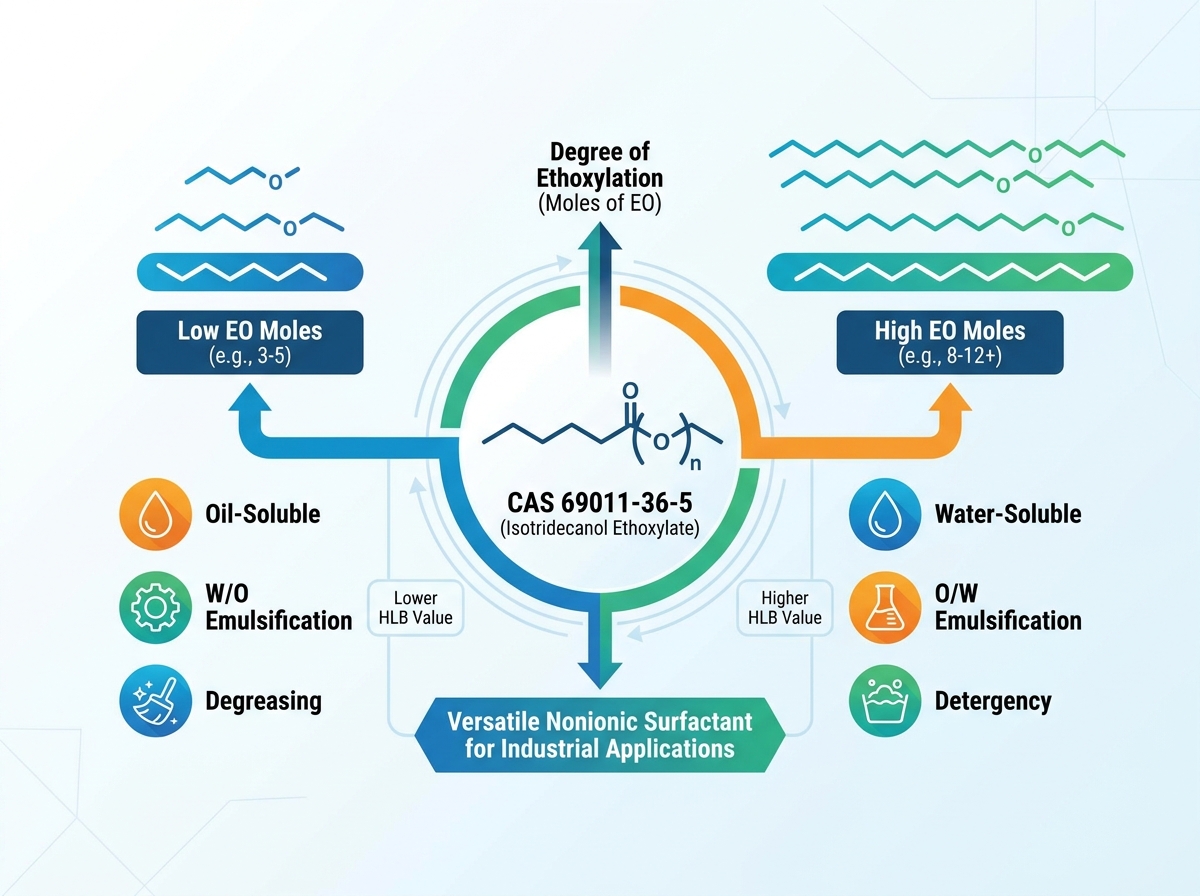
The degree of ethoxylation dictates the physical state and performance of the surfactant. Manufacturers add varying moles of ethylene oxide (EO) to the base alcohol. A range of 2.5 to 20 moles of EO is standard in industrial manufacturing. Low EO moles produce oil-soluble liquids. Mid-range EO moles create cloudy liquids or soft pastes. High EO moles yield solid waxes at room temperature.
Evaluating standard technical parameters is crucial for benchmarking. You must look closely at the Hydrophilic-Lipophilic Balance (HLB). HLB measures how water-soluble or oil-soluble the surfactant is. Cloud point indicates the temperature where a water-soluble surfactant becomes insoluble and turns cloudy. Pour point tells you the lowest temperature at which the chemical still flows. Finally, the pH of a standard aqueous solution (usually a 1% or 5% mixture) confirms product neutrality.
| Moles of EO | Physical State (at 25°C) | Estimated HLB | Primary Application Profile |
|---|---|---|---|
| 3 - 5 moles | Clear Liquid | 8.0 - 10.5 | W/O Emulsifier, Degreaser |
| 6 - 9 moles | Cloudy Liquid / Soft Paste | 11.0 - 13.5 | Wetting Agent, General Cleaner |
| 10 - 15+ moles | Solid / Hard Paste | 14.0 - 16.0+ | O/W Emulsifier, High-Temp Scouring |
Chemical stability drives the widespread adoption of this compound. It remains remarkably stable across broad pH ranges. You can safely formulate it into highly acidic rust removers or highly alkaline heavy-duty degreasers. The ether bonds in its structure resist hydrolysis under these extreme conditions. This resilience extends the shelf life of your final commercial products.
Furthermore, it demonstrates excellent compatibility within complex formulations. Because it lacks an ionic charge, it blends seamlessly with anionic surfactants (like SLS) and cationic surfactants (like quaternary ammonium compounds). This synergy allows formulators to create sophisticated multi-functional blends. You can combine it with solvents, builders, and polymers without risking phase separation or precipitation.
Industrial facility managers face a persistent business problem. They must clean heavy soil loads, carbonized grease, and synthetic lubricants off hard surfaces. Often, they must achieve this without relying on excessive mechanical action or intense manual scrubbing. Heavy scrubbing wastes labor hours and slows down maintenance cycles. Formulators need ingredients doing the heavy lifting chemically.
Implementing CAS 69011-36-5 provides an immediate positive outcome. It delivers superior surface wetting and rapid lipid emulsification. It lifts grease efficiently from porous concrete and metal grating. More importantly, it serves as a direct, environmentally preferable drop-in replacement for Nonylphenol ethoxylates (NPEs). NPEs face severe global regulatory restrictions due to their endocrine-disrupting breakdown products. Replacing NPEs with isotridecanol ethoxylates instantly upgrades a product's environmental profile without sacrificing degreasing power.
The oil and gas industry operates in harsh, unforgiving environments. Engineers use this nonionic surfactant extensively in drilling fluids, well stimulation packages, and downhole cleaning operations. It helps stabilize emulsions necessary for extracting hydrocarbons efficiently. It also aids in separating water from crude oil during surface processing operations.
The evidence of its immense value lies in its durability. It maintains peak performance in high-salinity brine and variable-temperature environments. Downhole conditions easily destroy weaker surfactants. However, this compound resists "salting out," remaining active when mixed with aggressive chlorides. Furthermore, operators frequently document its use in Tier 2 environmental risk assessments. Its reliable biodegradation profile makes it highly suitable for offshore drilling platforms operating under strict ecological guidelines.
Speed and consistency define profitability in textile and leather processing. Mills utilize this chemical as an aggressive scouring agent and an effective dye leveling assistant. Before dyeing raw cotton or wool, processors must remove natural waxes, spinning oils, and sizing agents. If scouring fails, dyes apply unevenly, ruining entire fabric batches.
Integrating the correct grade produces measurable operational outcomes. The branched structure ensures rapid penetration of densely woven fibers. This speeds up the overall wet processing line. Additionally, specific mid-EO grades exhibit low-foaming characteristics. Uncontrolled foam causes pump cavitation and fabric tangling in high-velocity jet dyeing machines. By keeping foam levels manageable, facilities can increase their continuous processing line speeds safely.
Procurement teams must align the specific chemical grade with their desired manufacturing outcome. You cannot buy a generic batch and expect universal performance. The exact number of EO moles dictates where and how the surfactant functions.
Low EO grades (typically 3-5 moles) are inherently oil-soluble. They possess low HLB values. Formulators choose these for water-in-oil (W/O) emulsification. They excel in heavy-duty degreasing formulas where the surfactant must penetrate thick oil layers before rinsing away with water. Conversely, high EO grades (8-12+ moles) are completely water-soluble. They carry higher HLB values. They are optimized for oil-in-water (O/W) emulsification, general detergency, and high-temperature operations. High EO grades exhibit higher cloud points, meaning they remain active and clear in hot water baths.
Selecting a grade on paper is only the first step. You must confront implementation realities through rigorous laboratory testing. Conducting phase-stability testing in the final formulation is an absolute necessity. You should subject your prototype blends to extreme freeze-thaw cycles. Heat them in ovens at 50°C for several weeks. If the surfactant separates or stratifies, you must adjust the EO mole selection or introduce a hydrotrope to stabilize the mixture.
Evaluating the foam profile is equally critical. You must assess whether a supplemental defoamer is required for high-shear applications. If you formulate a cleaner for floor scrubbing machines or pressure washers, excessive foam will cause the equipment to overflow. Lab technicians should run dynamic foam tests (like the Ross-Miles pour test) to benchmark initial foam height and foam decay rates over five minutes.
Transitioning from a beaker to a thousand-gallon mixing tank introduces scalability challenges. Facility managers must guarantee the chosen grade remains flowable or pumpable at ambient winter temperatures. A product flowing easily in July might turn into a solid block of wax in December.
Global regulatory compliance dictates modern chemical procurement. Navigating the European Chemicals Agency (ECHA) REACH registration status is mandatory for companies operating in or exporting to Europe. CAS 69011-36-5 generally holds favorable registration statuses among major suppliers. Furthermore, procurement teams review OECD guidelines regarding biodegradability.
Its primary regulatory advantage is its status as a recognized alternative to strictly regulated alkylphenol ethoxylates (APEOs). Regulatory bodies globally have phased out APEOs due to their severe aquatic toxicity and hormone-disrupting characteristics. Switching to isotridecanol ethoxylates keeps your company ahead of regulatory curves, future-proofing your product lines against sudden bans or heavy taxation.
While environmentally preferable to older chemistries, this compound still requires strict handling protocols. Under the Globally Harmonized System (GHS), it carries specific hazard classifications. Standard hazard statements typically include warnings for potential serious eye damage or severe eye irritation (often H318). Some specific grades also carry aquatic toxicity warnings for concentrated spills.
Facility managers must implement robust engineering controls. Local exhaust ventilation minimizes inhalation risks if the product is heated and produces vapors. Required Personal Protective Equipment (PPE) for safe handling is non-negotiable. Workers must wear chemical-splash goggles, impermeable nitrile gloves, and protective aprons when transferring raw materials. Eyewash stations must be immediately accessible near all mixing vats.
Evaluating environmental fate ensures downstream water discharge compliance. When industrial facilities wash their tanks, the wastewater eventually reaches municipal treatment plants or natural waterways. You must evaluate aquatic toxicity thresholds. Concentrated surfactants can harm aquatic life by disrupting cell membranes in fish gills.
However, this specific compound exhibits excellent ultimate biodegradability. Microorganisms in wastewater treatment facilities readily break down the ethoxylate chain and the alcohol backbone. Within standard testing timeframes, it degrades into harmless water and carbon dioxide. This rapid breakdown prevents the chemical from accumulating in the environment, ensuring you meet strict municipal discharge permits safely.
Building a resilient supply chain demands strict quality assurance. You must establish non-negotiable vendor requirements before issuing a purchase order. First, demand up-to-date Safety Data Sheets (SDS/MSDS) formatted to the latest GHS standards of your specific region. Outdated safety documents create massive liability during OSHA or regional safety audits.
Second, require specific Certificates of Analysis (COAs) for every single delivery. A generic specification sheet is not enough. The COA must detail exact lot-to-lot testing results. Monitor the moisture content closely; excess water dilutes your formula and ruins anhydrous blends. Scrutinize residual ethylene oxide limits to ensure the supplier stripped toxic byproducts effectively during manufacturing. Finally, verify the exact pH values to ensure the catalyst used during ethoxylation was properly neutralized.
Industrial suppliers offer various packaging formats. Your choice dictates handling efficiency and raw material costs. Standard industry availability includes 200kg steel or plastic drums. These suit small-scale formulators or niche product lines. For medium-scale production, 1000L Intermediate Bulk Containers (IBC totes) provide an excellent balance between cost and footprint.
Performing a cost-to-scale analysis based on packaging choices reveals significant savings. Buying in bulk ISO tanks dramatically lowers the price per kilogram. However, bulk deliveries require specialized receiving infrastructure, dedicated holding tanks, and high-volume plumbing. You must weigh the upfront capital expenditure of bulk infrastructure against the long-term chemical cost savings.
Selecting the right supplier involves looking beyond the base price. You must assess supplier lead times rigorously. A cheap product stranded on a cargo ship for three months stalls your manufacturing. Investigate their global inventory distribution. Do they hold local stock in regional warehouses, or do they ship directly from overseas factories on demand?
Furthermore, evaluate their ability to provide technical formulation support. Can they customize EO mole variations if your formula requires a unique cloud point? Use strict shortlisting logic. Prioritize manufacturers and distributors who provide transparent tracing. They should offer immediate, frictionless access to regulatory documentation, COAs, and technical support engineers.
CAS 69011-36-5 offers a highly adaptable, APEO-free surfactant solution tailored for demanding industrial sectors. It combines aggressive cleaning power, robust chemical stability, and rapid wetting capabilities into a single, cost-effective compound. By replacing outdated, heavily regulated chemistries, it modernizes your formulations while protecting your brand's environmental reputation.
As you move into the final decision stage, remember to align the exact ethoxylation grade with your specific manufacturing needs. Map your target cloud point, HLB, and solubility requirements carefully before placing bulk orders. A mismatch in EO moles will compromise your final product's stability and performance.
Take proactive steps today to secure your supply chain. Consult directly with technical sales representatives from reputable suppliers. Request physical product samples for laboratory phase-stability testing. Demand current lot COAs and localized SDS documentation to validate their quality control standards. By rigorously vetting both the chemical grade and the supplier, you ensure seamless, scalable production for years to come.
A: Industry professionals use several synonyms to identify this compound. Common names include Isotridecanol ethoxylated, tridecyl alcohol ethoxylate, and Isotrideceth. In technical catalogs, you might also see it listed as Polyethylene glycol mono(branched tridecyl) ether. Knowing these alternative names ensures accurate sourcing during procurement searches across different supplier databases.
A: Yes, it is highly biodegradable. Typical OECD 301 testing results show that isotridecanol ethoxylates rapidly break down in wastewater treatment environments. Microorganisms digest the chemical easily, preventing environmental accumulation. This rapid biodegradation makes it a preferred, widely accepted ingredient in eco-conscious formulations, especially when replacing problematic older surfactant classes like APEOs.
A: Follow standard MSDS guidelines for optimal storage. Keep the product in a dry, well-ventilated area away from direct sunlight. Protect it from extreme cold; low temperatures can cause higher-EO grades to turn into gels or freeze solid. If gelation occurs, gently warm the container using drum heaters while agitating until the liquid becomes clear and uniform again.
A: Absolutely. It serves as a structurally viable, high-performing alternative to NPEs. It matches or exceeds NPEs in general detergency, wetting speed, and lipid emulsification. Most importantly, it is fully regulatory-compliant and avoids the severe endocrine-disrupting health and environmental concerns associated with legacy nonylphenol chemistries.


