
English
Views: 0 Author: Site Editor Publish Time: 2026-08-08 Origin: Site


Sourcing chemical polymers for commercial formulations demands precision. Finding the exact variant to meet performance and regulatory standards often feels like navigating a maze. Procurement teams and formulation chemists face serious challenges when buying Polyethylene Glycol (PEG). You risk batch inconsistencies, compliance failures, and improper molecular weight selection if you rely solely on basic chemical registry numbers. A truly successful sourcing decision requires aligning the correct molecular weight, exact purity grade, and robust supplier documentation with your specific manufacturing end-use.
This article provides a straightforward, evidence-based evaluation of Polyethylene Glycol. We will guide your team through shortlisting, vetting, and purchasing the correct PEG variant. You will discover practical strategies to evaluate impurity controls, assess supplier reliability, and secure the exact materials your production line needs. We map out the crucial steps to ensure formulation integrity and regulatory compliance from the lab scale to commercial bulk ordering.
The biggest hurdle in procuring Polyethylene Glycol stems from the "One CAS, Many Profiles" challenge. The chemical identifier CAS 25322-68-3 acts as an umbrella term. It applies to the entire PEG polymer family rather than a single standardized chemical. If a procurement team orders this compound without specifying the exact average molecular weight (MW), they invite catastrophic formulation failures. The degree of polymerization dictates the physical and chemical properties of the material.
Polymers in the lower molecular weight spectrum exist as clear, viscous liquids at room temperature. They possess short polymer chains. This structural reality grants them exceptionally high hygroscopicity, meaning they attract and hold water molecules efficiently. Formulators primarily rely on these liquid PEGs to act as powerful solvents, humectants, and viscosity modifiers. You will frequently find PEG 400 serving as a liquid vehicle in softgel pharmaceutical capsules or acting as a solvent in specialty ink formulations.
As the polymer chain lengthens, the physical state transitions dramatically. Medium molecular weight variants (like PEG 1000 and 1500) behave as heavy pastes or semi-solids. High molecular weight versions (from PEG 3350 up to PEG 8000 and beyond) manifest as white, waxy flakes or free-flowing powders. These solid PEGs serve entirely different functional purposes. Formulators use them as structural binders in tablet compression, dry powder lubricants, and precise melt-point regulators in suppository manufacturing and industrial hot-melt adhesives.
Selecting the incorrect molecular weight triggers immediate processing issues. If you substitute a high-MW PEG into a liquid formula designed for a low-MW solvent, you will induce phase separation and crystallization. Conversely, using a liquid PEG instead of a solid variant in a pressed tablet will compromise structural integrity, leading to crumbling. In pharmaceutical and cosmetic applications, altering the molecular weight inadvertently shifts drug release rates and skin penetration profiles.
| Molecular Weight Range | Physical State at Room Temp | Primary Characteristics | Common Applications |
|---|---|---|---|
| PEG 200 – PEG 600 | Clear, viscous liquid | Highly hygroscopic, excellent solvency | Liquid solvents, humectants, softgels |
| PEG 1000 – PEG 1500 | Semi-solid paste | Moderate moisture retention, transitionary melting | Ointment bases, chemical intermediates |
| PEG 3350 – PEG 8000+ | Waxy flakes or powder | Low hygroscopicity, excellent lubricity | Tablet binders, laxatives, rubber lubricants |
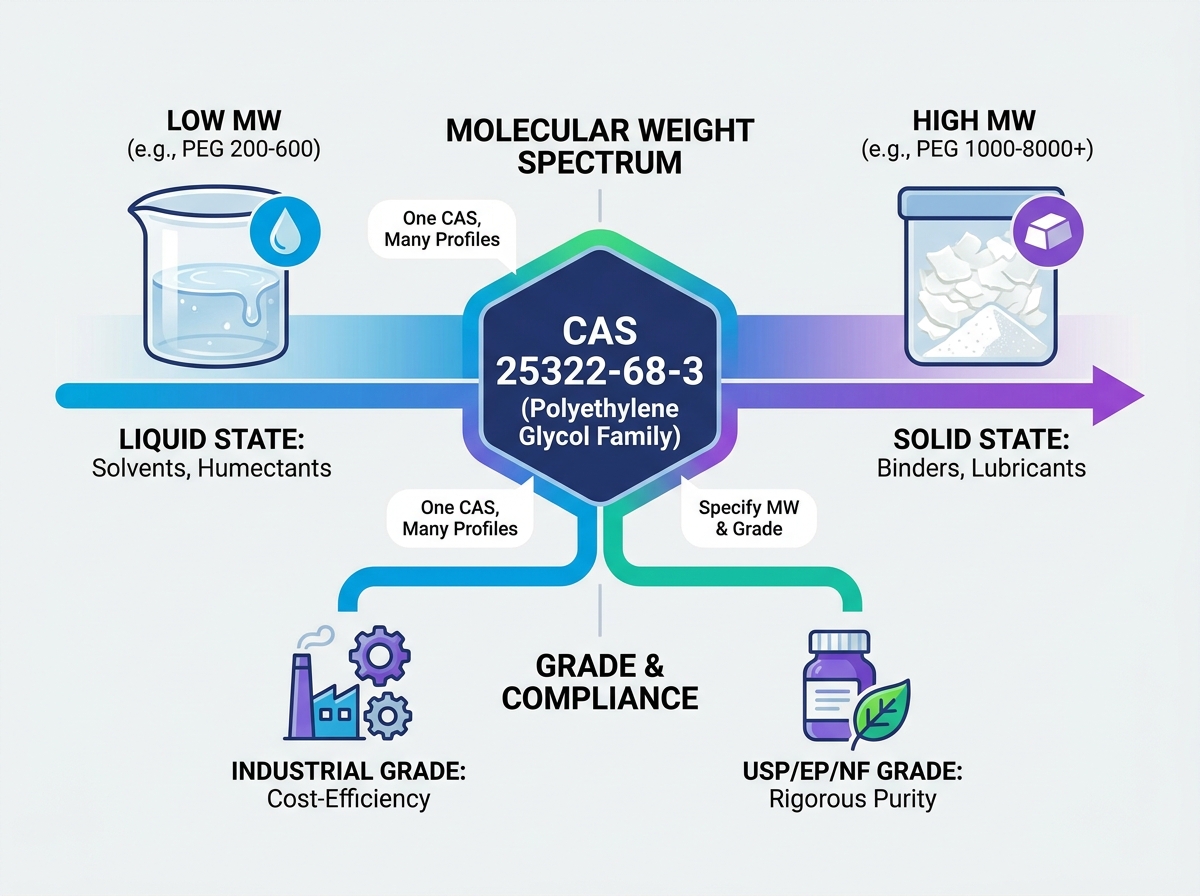
A chemical's grade defines its purity profile and allowable impurity thresholds. Polyethylene Glycol production yields different grades based on the refinement processes utilized. Procurement teams must match these grades directly to their respective compliance frameworks. Buying an over-spec grade wastes budget, while under-specing introduces immense regulatory and safety risks.
Technical grade PEG serves the backbone of heavy manufacturing. Applications include industrial lubricants, chemical intermediates, agricultural pesticide formulations, and wood preservation solutions. When sourcing technical grades, buyers evaluate cost-efficiency and bulk availability above all else. The manufacturing process for these grades allows for broader impurity profiles. Heavy metal limits and byproduct traces remain less strictly controlled because the end products rarely touch human skin or enter the food chain.
Regulated applications demand rigorous oversight. Formulations covering excipients, topical ointments, osmotic laxatives, and skincare creams require pharmaceutical or cosmetic grades. These strict designations (such as USP/NF in the United States or EP in Europe) guarantee testing against exhaustive monographs. The synthesis of PEG involves ethylene oxide, which can leave behind toxic byproducts if improperly refined. Regulated grades require stringent testing for residual Ethylene Oxide (EO) and 1,4-Dioxane, a known probable human carcinogen.
Assuming compliance without verifying the exact grade introduces severe regulatory risk. Plant audits routinely uncover unauthorized substitutions where buyers purchased industrial material for cosmetic use. Follow these verification steps to protect your supply chain:
Chemical engineers and formulators rely on Polyethylene Glycol because it delivers predictable, stable performance across a vast array of environments. Its unique molecular structure offers functional benefits rarely found combined in a single raw material.
PEG stands out as an exceptional solvent and coupling agent. The repeating ether linkages in its polymer chain allow it to interact favorably with both water and various organic compounds. It dissolves active pharmaceutical ingredients (APIs) that otherwise resist formulation. Furthermore, it blends incompatible formulation phases together seamlessly. By acting as a stabilizing bridge, it prevents emulsions from cracking under thermal stress.
Safety drives raw material selection in consumer goods. Polyethylene Glycol boasts an exceptionally low toxicity profile. Regulatory bodies classify it as Generally Recognized As Safe (GRAS) for numerous topical, oral, and even select intravenous applications. It does not irritate healthy skin or mucous membranes. This biocompatibility reduces the overall risk profile of formulations, making it a preferred base for sensitive skincare lines and pediatric liquid medications.
Unlike many synthetic polymers, PEG remains 100% water-soluble across its entire molecular weight spectrum. Whether you formulate using a liquid PEG 400 or a solid PEG 8000, the material dissolves in water to form clear, stable solutions. This predictability proves invaluable. It allows industrial manufacturers to create water-washable lubricants for metalworking. Consumer goods manufacturers utilize this trait to ensure personal care products rinse cleanly from the skin and hair without leaving stubborn residues.
Moisture control dictates product shelf life. Lower molecular weight PEGs act as active moisture-control agents. They absorb ambient humidity, preventing pastes, adhesives, and cosmetic creams from drying out and cracking in their packaging. As you move up the molecular weight scale, hygroscopicity drops significantly. Formulators leverage this inverse relationship. They select specific PEG variants to dial in the exact moisture retention behavior required for their distinct product environments.
Transitioning from the laboratory to plant-scale manufacturing introduces physical handling challenges. Facility managers must align their storage and safety protocols with the specific material safety data sheet (MSDS) guidelines for the chosen PEG variant.
Ambient humidity poses the greatest threat to stored Polyethylene Glycol. Because lower MW PEGs are highly hygroscopic, exposure to damp air quickly degrades their quality by introducing unwanted water weight. You must store all variants in tightly sealed containers within cool, dry environments. While PEG generally offers a robust 12 to 24-month shelf life, prolonged exposure to air and heat accelerates degradation. Oxygen exposure over long periods causes the polymer chains to oxidize into undesirable aldehydes and peroxides. These degradation byproducts can alter pH levels and interfere with sensitive active ingredients in your final formula.
Handling protocols shift depending on the physical state of the chemical. Although PEG maintains a low-toxicity profile, facility operators face distinct physical hazards. When processing solid, high-MW variants (like PEG 8000), workers often must melt the material into a liquid state before blending. Handling heated liquid polymers presents severe thermal burn risks. Operators must wear heat-resistant gloves, face shields, and heavy aprons. Conversely, transferring high-MW dry powders generates airborne dust. While not highly toxic, this dust causes mild respiratory irritation. Facilities should implement local exhaust ventilation and require N95 respirators during bulk powder transfers.
Sustainability and waste management require proactive planning. Polyethylene Glycol is readily biodegradable under aerobic conditions. Environmental microbes effectively break down the polymer chains, meaning minor spills present low ecological risk. However, high-volume industrial disposal poses challenges. Dumping large quantities of concentrated PEG into municipal drains sharply spikes the Biochemical Oxygen Demand (BOD) of the wastewater. Industrial facilities must carefully meter their disposal rates to comply with local wastewater treatment regulations and avoid overwhelming municipal microbial processing systems.
Procurement goes beyond comparing price tags per kilogram. Securing a reliable supply chain requires vetting chemical manufacturers through a rigid, evidence-based lens. Buyers must treat supplier evaluation as a critical risk-management exercise.
Never bypass or skim the Certificate of Analysis (COA). The COA serves as the binding technical contract between you and the supplier. You must cross-reference the specified average molecular weight to ensure it falls within your acceptable formulation tolerance band. Check the reported pH levels of a 5% aqueous solution, as unexpected acidity or alkalinity indicates poor manufacturing control. Additionally, review the heavy metal and impurity limits to confirm they align perfectly with your intended grade.
When purchasing for pharmaceutical or cosmetic applications, broad promises hold no value. Ask potential suppliers for their specific analytical testing methodologies regarding trace toxins. Demand verifiable limits on 1,4-Dioxane. High-tier suppliers routinely guarantee 1,4-Dioxane levels below 10 ppm, and often below 1 ppm for highly sensitive applications. If a supplier hesitates to share their gas chromatography data for residual ethylene oxide, eliminate them from your shortlist immediately.
A supplier might deliver an excellent bench-scale sample but fail during bulk fulfillment. Assess their ability to maintain a tight molecular weight distribution across multiple commercial batches. Lot-to-lot consistency prevents costly formulation adjustments on your production floor. Ask potential manufacturing partners about their batch sizing, production capacity, and lead times. Reliable suppliers maintain robust quality control systems that automatically flag and quarantine out-of-spec batches before they ship.
Do not commit to commercial-scale Minimum Order Quantities (MOQs) based solely on paperwork. Request smaller samples first. Run pilot-scale formulation testing using the exact manufacturing equipment you plan to use for full production. Evaluate how the specific material handles shear stress, thermal cycling, and blending phases. Only after the pilot batch passes your internal stability testing should you negotiate annual supply contracts and bulk pricing matrices.
Successfully navigating the procurement of Polyethylene Glycol demands technical clarity. While the baseline chemical identity offers immense versatility across dozens of industries, buying the correct material requires narrowing down the specific molecular weight and purity grade. You must match the polymer’s physical state and functional properties to your distinct formulation requirements, recognizing how chain length directly dictates viscosity, melting point, and moisture retention.
Protect your production runs by prioritizing suppliers who provide transparent compliance documentation. Insist on lot-to-lot consistency and rigorous impurity testing, particularly concerning residual 1,4-Dioxane and ethylene oxide. Never compromise on quality when your final product operates in regulated pharmaceutical or cosmetic spaces.
We encourage you to review your current formulation parameters. Request a targeted, lot-specific COA from a fully vetted supplier, or reach out to specialized technical sales engineers to ensure you have perfectly matched your PEG grade to your application.
A: It depends entirely on the average molecular weight. Polyethylene Glycol encompasses a range of physical states. Lower molecular weights like PEG 400 exist as clear liquids at room temperature. As the polymer chain lengthens, the material becomes semi-solid, and high molecular weights like PEG 3350 or 8000 present as solid, waxy flakes or powders.
A: There is no chemical difference. Macrogol is simply the International Nonproprietary Name (INN) used within pharmaceutical and medical contexts to describe Polyethylene Glycol. When reviewing pharmaceutical monographs or drug labels, you will see Macrogol followed by a number indicating its molecular weight, identical to standard PEG naming conventions.
A: Yes, it typically carries a standard shelf life of 12 to 24 months. While highly stable, prolonged exposure to ambient air and humidity degrades it. It absorbs moisture rapidly, and oxygen exposure can lead to the formation of peroxides and aldehydes, which may negatively interact with other ingredients in your formulation.
A: No. There is a strict difference between an FDA-approved final drug product and a raw material that simply meets USP/NF standards. While certain high-purity PEG grades are recognized as safe for food and pharma use, technical and industrial grades carry impurities making them entirely unfit and unapproved for human consumption or topical use.


