
English
Views: 0 Author: Site Editor Publish Time: 2026-08-02 Origin: Site


Formulators across industries rely heavily on CAS 9003-11-6. You likely know this material as Poloxamer or an ethylene oxide/propylene oxide block copolymer. This foundational ingredient powers complex formulations daily. We see it actively utilized in advanced pharmaceutical excipients and robust industrial surfactants.
Selecting the perfect specification challenges many procurement teams. You must nail the exact molecular weight and purity grade for your application. A slight misstep here can completely ruin product stability. It can also compromise biological efficacy and trigger severe regulatory compliance failures. Choosing incorrectly creates massive downstream headaches for your manufacturing pipeline.
This guide gives you a strict evaluation framework. We will help you assess copolymer specifications properly. You will learn to manage implementation risks effectively. Finally, we show you how to shortlist reliable suppliers for successful commercial scale-up.
The core structure of this chemical defines its versatility. It is an A-B-A triblock copolymer. The central polyoxypropylene (PPO) block is distinctly hydrophobic. The two flanking polyoxyethylene (PEO) blocks are hydrophilic. By tweaking the ratio of these blocks, manufacturers tightly control physical properties. This specific ratio dictates how the material behaves inside aqueous solutions. Molecular weight variations also determine whether the final product exists as a liquid, paste, or solid flake at room temperature.
Formulators must evaluate two primary performance metrics when qualifying a new supplier lot. Understanding these metrics prevents catastrophic formulation failures.
This polymer exhibits fascinating thermoreversible gelation. Aqueous solutions remain liquid at cooler temperatures. Upon warming to body temperature, they rapidly transition into a robust gel. This critical gelation temperature (CGT) matters deeply for drug delivery applications. You can formulate liquid eye drops spreading easily across the cornea. Once warmed by the eye, the solution gels instantly. This extends the active pharmaceutical ingredient (API) release time.
Specific variations within the copolymer family carry distinct Hydrophilic-Lipophilic Balance (HLB) values. High-HLB variations excel at forming stable micelles. These micelles encapsulate poorly soluble APIs effectively. They improve drug bioavailability dramatically. Conversely, lower-HLB variations perform brilliantly as defoamers. They stabilize complex emulsions under high mechanical shear.
Copolymer Behavior Matrix
| Copolymer Type | Physical State (25°C) | General HLB Range | Primary Function |
|---|---|---|---|
| Low PEO content | Liquid | 1-7 | Defoaming, wetting agent |
| Medium PEO content | Paste | 8-15 | Emulsification, dispersion |
| High PEO content | Solid / Flake | 16-24+ | Solubilization, gelation |
Subtle variations in average molecular weight between supplier lots present a massive implementation risk. A minor molecular weight shift can alter phase-transition temperatures significantly. Your controlled-release gel might suddenly turn liquid at body temperature. Strict QA/QC tolerances are absolutely necessary. You must demand narrow molecular weight distribution data from your supplier.
Common Mistakes to Avoid:
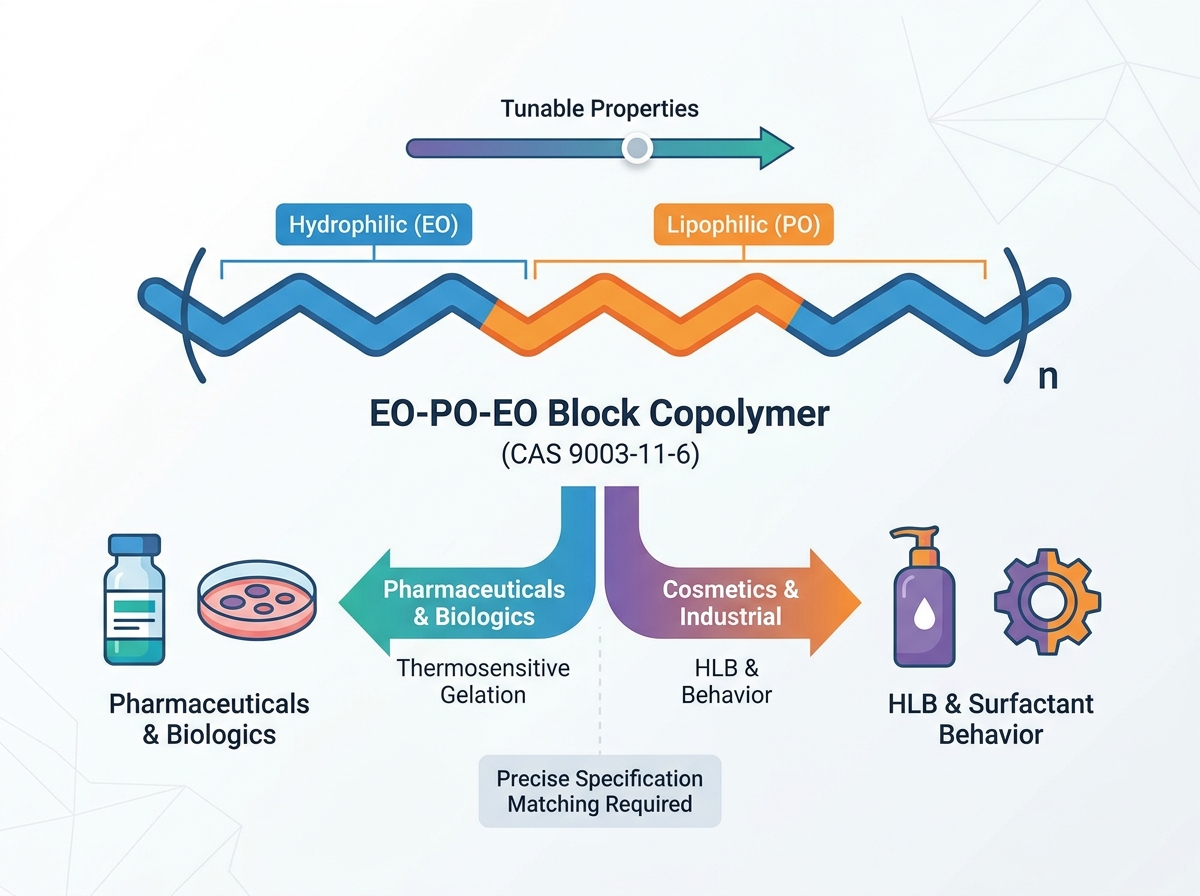
The pharmaceutical sector relies on this copolymer extensively. It acts as a powerful solubilizer and stabilizer. Bioprocessing engineers use it as a cell culture shear-protectant. Mammalian cells grown inside massive bioreactors face extreme mechanical stress. Sparging bubbles can easily rupture delicate cell membranes. Adding this polymer shields these cells effectively.
Success criteria: Formulations must achieve uncompromised cell viability. They must also maintain stable protein folding over long incubation periods. Endotoxin-free grades are mandatory here.
Cosmetic chemists prize this material for skin-friendly properties. You will find it inside premium micellar waters, soothing lotions, and advanced dental care products. It removes makeup gently without stripping natural skin lipids. In toothpaste formulations, it helps disperse active ingredients uniformly.
Success criteria: End products must demonstrate ultra-low irritation profiles. They also require highly consistent viscosity across different temperature extremes during shipping.
Heavy industry utilizes robust grades of CAS 9003-11-6 constantly. Facilities deploy them as low-foaming surfactants, powerful dispersants, and highly active defoamers. They keep industrial cooling systems clear of organic build-up. They also optimize pigment dispersion inside architectural paints.
Success criteria: Procurement teams look for maximum process stability under extreme thermal stress. Consistency matters immensely for large-scale continuous manufacturing processes.
Selecting the right tier of this copolymer prevents expensive compliance failures. You must frame the decision process around end-use severity.
Impurity profiling separates premium suppliers from unreliable aggregators. The synthesis process utilizes highly reactive starting materials. Testing for unreacted monomers like ethylene oxide and propylene oxide is non-negotiable. These monomers are highly toxic and strictly regulated. High-quality manufacturers utilize advanced vacuum stripping techniques.
Heavy metal contamination presents another severe risk. You must verify elemental impurity testing according to ICH Q3D guidelines. For injectable or cell-culture applications, endotoxin limits and bioburden levels require rigorous scrutiny. High endotoxin levels will instantly kill sensitive mammalian cell lines.
Procurement teams must demand transparent documentation prior to shortlisting any vendor. A proper Certificate of Analysis (CoA) should accompany every single batch. You need comprehensive Material Safety Data Sheets (MSDS/SDS). Furthermore, biological applications require strict TSE/BSE free declarations. These documents prove the material contains no animal-derived components.
Proper storage dictates shelf life. This copolymer family exhibits notable hygroscopic tendencies. The material eagerly absorbs ambient moisture from the air. You must mandate airtight packaging across your entire facility. Light-resistant containers also help prevent long-term degradation.
Optimal temperature ranges must be strictly enforced in your warehouse. Excessive heat exposure can cause premature degradation or unwanted phase separation in liquid grades. Solid flake variations might fuse into solid blocks under high heat. We recommend storing these materials in climate-controlled environments carefully maintained between 15°C and 25°C.
The general safety profile is highly favorable. Global regulatory bodies typically recognize it as low-toxicity and non-irritating. However, industrial formulation teams must maintain a skeptical, evidence-backed approach. Handling concentrated bulk forms demands respect.
Operators handling fine powder or flake grades should wear appropriate PPE. Fine powders can generate nuisance dust. This dust poses mild inhalation risks. Ensure local exhaust ventilation operates efficiently. Regarding environmental disposal, industrial-scale spills require containment. Large quantities should never enter municipal wastewater systems directly without proper pre-treatment.
Best Practices for Bulk Handling:
Your supply chain is only as strong as your primary manufacturer. Procurement must learn to differentiate between catalog aggregators and actual primary synthesis manufacturers. Aggregators often repackage aging lots from multiple origins. This introduces severe batch-to-batch inconsistency. Primary manufacturers control the synthetic pathway directly. They offer superior traceability and technical support.
Evaluate potential partners across three specific dimensions.
Can the vendor bridge the dangerous gap from gram-scale R&D testing to multi-ton commercial production? Many suppliers perform well sending pristine 100-gram lab samples. They often fail miserably delivering 50-drum commercial orders possessing the same purity profile.
Do they offer robust change-control notifications? You need immediate alerts if they alter their catalyst system or sourcing pathway. Historical batch consistency data proves their synthesis mastery. Request CoA trend data spanning at least two years.
Analyze their lead-time realities carefully. Determine the exact geographic origin of their manufacturing plants. Evaluate their internal inventory buffering strategies. A reliable partner holds dedicated safety stock specifically allocated for your production runs.
We strongly recommend ordering specific sample quantities immediately. Use these samples for rigorous formulation stress-testing. Expose the formulated product to accelerated stability chambers. Simultaneously, conduct a strict audit covering the supplier’s regulatory paperwork. Do not approve the vendor until both formulation chemists and quality assurance teams sign off entirely.
Evaluating CAS 9003-11-6 goes far beyond checking a simple CAS number on a spreadsheet. It requires a precise match between the polymer's structural specifications and your intended regulatory outcomes. Minor impurity variations or molecular weight shifts can derail years of formulation work.
Your formulation teams must rigorously review supplier CoAs against internal purity thresholds. Always request application-specific samples to validate lot-to-lot consistency. Build a secure, transparent supply chain today to guarantee flawless manufacturing tomorrow.
A: The CAS number serves as the broad identifier for the entire ethylene oxide/propylene oxide copolymer family. Specific names denote exact molecular weights and precise EO/PO block ratios. Formulators use these specific grade names to guarantee physical performance characteristics.
A: Yes. You must utilize standard ambient or temperature-controlled storage facilities. Keep the material between 15°C and 25°C. Most importantly, use airtight packaging to prevent ambient moisture ingress. Hygroscopic absorption can alter the copolymer's delicate phase-transition properties over time.
A: You must carefully check the supplier's Certificate of Analysis (CoA). Look specifically for rigorous endotoxin testing results. Ensure they perform specialized cell-toxicity screening. Finally, verify they operate under strict cGMP compliance markers tailored for biological manufacturing applications.


