
English
Views: 0 Author: Site Editor Publish Time: 2026-08-06 Origin: Site


Sourcing Polyethylene Glycol (PEG) requires navigating a remarkably broad spectrum of molecular weights. Each variant offers distinct physical states and highly specific functional properties. Formulators must understand these differences quickly to avoid catastrophic product failures during scale-up.
Briefly, CAS 25322-68-3 serves as the universal registry number for all PEG homopolymers. Interestingly, this exact same chemical identifier applies to clear liquids like PEG 400 and hard, opaque solids like PEG 8000. This single identification number masks a wide variety of physical behaviors and chemical capabilities.
You need a reliable way to sort through these critical variations. This article aims to provide formulators, procurement managers, and R&D teams with an evidence-based framework. We will explore how to evaluate PEG specifications, navigate compliance standards, and assess supplier capabilities effectively.
Understanding the core chemistry of CAS 25322-68-3 begins with its molecular backbone. The polymer consists of repeating ethylene oxide units. These specific units dictate how the chemical behaves in various environments. They create strong hydrogen bonds with water molecules. This structural trait gives the polymer its exceptional hydrophilicity and famously low toxicity.
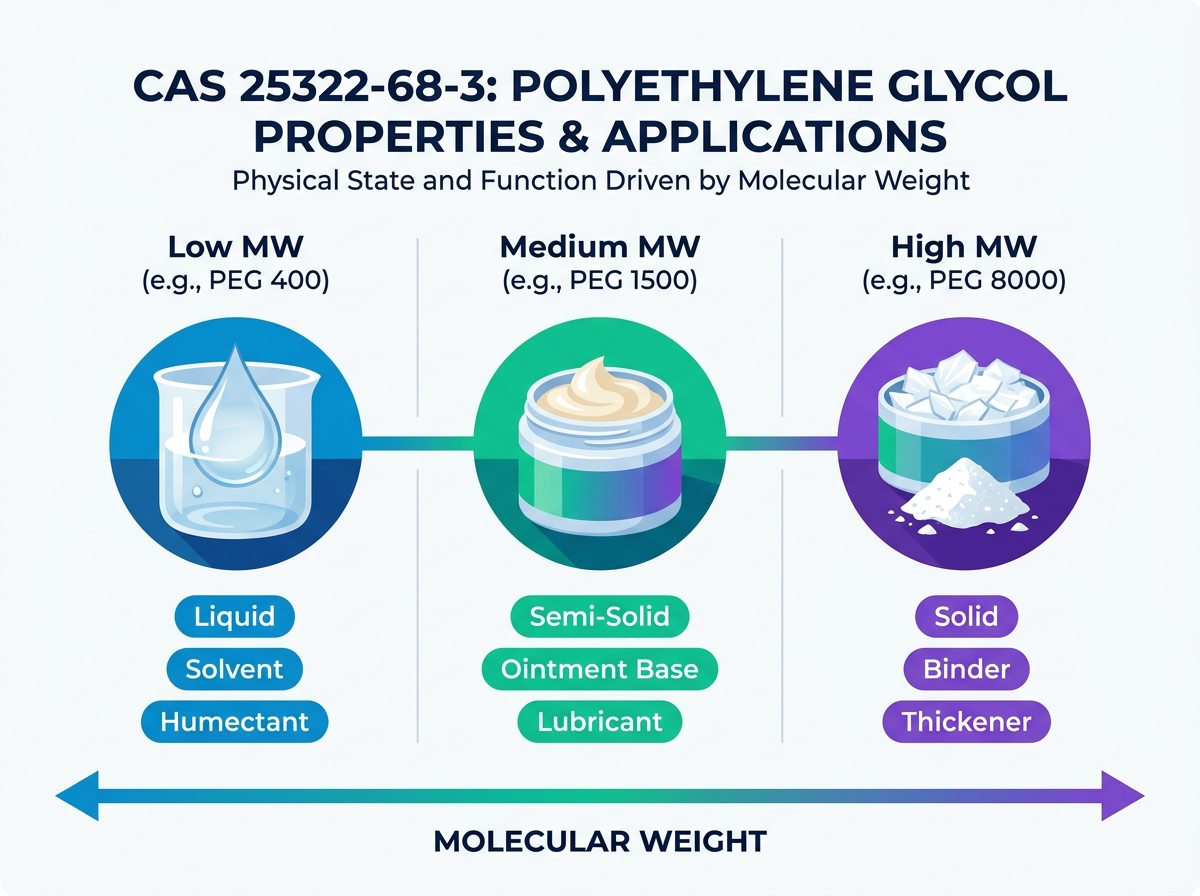
Because the chain length determines the physical state, you must classify these polymers by their average molecular weight (MW). We generally group them into three main categories.
These variants exist as clear, viscous liquids at room temperature. They are highly hygroscopic, meaning they readily absorb moisture from the surrounding air. Formulators often select them when they need powerful solvents or effective dispersion agents. They flow easily and blend seamlessly into aqueous solutions.
As the polymer chains lengthen, the material transitions into a pasty, semi-solid wax. These medium-weight grades melt at relatively low temperatures. They offer a unique balance of solubility and structural integrity. You will frequently see them used in topical ointments and specialized industrial coatings.
At the upper end of the spectrum, the polymers become hard, opaque, crystalline flakes or fine powders. They lose much of their hygroscopic nature. While they remain water-soluble, they dissolve much slower than their liquid counterparts. These robust grades provide excellent binding, thickening, and lubricating properties.
To accurately assess these polymers, formulators rely on Core Technical Data found in Technical Data Sheets (TDS). You must evaluate several key metrics to ensure formulation compatibility.
| TDS Indicator | Significance for Formulators |
|---|---|
| Hydroxyl Value | Inversely proportional to molecular weight. It serves as the primary analytical method to verify chain length. |
| pH (5% Aqueous) | Indicates the neutrality of the polymer. Typically ranges from 4.5 to 7.5. Crucial for active ingredient stability. |
| Freezing/Melting Point | Determines thermal stability limits and dictates manufacturing temperature requirements. |
| Kinematic Viscosity | Measures fluid resistance. Essential for scaling up pumping and mixing operations in liquid grades. |
The versatility of CAS 25322-68-3 allows it to cross multiple industrial boundaries. Let us examine how different sectors leverage its unique properties.
The pharmaceutical industry relies heavily on this polymer due to its proven safety profile. It primarily serves as an inactive ingredient, or excipient. It acts as a reliable solvent for poorly soluble drugs and functions as a stable API delivery vehicle. Two notable applications stand out in modern medicine:
Cosmetic formulators value the polymer for its structural enhancement capabilities. It functions beautifully as a moisture-stabilizer in high-end skincare lines. It prevents creams from separating under thermal stress. Furthermore, it acts as a gentle surfactant and a precision viscosity modifier. It gives lotions a smooth, luxurious skin feel without leaving a greasy residue.
Beyond human contact applications, the polymer acts as an industrial workhorse. Factories use it extensively as an intermediate binder for ceramics and metallurgy. It performs exceptionally well as a metalworking lubricant because it washes away completely with water. It also functions as an efficient anti-static agent in plastics.
Industrial scale-up requires careful grade selection. Technical-grade products suffice for heavy manufacturing, saving considerable costs. However, purified grades remain necessary if the industrial process involves sensitive catalytic reactions.
Choosing the right grade of CAS 25322-68-3 is rarely a simple guess. It requires a systematic approach to matching chemical properties with desired physical outcomes.
You must first define your success criteria. How do you translate formulation requirements into a specific grade request? If your primary goal involves rapidly dissolving an active chemical, you need the aggressive solubility of a low-molecular-weight liquid. If your goal is structural binding for a pressed tablet, you require the cohesive strength of a high-molecular-weight powder.
Formulators constantly navigate solubility trade-offs. As molecular weight increases, hygroscopicity decreases rapidly. The polymer also becomes significantly less soluble in organic solvents. However, this same increase in molecular weight dramatically enhances film-forming capabilities and dry lubricating power. You cannot maximize both ends of the spectrum simultaneously. You must pinpoint the exact molecular weight that balances these opposing forces for your specific product.
Chemical stability plays another vital role. While generally inert, the polymer does face compatibility challenges under extreme conditions. Below is a simplified compatibility matrix detailing how it behaves when mixed with various formulation environments.
| Formulation Environment | Compatibility & Risks | Best Practices |
|---|---|---|
| Strong Acids/Bases | Highly compatible. The ether bonds resist hydrolysis effectively. | Monitor pH shifts over long-term storage. |
| High Heat (>150°C) | Moderate risk. Potential for oxidative degradation. | Add antioxidants; use inert gas purging. |
| Organic Solvents | Variable. Excellent for low MW, poor for high MW. | Pre-test solubility at room temperature. |
| Reactive APIs | Generally inert. Low risk of cross-linking. | Verify peroxide limits in the PEG CoA. |
Regulatory bodies scrutinize the use of CAS 25322-68-3 intensely, especially in life science applications. You cannot assume all grades meet necessary safety thresholds.
Pharmacopeial standards dictate stringent evaluation criteria. To achieve USP (United States Pharmacopeia), EP (European Pharmacopoeia), or JP (Japanese Pharmacopoeia) compliance, a batch must pass rigorous impurity testing. Auditors look specifically for heavy metals and residual solvents. They also measure moisture content precisely. More importantly, they test for toxic manufacturing byproducts. Strict limits on ethylene oxide and 1,4-dioxane remain heavily enforced. These chemicals pose severe health risks, making pure grades an absolute necessity for human use.
From a Safety Data Sheet (SDS) context, the polymer maintains an excellent low-toxicity profile. It does not cause systemic poisoning under normal handling. However, distinct physical forms present specific localized hazards. Powdered grades (high MW) can generate fine dust. This dust poses inhalation risks and may cause mechanical lung irritation. Conversely, liquid grades (low MW) can cause mild eye irritation upon direct contact. Facility managers must implement appropriate personal protective equipment (PPE) based on the physical state.
Storage and stability protocols directly impact shelf life. The primary enemy of this polymer is oxidative degradation. When exposed to heat and oxygen over time, it can form hydroperoxides. To prevent this, you must implement strict temperature controls in your warehouse. For highly sensitive grades, suppliers often use inert gas purging (like nitrogen) before sealing the drums. When stored correctly in cool, dry, and dark conditions, you can expect a reliable shelf life of one to two years.
Sourcing reliable chemicals goes far beyond checking price tags. A flawed procurement strategy for CAS 25322-68-3 will eventually cause manufacturing bottlenecks.
Batch-to-batch consistency separates mature manufacturers from amateur operations. The most revealing metric here is the polydispersity index (PDI). PDI measures the breadth of the molecular weight distribution within a single batch. A narrow distribution means the polymer chains are nearly identical in length. This uniformity guarantees consistent melting points and reliable viscosity. If a supplier cannot control their PDI, your final product will perform unpredictably.
You must establish strict audit requirements before signing contracts. Do not accept generic specification sheets. Follow these exact steps when evaluating a new vendor:
Finally, assess supply chain scalability. Many boutique suppliers can produce flawless R&D sample quantities. However, they often fail to maintain that quality when transitioning to consistent commercial tonnage. Thermal gradients in massive industrial reactors can cause specification drift. Ask potential suppliers about their reactor capacities. Request case studies demonstrating their ability to scale up production without altering the PDI or introducing new impurities.
Sourcing CAS 25322-68-3 is clearly not a one-size-fits-all process. The vast differences between low-molecular-weight liquids and high-molecular-weight powders demand careful evaluation. It requires precise alignment between the target molecular weight, the required purity grade, and the specific end-use application.
Decision-makers must prioritize risk mitigation over minor cost savings. We advise you to prioritize suppliers who offer complete, transparent TDS and SDS documentation. Look for partners who provide verifiable compliance testing and possess a demonstrated history of batch-to-batch consistency. The stability of your final formulation depends entirely on the chemical integrity of your raw materials.
Take action today to secure your supply chain. We encourage you to request a product sample immediately. Compare their detailed CoAs directly against your internal formulation requirements. If you encounter any ambiguities, contact a technical specialist to determine the exact, optimal PEG grade required for your upcoming project.
A: No. CAS 25322-68-3 applies universally to the entire range of PEG homopolymers. It remains the same regardless of whether the specific grade is a liquid, wax, or solid molecular weight variant.
A: There is no chemical difference. "Macrogol" is simply the International Nonproprietary Name (INN) used in European pharmacopeias. It refers to the exact same chemical substance registered under CAS 25322-68-3.
A: They share an inverse relationship. Lower molecular weights yield higher hydroxyl values. Suppliers rely on measuring this hydroxyl value as their primary analytical method to confirm the average molecular weight of a batch.
A: Generally, no. Cosmetic and pharmaceutical applications require specific high-purity grades. These purified grades ensure strict adherence to limits on toxic manufacturing impurities like 1,4-dioxane. Technical grades usually lack this rigorous purification.
A: Standard stability timelines range from one to two years. However, this depends heavily on sealed, dry storage. Proper storage is necessary to prevent moisture absorption and auto-oxidation, which can degrade the polymer over time.


