
English
Views: 0 Author: Site Editor Publish Time: 2026-08-12 Origin: Site


Selecting the ideal surfactant is a high-stakes decision for any formulator. It directly dictates formulation stability, product efficacy, and strict regulatory compliance. One incorrect specification can easily compromise an entire production run. Today, many professionals rely heavily on generic supplier claims instead of demanding precise chemical data. This habit creates massive blind spots during procurement.
Enter CAS 69011-36-5, representing a broad family of branched and linear ethoxylated alcohols. This chemical category is immensely versatile but famously sensitive to specification variances. Our guide exists to help you navigate these complex formulation challenges. You will move past marketing jargon and adopt a rigid, evidence-based evaluation framework. We will show you exactly how to evaluate, shortlist, and rigorously test the absolute correct grade for your unique application.
Surfactants wear many hats in industrial chemistry. You must establish their primary function before evaluating any technical data sheets. Some ethoxylates excel at rapidly wetting hard surfaces. Others act primarily to stabilize fragile emulsions or disperse heavy solid particles. You must pinpoint this core duty first. If you need a powerful industrial degreaser, your chemical criteria will differ vastly from those of a delicate cosmetic emulsifier. Formulators often fail by expecting one surfactant grade to perform all functions perfectly.
Formulation environments are often harsh and unforgiving. You must define the exact conditions your finished product will face in the real world. Carefully evaluate these three critical variables:
Vague goals lead directly to formulation failure. You must identify strictly measurable outcomes for your initial evaluation stage. Establish rigid "pass/fail" metrics before ordering any samples. Measure the exact foam height profile over a five-minute window. Calculate the specific degreasing speed on standardized soiled panels. Record the precise surface tension reduction in dynes per centimeter. Concrete benchmarks separate superior chemical grades from mediocre substitutes.
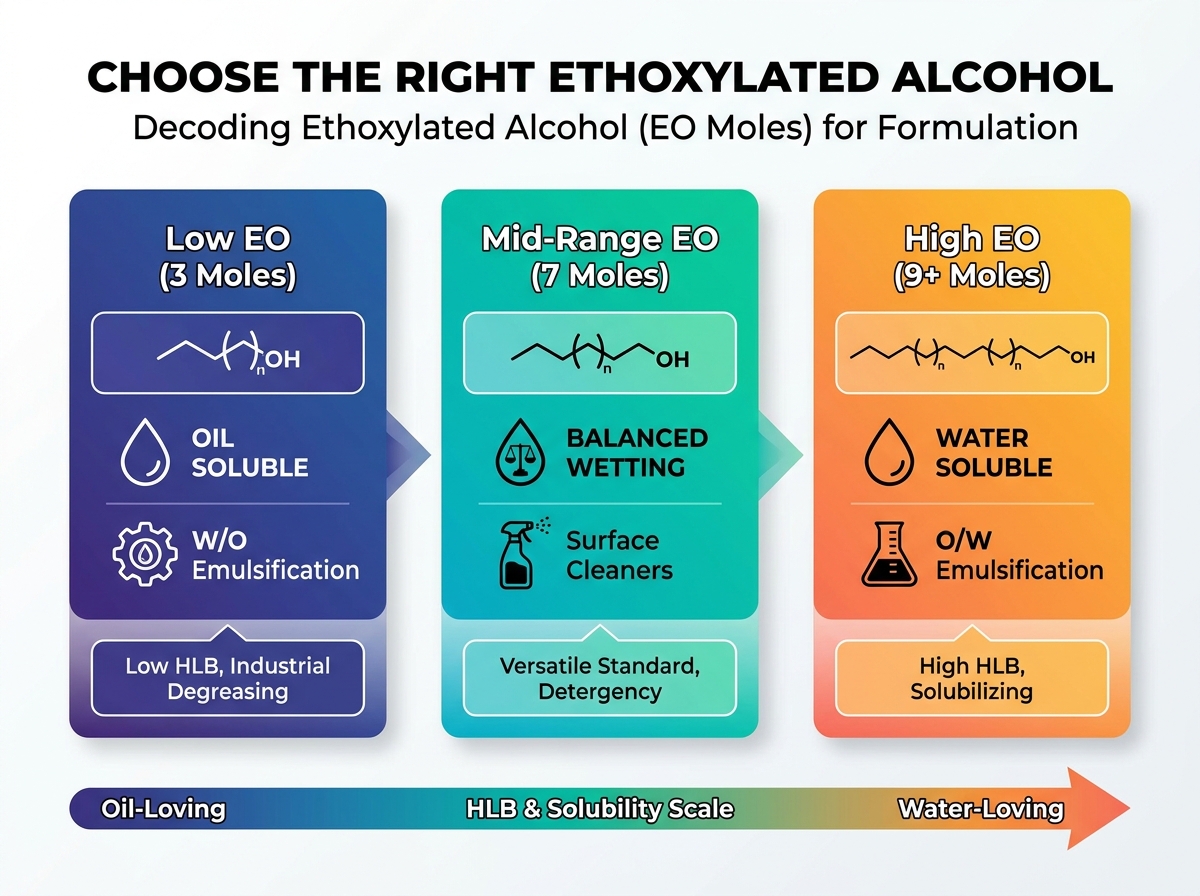
Ethylene oxide (EO) addition defines the hydrophilic nature of the molecule. Low EO variants, typically around 3 moles, possess a very short hydrophilic tail. Oil solubility dominates their physical behavior. They exhibit a correspondingly low Hydrophilic-Lipophilic Balance (HLB). Formulators rely heavily on them for water-in-oil (W/O) emulsification tasks. They also serve as vital chemical precursors for manufacturing sulfated industrial degreasers. You will rarely use them for direct water solubilization.
Moving up the scale, 7-mole variants offer incredible functional balance. They provide rapid wetting characteristics alongside powerful detergency. You will find these mid-range grades everywhere in modern household cleaners. They stand as the highly versatile standard for industrial and institutional (I&I) surface cleaning formulas. Their balanced HLB allows them to tackle both particulate soils and greasy residues effectively. They lift dirt efficiently without creating unmanageable foam levels.
High EO variants boast significant hydrophilic chains. Water solubility increases dramatically at this stage. They possess a highly elevated HLB value. Formulators select them specifically for oil-in-water (O/W) emulsions. They excel in high-temperature detergency environments where lower EO grades would fail. You can also deploy them to solubilize complex fragrance oils or botanical essential oils into clear aqueous solutions. They act as exceptional stabilizers in complex chemical mixtures.
| EO Mole Count | Primary Solubility | HLB Range (Typical) | Best Suited Applications |
|---|---|---|---|
| 3 Moles | Oil Soluble | 7.0 - 9.0 | W/O Emulsions, Defoamers, Synthetic Precursors |
| 7 Moles | Dispersible / Soluble | 11.0 - 12.5 | Surface Cleaners, I&I Detergents, Fast Wetting |
| 9+ Moles | Highly Water Soluble | 13.0 - 15.0+ | O/W Emulsions, High-Temp Cleaning, Fragrance Solubilization |
The HLB system remains your most crucial guiding metric. You must strictly match this numerical value to the specific oil phase of your formula. An unmatched HLB guarantees disastrous emulsion separation over time. Use Griffin's calculation method to establish your required baseline. When evaluating CAS 69011-36-5 derivatives, exacting HLB alignment prevents costly phase separation. Do not guess these values; calculate them precisely.
Heating surfactant solutions fundamentally changes their physical clarity. The cloud point marks the exact temperature where a clear solution suddenly becomes turbid. Evaluating this threshold is completely non-negotiable for high-temperature applications. Above their specific cloud point, ethoxylated alcohols lose their critical water solubility. They undergo phase inversion and begin acting as defoamers rather than effective detergents. You must ensure your operating temperature remains safely below the surfactant's cloud point.
The hydrophobe portion of the molecule also demands strict scrutiny. You face immediate performance trade-offs regarding carbon chain length.
Room temperature appearance dictates your manufacturing logistics. You must carefully evaluate whether the specific grade is a pourable liquid, a thick paste, or a hard waxy solid. Match this physical state directly to your existing mixing infrastructure. Pumping a solid grade through unheated pipes will destroy your equipment. Solid ethoxylates require heated bulk storage and specialized melting apparatuses before formulation can even begin.
The chemical ethoxylation process inherently generates trace impurities. 1,4-dioxane stands as the most notorious and heavily regulated byproduct. Global regulatory bodies classify it as a probable human carcinogen. You must aggressively demand low-dioxane variants from all potential suppliers. Vacuum-stripped grades effectively mitigate severe health concerns. Utilizing highly purified surfactants protects your brand reputation and shields your enterprise from devastating regulatory fines.
Basic compliance extends far beyond single impurities. You must proactively verify REACH registration if you intend to access European markets. Look for verified EPA Safer Choice listings when formulating for North American consumers. Regional ecological mandates often dictate strict wastewater discharge limits. Secure all relevant compliance certifications before commencing any expensive bench trials. Ignoring these frameworks guarantees massive product launch delays.
Greenwashing remains rampant across chemical marketing materials. You must cross-reference all supplier sustainability claims against rigorous, standardized testing protocols. The OECD 301 testing series serves as the global gold standard for assessing ready biodegradability. Scrutinize the aquatic toxicity data carefully. You must ensure your final product runoff does not damage fragile marine ecosystems or disrupt local municipal water treatment facilities.
Diluting ethoxylated alcohols requires immense caution and precise technique. Adding water indiscriminately often triggers the formation of highly viscous, unmixable liquid crystal gels. You must plan and enforce specific dilution sequences on the factory floor. Always add the concentrated surfactant slowly to warm, agitated water. Never add cold water directly into the bulk surfactant. Breaking a severe gel phase requires massive shear force and wastes valuable production time.
Winter logistics present severe handling challenges for bulk chemicals. Higher-EO grades readily solidify or stratify during cold ambient temperatures. You must assess your facility's environmental heating capabilities early in the project. You might require heated bulk storage tanks, drum warming blankets, or heat-traced transfer lines to maintain flowability. Failing to account for winterization leads to delayed batches and damaged pumping equipment.
Surfactants rarely operate in isolation. You must validate physical stability across your entire ingredient deck. Test the ethoxylate alongside strong anionic surfactants, highly alkaline builders, and aggressive solvents. Expose the finalized formula to extreme hard water environments. High concentrations of calcium and magnesium ions frequently disrupt delicate surfactant micelle networks. Rigorous stress testing ensures a long, stable product shelf life.
Technical documents instantly reveal a supplier's true manufacturing reliability. Reject any vendors who obscure exact carbon chain distributions on their Technical Data Sheets (TDS). Ambiguous or excessively broad EO ranges signal poor internal quality control. You require precise, batch-specific analytical metrics. A reputable manufacturer will readily provide narrow specification limits and comprehensive analytical methodologies.
Always request small lab-scale samples before committing to bulk drums. Test these samples rigorously to verify batch-to-batch consistency. Analyze the chemical odor profile thoroughly; foul organic odors will ruin consumer goods instantly. Check the visual color using the APHA or Hazen scale to guarantee aesthetic compatibility. Small-scale vetting prevents massive financial losses later in the production cycle.
Feedstock origins matter immensely to your bottom line. Evaluate whether the vendor utilizes synthetic petrochemicals or natural oleochemicals to build the carbon chain. This sourcing choice impacts direct price volatility. It also dictates long-term lead times during inevitable global supply chain disruptions. Diversifying your approved vendor list across different feedstock origins provides excellent operational security.
Selecting the right ethoxylated alcohol requires balancing precise HLB targeting, strict compliance verification, and practical factory handling. You cannot treat these complex chemicals as interchangeable commodities. Success demands a rigorous, evidence-based approach to procurement.
We highly encourage formulators and procurement teams to initiate supplier conversations armed with precise physical parameters. Discard generic requests. Contact a technical sales representative today to request a detailed TDS and schedule a tailored grade matching consultation.
A: Lauryl alcohol ethoxylate utilizes a highly specific, narrow carbon chain cut (primarily C12). It offers highly predictable foaming and wetting behavior. Generic fatty alcohol ethoxylates use broader, mixed carbon cuts (like C12-C15). They are usually more economical but exhibit wider performance variances across different batches.
A: You must strictly control the mixing order and temperature. Always add the concentrated surfactant slowly into warm, well-agitated water. Never pour cold water directly into the surfactant concentrate. Maintaining the water temperature above the surfactant's gel phase threshold prevents these viscous formations.
A: Yes, they are generally safe for consumer goods, but safety hinges entirely on manufacturing purification. The ethoxylation process creates 1,4-dioxane as a byproduct. You must specifically source vacuum-stripped grades that remove this trace impurity to meet modern health and environmental safety standards.
A: No, direct substitution usually fails. A 7-mole variant has a significantly lower HLB and different water solubility characteristics compared to a 9-mole variant. Swapping them without recalibrating the rest of the formula will likely cause emulsion separation or severe performance drops.


