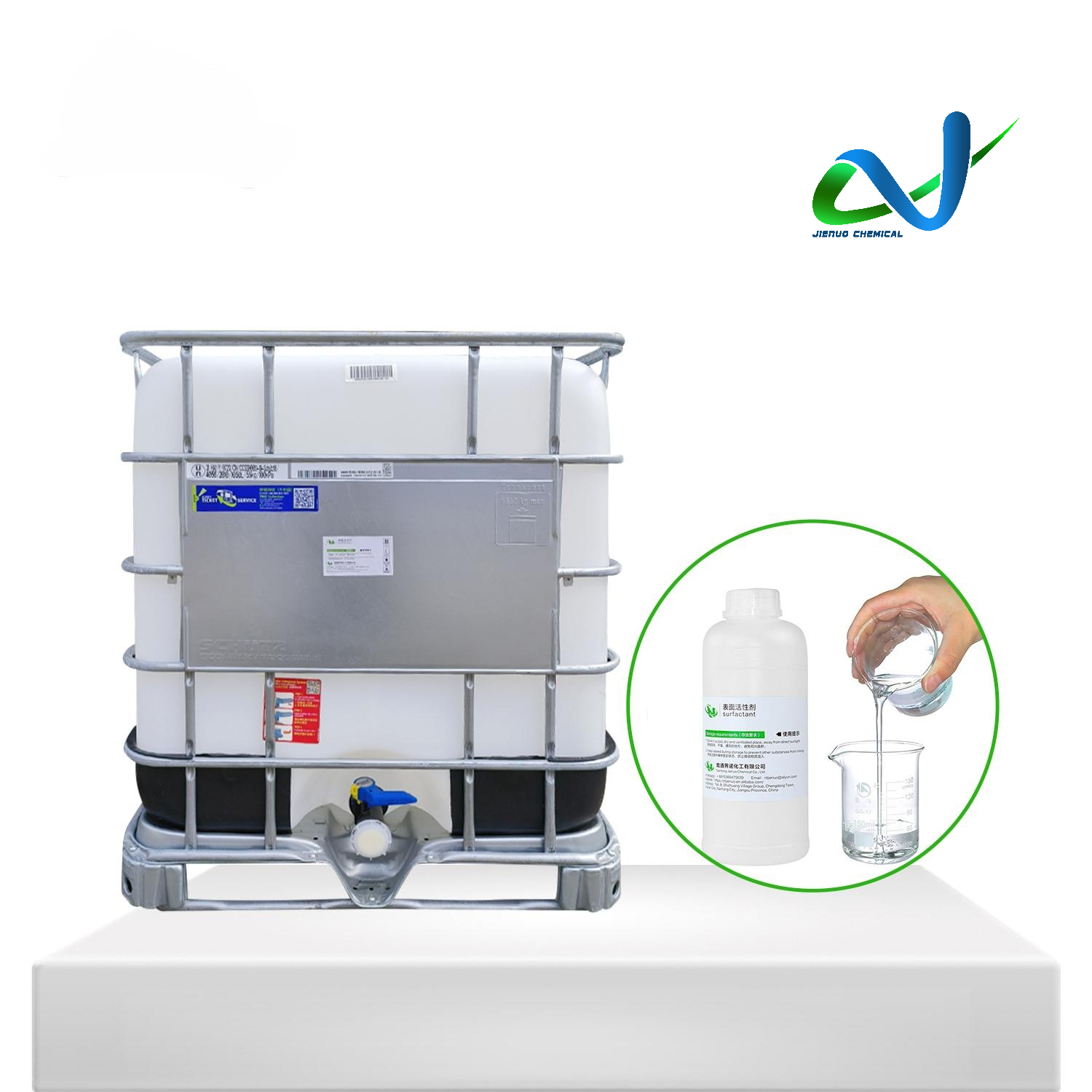
Isotridecyl alcohol polyoxyethylene ether E-1306, a non - ionic surfactant, usually appears as a colorless to light yellow liquid at room temperature. It features good wettability, permeability, and emulsifying ability.
E - 1306 can be easily dispersed or dissolved in water. In the textile and leather industries, it acts as a component in degreasing agents, detergents, emulsifiers, and scouring agents. It also has an excellent emulsifying effect on amino - silicone oil and dimethyl - silicone oil. Besides, it can be used in metal processing aids, detergents, and cleaning agents. What's more, being free of benzene ring structure, it is environmentally friendly.
Product Advantage
1. Exceptional Surface Activity with Proven Efficiency
Isotridecyl Alcohol Ethoxylate E1306 exhibits outstanding surface activity, with a critical micelle concentration (CMC) as low as 0.02-0.05 g/L. This low CMC enables it to reduce surface tension of water from 72 mN/m to 30-35 mN/m at a minimal dosage (0.1-0.5%), ensuring strong wetting and penetration. In textile scouring tests, it improves fiber cleaning efficiency by 30% compared to conventional surfactants, shortening processing time while maintaining product quality.
2. Stable Emulsification for Silicone Oils & Industrial Formulations
With a hydrophilic-lipophilic balance (HLB) value of 13-14, this surfactant delivers superior emulsifying performance for amino-silicone oil and dimethyl-silicone oil. Laboratory data shows it forms stable emulsions (particle size <1 μm) that remain uniform for over 6 months without layering. It also enhances the stability of industrial detergent formulations, resisting pH changes (3-11) and high temperatures (up to 80°C), making it suitable for harsh processing environments.
3. Eco-Friendly Composition with Regulatory Compliance
Free of benzene ring structures and APEO (alkylphenol ethoxylates), Isotridecyl Alcohol Ethoxylate E1306 meets global environmental standards, including EU REACH and US EPA requirements. Its biodegradability rate reaches over 90% within 28 days (per OECD 301B test), minimizing environmental impact. Additionally, it has a low acute oral toxicity (LD50 >5000 mg/kg in rats), ensuring safe handling for operators.
4. High Purity & Consistent Quality for Reliable Production
Our product maintains a purity level of ≥99%, with minimal impurities (moisture content <0.1%, ash content <0.05%) verified by ISO 9001-certified quality control processes. Each batch undergoes strict testing, with a quality consistency rate of 99.8% over the past 5 years. This high purity prevents formulation defects, reducing production waste by 15% for customers and ensuring stable performance across different application scenarios.
5. Versatile Compatibility & Customizable Solutions
Isotridecyl Alcohol Ethoxylate E1306 is highly compatible with anionic, cationic, and other non-ionic surfactants, as well as common industrial additives (e.g., chelating agents, solvents). It can be tailored to specific customer needs—we offer adjustable ethoxylation degrees (6-12 moles) and concentration grades (30%-100%), supporting diverse applications from textile finishing to metal degreasing. Our technical team provides 24/7 support to optimize formulations for clients.
Technical Parameters
Parameter Category | Parameter Name | Specification Value |
Physical Properties | Appearance (25°C) | Colorless to light yellow transparent liquid |
| Hydroxyl value(mgKOH/g) | 120±5 |
| Density (20°C, g/cm³) | 0.920 - 0.950 |
| Viscosity (25°C, mPa·s) | 80 - 150 |
| Flash Point (Closed Cup, °C) | ≥ 180 |
| Water Solubility (25°C) | Miscible with water in any proportion |
Chemical Properties | Active Matter Content (%) | ≥ 99.0 |
| Moisture Content (%) | ≤ 0.10 |
| Ash Content (%) | ≤ 0.05 |
| pH Value (1% Aqueous Solution) | 6.0 - 8.0 |
| HLB Value | 13.0 - 14.0 |
Performance Indicators | Critical Micelle Concentration (CMC, g/L) | 0.02 - 0.05 |
| Surface Tension (0.1% Aqueous Solution, 25°C, mN/m) | 30.0 - 35.0 |
| Biodegradability (28 Days, %) | ≥ 90.0 |
| Acute Oral Toxicity (LD50, Rat) | > 5000 mg/kg |
Product Uses
1. Textile Industry
As a key component in scouring agents and finishing auxiliaries, it efficiently removes impurities (wax, oil) from cotton, polyester, and blended fibers. Its low CMC ensures thorough penetration, improving fabric whiteness by 20%+; it also stabilizes amino-silicone oil emulsions for soft, smooth fabric handfeel.
2. Leather Processing
Applied in degreasing and soaking processes, it dissolves excess fat in raw hides without damaging collagen fibers. Its pH stability (3-11) adapts to acidic/alkaline leather baths, enhancing dye absorption uniformity and reducing leather defects like color spots.
3. Metalworking
Used in water-based metal cleaners and coolants, it penetrates and lifts cutting oil, rust, and debris from metal surfaces. With high-temperature resistance (up to 80°C), it maintains performance in machining, preventing tool wear and improving workpiece precision.
4. Daily Chemical & Detergent Industry
Blended into industrial detergents (for machinery, pipelines), it boosts dirt-removing power, especially for oil-based stains. Being APEO-free, it meets green detergent standards, suitable for low-irritation household cleaning products (e.g., dishwashing liquids) too.
5. Coatings & Adhesives
Acts as a wetting agent in water-based coatings, reducing surface tension to ensure uniform substrate coverage, avoiding pinholes or orange peel. It also stabilizes pigment emulsions in adhesives, extending shelf life and enhancing bonding strength.
Product Operate Guide
1、Addition Method: Add to water or formulations at 20-40°C (avoid high temps >80°C). Stir gently for 5-10 mins until fully dissolved (miscible with water in any ratio).
2、Dosage: Use 0.1-0.5% for textile scouring, 0.3-1% for metal cleaning, 0.2-0.8% for detergents (adjust based on specific needs).
Notes: Store in a cool, dry place. Avoid mixing with strong acids/bases directly. Test a small batch first for new formulations.
FAQ
1. How long can the product be stored, and will it deteriorate?
It has a 24-month shelf life when stored in sealed containers in a cool, dry place (5-30°C). Avoid direct sunlight—if it becomes slightly cloudy, stir gently; it won't affect performance.
2. Can it be mixed with anionic surfactants like sodium lauryl sulfate?
Yes, it's highly compatible with anionic, cationic, and other non-ionic surfactants. Mix in small batches first to ensure no precipitation, then scale up for formulations.
3. What if the wetting effect is poor in textile scouring?
Check if the dosage is ≥0.1% and the water temperature is 20-40°C. Increase dosage by 0.1-0.2% or extend stirring time by 5 mins—this usually improves wetting and penetration.
4. Is it safe to handle, and do I need protective gear?
It's low-toxic (LD50 >5000 mg/kg), but wear gloves and goggles when handling large quantities. If it contacts skin, rinse with water immediately; no serious irritation will occur.
5. Can it be used in high-temperature (over 80°C) processes?
No, high temps (>80°C) may reduce its surface activity. For high-temperature scenarios, pre-dissolve it at 20-40°C first, then add to the high-temperature system slowly.