
English
Views: 0 Author: Site Editor Publish Time: 2026-07-29 Origin: Site


For decades, the biomanufacturing industry relied heavily on one specific nonionic surfactant for cell lysis and protein extraction. We know this gold standard as CAS 9002-93-1, widely recognized under trade names like Triton™ X-100. It delivered unparalleled performance in permeabilizing membranes while preserving delicate protein structures.
However, the global landscape is shifting rapidly. Regulatory bodies now classify its degradation byproducts as severe endocrine-disrupting compounds. The European Union formally added it to the REACH SVHC authorization list. This designation forces bioprocess engineers and lab managers to confront a critical business problem. You must find compliant substitutes quickly. Failing to transition risks process shutdowns and massive regulatory penalties.
This article provides a rigorous, evidence-based framework for evaluating alternatives. You will learn how to compare replacements against the historical baseline. We will guide you through matching critical physicochemical properties. You will discover how to transition to sustainable, GMP-grade substitutes effectively without compromising downstream yields.
Before switching reagents, you must understand exactly why CAS 9002-93-1 works so well. Establish clear baseline parameters for your current workflows. This step prevents wasted time during alternative screening. Let us examine the technical benchmarks making this surfactant exceptionally successful.
You must evaluate three primary technical dimensions before abandoning your current protocols.
Finding a reliable replacement poses immense technical difficulties. Viable alternatives must approximate these exact structural properties. Any significant deviation forces a complete protocol redesign. A substitute lacking a matching HLB will fail to solubilize target lipids. A replacement possessing a higher CMC will require much larger chemical volumes. You cannot simply swap reagents. You must engineer a comprehensive transition strategy.
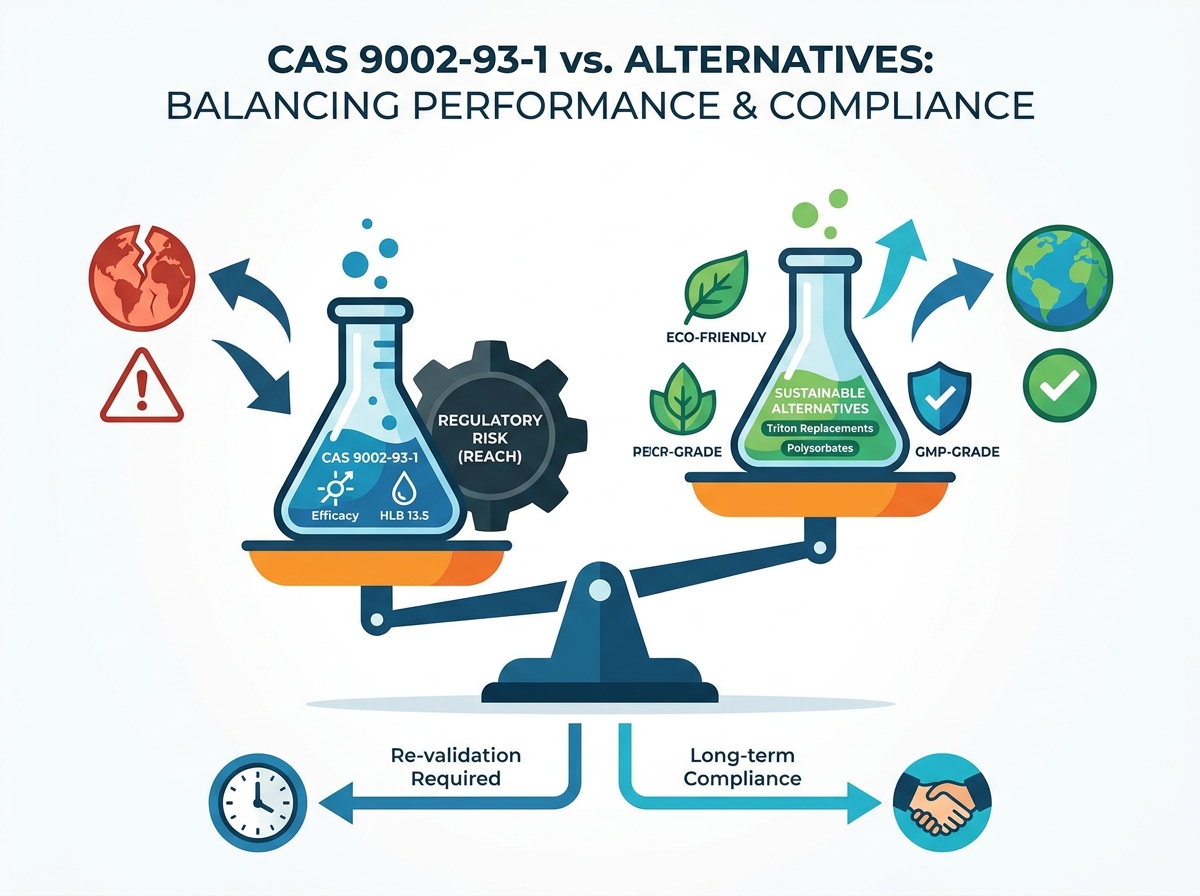
The transition away from legacy surfactants is not merely a trend. Enforceable international laws now dictate chemical procurement strategies. We must examine the precise legal mechanisms driving this industry shift.
Regulatory agencies identified severe environmental issues tied to legacy surfactant disposal. When CAS 9002-93-1 degrades in aquatic systems, it forms 4-(1,1,3,3-tetramethylbutyl)phenol. Authorities classify this specific byproduct as an aggressive endocrine disruptor. It severely impacts reproductive systems in aquatic life.
Consequently, the European Chemicals Agency (ECHA) took decisive action. They placed this chemical compound on the REACH Authorization List (Annex XIV). Manufacturers cannot use it for commercial production in Europe without highly restricted exemptions. This regulatory action essentially bans its use in large-scale biomanufacturing across the continent.
You will encounter different regulatory landscapes depending on your location. Some jurisdictions still permit limited R&D usage. Basic academic laboratories might evade immediate penalties. However, commercial scaling faces universal barriers. GMP manufacturing requires strict environmental compliance everywhere. Global pharmaceutical supply chains cannot accommodate split protocols for different regions. Standardizing on compliant alternatives is mandatory for multinational organizations.
Modern safety assessments penalize continued usage heavily. Governmental environmental limits restrict wastewater discharges strictly. Cosmetic ingredient reviews parallel these findings closely. They demand rapid biodegradability and entirely non-toxic degradation paths. Scalable applications simply cannot rely on environmentally hazardous chemistry anymore. You risk immense legal exposure by ignoring these established toxicological thresholds.
Procurement and engineering teams face a crowded marketplace of replacement options. We can divide these options into three distinct categories. Each category presents specific operational trade-offs.
These chemicals share a nearly identical molecular backbone with legacy reagents. They mimic the original performance metrics almost perfectly.
Chemical manufacturers developed specialized blends like TERGITOL™ 15-S-9, Nereid, and Ecophen. They engineered these products specifically to address environmental mandates.
Biopharma extensively uses reagents like Tween 20, Tween 80, and various Brij formulations. They represent the safest, most established class of detergents.
Use the following table to quickly assess which category fits your specific processing requirements.
| Solution Category | Examples | Lysis Efficacy Match | Regulatory Viability | Analytical Impact |
|---|---|---|---|---|
| Category 1: APEs | IGEPAL CA-630, Nonidet P-40 | High (Nearly Identical) | Poor (Pending Bans) | Low (Matches Baseline) |
| Category 2: Eco-Friendly | TERGITOL™ 15-S-9, Ecophen | High (Optimized) | Excellent (Compliant) | High (UV recalibration needed) |
| Category 3: Polysorbates | Tween 20, Tween 80, Brij-35 | Moderate (Requires adjustment) | Excellent (GMP Standard) | Low to Moderate |
Selecting the right substitute requires moving beyond theoretical chemical properties. You must evaluate how these alternatives perform under rigorous, real-world manufacturing conditions.
The primary function of any nonionic surfactant is cell disruption. You must assess how alternatives perform in real-world mammalian and bacterial cell lysis. CAS 9002-93-1 achieved optimal permeabilization rapidly. Eco-friendly alternatives often require extended incubation times.
Watch out for target protein aggregation. Some milder substitutes fail to keep hydrophobic membrane proteins in solution. If the micelles are unstable, proteins crash out of the buffer. You must perform Native PAGE or size-exclusion chromatography during screening. These tests verify the structural integrity of your target molecules remains intact after extraction.
Downstream processing relies heavily on analytical assays. You must determine whether the substitute interferes with these critical tests. As mentioned earlier, UV spectroscopy at 280 nm is particularly vulnerable. Legacy reagents possess an aromatic ring absorbing light at this wavelength.
Eco-friendly alternatives lack this ring. The background noise drops significantly. While this actually improves assay sensitivity, it breaks established baseline calculations. Furthermore, you must test compatibility across mass spectrometry and colorimetric assays like BCA or Bradford. High concentrations of polysorbates frequently skew colorimetric readouts. Engineers must run blank-buffer comparisons to establish new standard curves.
A successful R&D run means nothing if you cannot scale it. You must evaluate whether chemical manufacturers produce the alternative at commercial scale under cGMP conditions. Regulatory filings require exhaustive documentation tracing chemical origins.
Lot-to-lot consistency is paramount for viral inactivation steps in biomanufacturing. Minor impurities in non-GMP grade surfactants can derail an entire downstream purification train. Always audit the supplier. Verify their manufacturing capacity can support your projected commercial volumes. Demand robust Certificates of Analysis (CoA) confirming stable CMC and HLB parameters across multiple batches.
Executing a chemical swap in a highly regulated environment is complex. You cannot approach this as a simple purchasing decision. It requires a coordinated engineering effort.
We must acknowledge a hard truth regarding bioprocessing. Switching surfactants in validated processes requires extensive comparability studies. Regulatory bodies demand proof demonstrating product equivalence. You will need to file amendments for existing biologics license applications.
This validation pipeline takes time. Analytical teams must validate clearance assays ensuring the new detergent washes out entirely. Viral clearance studies must be repeated using the new chemical agent. Plan for a transition period lasting several months. Do not wait until your legacy stockpile depletes to begin validation.
Changing away from CAS 9002-93-1 frequently requires tweaking core operating parameters. You may need to adjust buffer formulations entirely. The new detergent might exhibit a different cloud point. If your process operates near this temperature threshold, the surfactant will phase-separate.
Viscosity changes present another common engineering hurdle. Polysorbates often increase fluid viscosity at high concentrations. This pressure strains filtration membranes and chromatography columns. You must recalibrate pump speeds and adjust temperature controls to maintain optimal flow rates. Expect to alter incubation times to achieve historical lysis yields.
Never implement a substitute directly at pilot scale. We strongly recommend starting with small-scale parallel screening. Utilize Design of Experiments (DoE) methodologies. A robust DoE framework helps identify the optimal alternative concentration quickly.
Test multiple variables simultaneously. Evaluate temperature, buffer pH, and detergent concentration in a matrix format. This statistical approach prevents costly failures in the bioreactor. Once the DoE identifies the sweet spot, you can scale confidently. This deliberate, data-driven methodology minimizes transition risks effectively.
The biomanufacturing industry stands at a critical regulatory crossroads. Adhering to historical practices carries unacceptable legal and operational risks.
Your path forward depends entirely on your operational scope. If compliance is not an immediate factor, such as in basic academic R&D, CAS 9002-93-1 remains a reliable standard. However, this window is closing rapidly. For clinical phases, commercial biomanufacturing, or any EU-regulated markets, migrating to an eco-friendly surfactant is absolutely mandatory.
Take immediate action to secure your operational future. We advise procurement and lab teams to execute the following steps:
By treating this transition as a strategic engineering upgrade, you ensure long-term compliance while maintaining absolute product quality.
A: CAS 9002-93-1 defines the specific chemical polymer (polyethylene glycol tert-octylphenyl ether). Discrepancies often occur because suppliers use overlapping CAS numbers for slightly different chain lengths, related generic classes (octoxynols), or proprietary blends. Always verify the exact molecular weight and chain length on the provided Certificate of Analysis (CoA).
A: Rarely. Because molecular weights and Critical Micelle Concentrations (CMCs) differ across chemical families, a direct 1:1 volume or weight swap often yields different functional results. You must optimize the new concentration experimentally to match historical lysis or viral clearance yields.
A: The REACH regulation bans its unauthorized use in large-scale manufacturing and commercial processes within the EU. However, it does not ban it entirely. Specific exemptions exist for certain in vitro diagnostic (IVD) manufacturing applications, but these require stringent reporting and eventual phase-out plans.
A: Yes. CAS 9002-93-1 contains an aromatic ring that absorbs UV light heavily at 280 nm. Many modern eco-friendly alternatives lack this chemical ring. This actually improves UV assay accuracy by significantly reducing background noise. However, you must recalibrate all established baseline protocols to account for this change.


