
English
Views: 0 Author: Site Editor Publish Time: 2026-07-25 Origin: Site


Formulating high-performance cleaners and industrial solutions is a demanding process. Selecting the right surfactant or chemical intermediate requires balancing wetting performance, foaming profiles, and regulatory compliance. Minor formulation tweaks can drastically alter a product. This guide compares the specific functional advantages of the C8-C10 alcohol ethoxy compound against standard unethoxylated fatty alcohols, such as cetyl or stearyl variants. We also evaluate it alongside longer-chain ethoxylates, like C12-C14, to highlight critical functional differences. Making the correct chemical choice directly impacts your overall application efficiency. It also influences cost-in-use and long-term product stability at scale. By understanding these structural nuances, you can streamline production and ensure your final formulas meet stringent industry demands without sacrificing field performance.
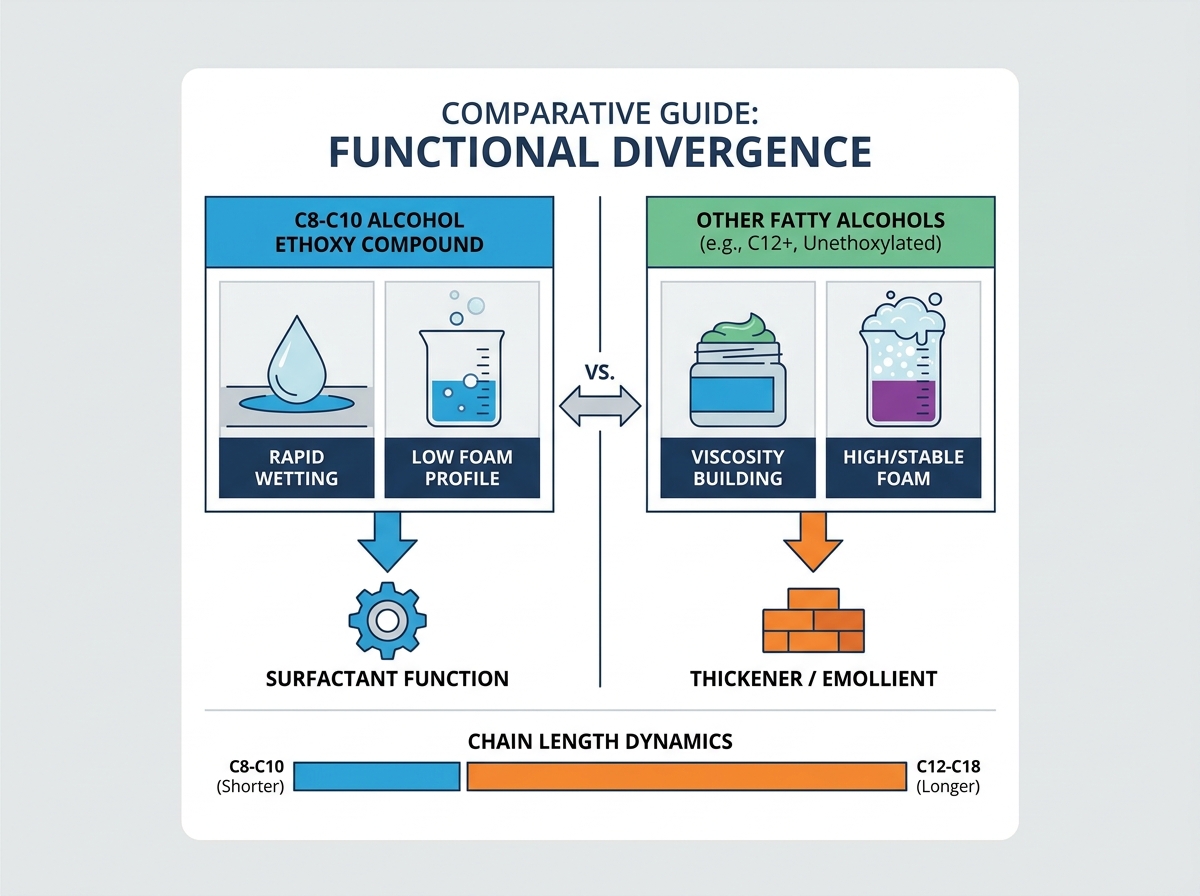
The carbon backbone of a chemical dictates its fundamental behavior. A C8-C10 alcohol ethoxy compound features a shorter carbon chain containing eight to ten carbon atoms. This shorter structure inherently dictates a lower molecular weight. It alters the overall hydrophobicity of the molecule. Longer-chain fatty alcohols, ranging from C12 to C18, remain highly hydrophobic and dense. They behave differently in aqueous environments. The reduced chain length of C8-C10 variations allows them to move faster to interfaces. They pack less tightly than heavier alternatives. This structural mobility forms the basis for their rapid action in diverse formulations.
Reacting a base C8-C10 alcohol with ethylene oxide (EO) transforms it completely. Base fatty alcohols act as simple structural ingredients. Formulators primarily use them as thickeners or stabilizers in emulsions. Adding EO shifts the compound from a passive structural component to a highly active surface-tension-reducing agent. The ethoxylation process attaches hydrophilic chains to the hydrophobic carbon tail. This dual nature creates a nonionic surfactant. It pulls water and oil interfaces together effectively. Unethoxylated alcohols simply cannot bridge this gap. Ethoxylation unlocks the cleaning and wetting potential hidden within the raw carbon chain.
Formulators rely heavily on the HLB system to predict surfactant behavior. Varying the moles of ethylene oxide on a C8-C10 base allows precise HLB customization. You can dial in specific water solubility for your exact needs. Adding fewer EO moles keeps the HLB low, creating oil-soluble variants. Attaching more EO moles pushes the HLB higher, resulting in excellent water solubility. Standard unethoxylated alcohols lack this flexibility entirely. They offer a fixed, extremely low HLB. The ability to customize the EO count gives you immense control over phase stability and micelle formation in complex mixtures.
Dynamic surface tension measures how quickly a surfactant works under active conditions. This metric matters deeply for high-speed applications. A C8-C10 alcohol ethoxy compound excels here. It lowers dynamic surface tension incredibly fast. Agricultural adjuvants rely on this speed. Spray droplets must spread across a leaf surface instantly before bouncing off. Hard surface cleaners also benefit from rapid penetration. The shorter carbon chain migrates to newly formed interfaces quicker than bulkier C12-C14 molecules. If your process requires rapid wetting, short-chain ethoxylates remain the superior choice.
Foam generation dictates surfactant suitability in mechanical systems. Longer-chain ethoxylates (C12-C14) generate high, dense, and highly stable foam. While desirable for hand dishwashing, this foam wreaks havoc in industrial machinery. C8-C10 ethoxylates generate low-to-moderate, unstable foam. The bubbles break and collapse rapidly. The shorter hydrophobic tail simply cannot sustain a rigid foam wall. This characteristic makes them perfect for applications needing foam control. You often avoid adding expensive defoamers entirely.
Comparison of Surfactant Performance Profiles
| Surfactant Type | Wetting Speed | Foam Stability | Primary Function |
|---|---|---|---|
| C8-C10 Ethoxylates | Extremely Fast | Low / Unstable | Rapid wetting, hard surface cleaning |
| C12-C14 Ethoxylates | Moderate | High / Stable | Emulsification, high-foam detergents |
| Unethoxylated Cetyl Alcohol | Poor (Insoluble) | None (Suppresses) | Viscosity building, emollience |
Detergency requirements dictate chain length selection. Longer-chain alcohols perform best when emulsifying heavy, oily greases. They form robust micelles around large lipid molecules. Conversely, a C8-C10 compound excels at penetrating particulate soils. It slips into microscopic crevices on hard surfaces. It lifts dirt, clay, and grime quickly. Furthermore, shorter chains rinse away easily. They leave absolutely no sticky residue behind. You should match the surfactant chain to the specific soil target. Use shorter chains for fast particulate removal and longer chains for heavy degreasing.
Industrial environments rely heavily on mechanical action. Clean-in-Place (CIP) systems, spray washes, and automated scrubbers agitate liquids violently. High mechanical action creates massive foam if you use the wrong chemistry. We justify using C8-C10 ethoxylates here because foam must remain minimized. Excess foam causes pump cavitation and prolongs rinse cycles. By integrating a C8-C10 alcohol ethoxy compound, you maintain high detergency while controlling suds. Facility managers save water and reduce downtime.
You rarely find C8-C10 ethoxylates in luxury personal care formulations. The cosmetics space operates on different rules. Unethoxylated long-chain fatty alcohols, like cetyl and stearyl alcohol, remain the golden standard here. Lotions and creams require structural integrity. They need viscosity building and rich emollience. Shorter-chain ethoxylates behave too aggressively for leave-on skin products. They strip lipids rather than condition the skin. Formulators correctly reserve C8-C10 chemistry for robust cleaning rather than gentle cosmetic conditioning.
Agriculture and textile processing share a common challenge. Both industries must wet highly hydrophobic surfaces quickly. Plant leaves possess waxy cuticles. Raw fabrics contain natural oils resisting water. A C8-C10 advantage shines here. It provides instant wetting on these difficult substrates. Agricultural sprays spread evenly, improving active ingredient uptake. In textiles, raw cotton wets out uniformly during pretreatment. Crucially, these short-chain molecules wash out easily. They do not inhibit or interfere with downstream dyeing or finishing processes.
Diluting ethoxylates requires strict engineering controls. Many ethoxylates tend to form highly viscous gel phases upon water dilution. These liquid crystal phases can instantly clog pipes, pumps, and mixing vessels. Breaking these gels wastes immense time and energy. You must follow proper handling procedures to avoid this risk completely.
Modern regulatory landscapes demand excellent environmental profiles. We evaluate the environmental breakdown of chemicals using standard frameworks like OECD 301. C8-C10 compounds generally offer rapid biodegradability. Environmental bacteria metabolize the shorter carbon chains efficiently. They break down much faster than heavier synthetic alternatives. Furthermore, their aquatic toxicity profile often proves favorable compared to branched or aromatic nonylphenol ethoxylates (NPEs). Formulators designing products for stringent eco-labels lean heavily on these short-chain options to pass environmental audits.
Any ethoxylated compound carries an inherent manufacturing risk. The ethoxylation process can generate trace amounts of 1,4-dioxane as a byproduct. Global regulations now strictly limit 1,4-dioxane levels in finished goods. You must mitigate this risk through careful procurement. Always source from manufacturers employing strict vacuum stripping processes. Vacuum stripping effectively removes this volatile byproduct before the chemical ships. Requesting detailed Certificates of Analysis (COA) ensures your raw materials comply with the latest regional safety thresholds.
Cost implications require a deeper look beyond the initial price tag. A C8-C10 alcohol ethoxy compound may present a higher per-kilo baseline than commodity unethoxylated fatty alcohols. However, you must analyze its efficiency. Because it acts as a highly active surfactant, it delivers high efficacy at significantly lower concentration levels. You use far less material to achieve the desired wetting or cleaning effect. This efficiency often reduces the total formulation cost per batch, making it highly economical for large-scale production.
Supply chain stability directly impacts manufacturing consistency. C8-C10 fractions derive from two primary sources. Natural oleochemical sources rely on palm kernel or coconut oil. These natural feedstocks face volatility from weather events and agricultural yields. Conversely, petrochemical-derived fractions face fluctuations tied to global crude oil prices. Understanding your supplier's feedstock origin helps you anticipate market shifts. Diversifying your raw material approvals between synthetic and natural origins protects your production schedule.
Complex formulas complicate supply chains. Standardizing on a versatile C8-C10 ethoxylate allows for formula consolidation. You can often remove supplementary wetting agents from your recipe. You might also eliminate silicone defoamers because the base surfactant produces so little foam. Reducing the total number of distinct raw materials simplifies procurement. It lowers inventory holding requirements and minimizes mixing errors on the production floor. Simpler formulas scale better across multiple manufacturing sites.
A: No. A C8-C10 ethoxylate functions as a water-soluble, active nonionic surfactant designed for wetting and cleaning. Cetyl alcohol is an unethoxylated, highly hydrophobic long-chain alcohol. Formulators use cetyl alcohol primarily as a structural thickener and emollient in cosmetic emulsions. They serve entirely different chemical purposes.
A: The ethylene oxide (EO) mole count dictates the Hydrophilic-Lipophilic Balance (HLB). Adding fewer EO moles creates a lipophilic, oil-soluble surfactant. Adding more EO moles increases water solubility, creating a highly hydrophilic surfactant. Formulators adjust the EO count to match the specific phase requirements of their mixture.
A: Yes. Because of their shorter linear carbon chains, these compounds generally pass standard environmental breakdown tests, such as OECD 301 methodologies. Environmental bacteria easily metabolize them, making them highly suitable for eco-friendly and green-label cleaning formulations.
A: Gelling occurs when water and surfactant form highly viscous liquid crystal phases at specific concentrations. To avoid this, always add the surfactant slowly into a larger volume of well-agitated, moderately warm water. Never pour water directly into the concentrated surfactant bulk.


