
English
Views: 0 Author: Site Editor Publish Time: 2026-08-01 Origin: Site


For procurement teams and laboratory managers, sourcing raw materials requires more than just confirming a chemical name. Relying on basic catalog listings often exposes facilities to hidden compliance and safety risks. Evaluating CAS 9002-93-1 (commonly known as Triton X-100) demands a strict review of its physical specifications, safety profile, and increasingly complex regulatory status. Buyers cannot afford to overlook subtle grading differences or regional environmental restrictions. Ignoring these factors frequently leads to supply chain bottlenecks, ruined experimental batches, or hefty regulatory fines. This guide breaks down the essential technical specifications, GHS hazard classifications, compliance realities, and supplier evaluation criteria. You will gain practical insights into verifying batch consistency, decoding safety data sheets, and navigating global restrictions. Ultimately, these critical details empower you to make secure, informed purchasing decisions tailored exactly to your specific industrial or laboratory requirements.
Accurate chemical identification prevents costly procurement errors. Suppliers often list this substance under various commercial and scientific synonyms. You will frequently see names like Octylphenol ethoxylate, Triton X-100, or Octoxynol-9. These terms all reference the exact same chemical registry number. Mapping these synonyms correctly ensures accurate cross-referencing across diverse supplier catalogs.
Structurally, this chemical functions as a highly efficient nonionic surfactant. The molecule features distinct hydrophilic polyethylene oxide chains combined alongside a lipophilic hydrocarbon group. This dual nature allows it to interact seamlessly across both water and oil interfaces. The absence of a net electrical charge makes it incredibly stable. It resists precipitation in hard water environments. Laboratories value it highly for breaking down cell membranes gently. Industrial sectors rely on it for heavy-duty emulsification tasks.
Understanding baseline physical properties helps teams optimize their handling and mixing protocols. Recognizing normal parameters also aids in spotting degraded or contaminated batches early. The substance typically presents as a clear to slightly hazy liquid. It feels noticeably viscous at room temperature.
Solubility plays a major role in its versatility. It dissolves completely in water, toluene, and most standard alcohols. Conversely, it remains largely insoluble in aliphatic hydrocarbons. This selective solubility profile dictates its application limits in complex formulations.
| Property | Standard Specification | Practical Implication |
|---|---|---|
| Appearance | Clear to slightly hazy, viscous liquid | Cloudiness or discoloration may indicate oxidation. |
| Solubility | Miscible in water/alcohols; insoluble in aliphatic hydrocarbons | Dictates mixing order in multi-component formulas. |
| Specific Gravity / Density | ~1.07 g/cm³ at standard room temperature | Slightly heavier than water; requires thorough mechanical stirring. |
| pH Level | 6.0 – 8.0 (5% aqueous solution) | Neutral profile minimizes interference in sensitive biological assays. |
Procurement teams must carefully distinguish between available purity grades. Selecting an inappropriate grade compromises entire production runs. Molecular Biology grade represents the highest purity level available. Manufacturers subject this grade to rigorous purification processes. It must meet strict, undetectable limits for DNase, RNase, and Protease enzymes. Laboratories require this grade to prevent the degradation of sensitive genetic materials during extraction.
Industrial grade parameters focus instead on bulk efficacy and cost-efficiency. These batches maintain the core surfactant properties. However, they may contain trace impurities or slight color variations. Industrial users utilize this grade for formulating detergents, metalworking fluids, and paints. Using industrial grade for biological applications guarantees failed assays. Using molecular biology grade for floor cleaners wastes vital budget resources.
Handling CAS 9002-93-1 safely requires a thorough understanding of its primary health risks. The substance carries a known risk for acute oral toxicity. Ingestion causes significant gastrointestinal distress. Direct dermal contact often leads to moderate skin irritation, especially during prolonged exposure.
The most critical human health warning involves ocular exposure. The Globally Harmonized System (GHS) classifies this chemical under Category 1 for serious eye damage. Splashing concentrated solutions into the eyes can cause severe, irreversible corneal injury. A common mistake in busy laboratories is relying solely on basic safety glasses. Standard glasses fail to protect against side splashes. Comprehensive hazard communication training must emphasize these specific risks to all personnel.
The ecological impact of this surfactant demands serious attention from facility managers. The compound exhibits pronounced acute and chronic aquatic toxicity. When released into waterways, it harms fish, invertebrates, and algae at remarkably low concentrations.
This toxicity profile directly impacts downstream wastewater management. Facilities cannot route untreated wash water containing this chemical into municipal sewer lines. Doing so violates local environmental discharge permits. Managers must implement dedicated capture systems for all concentrated waste. Many industrial plants utilize advanced filtration or chemical breakdown processes before discharging diluted effluents. Understanding these environmental constraints helps organizations avoid catastrophic fines and ecological damage.
Mitigating these health risks relies entirely on enforcing strict PPE protocols. Frontline workers must wear appropriate gear whenever dispensing or mixing the raw material. Relying on optional guidelines creates unnecessary liability.
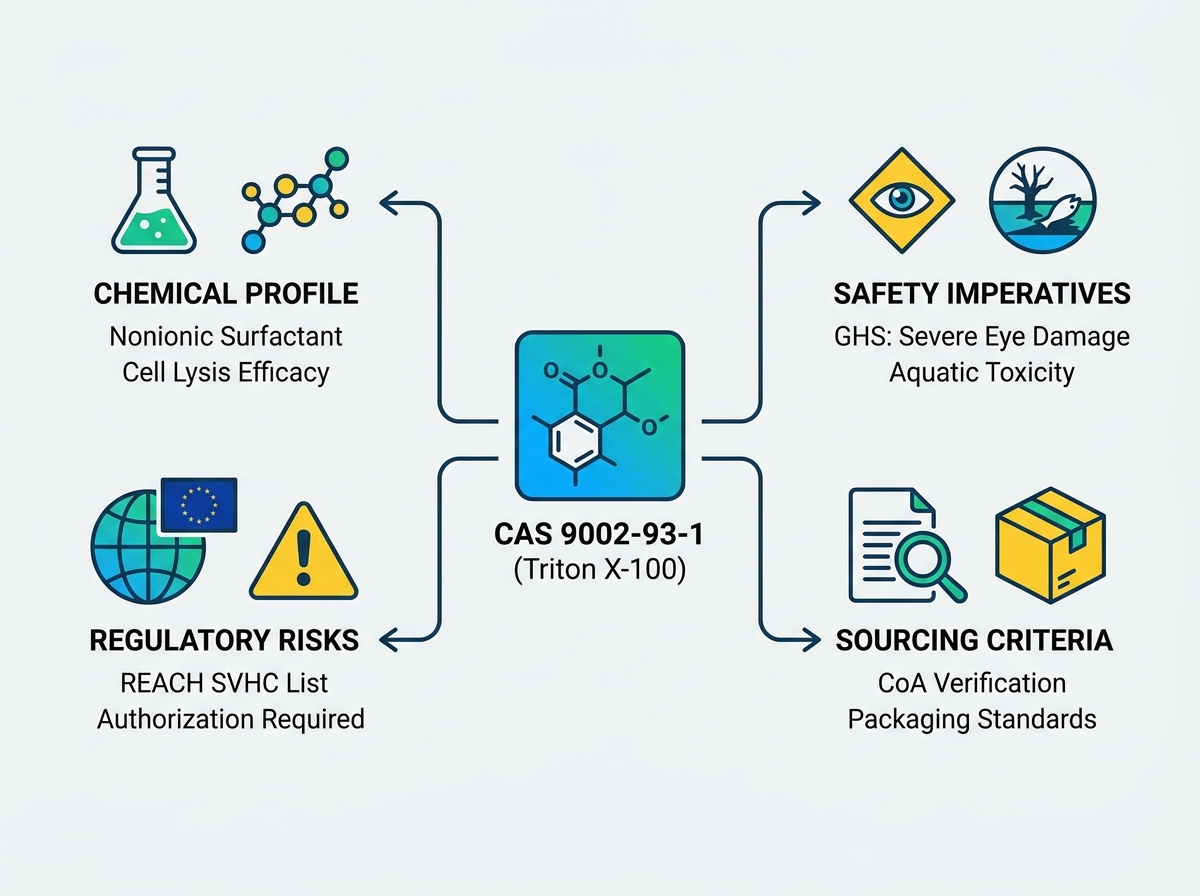
Regulatory landscapes surrounding this chemical have shifted dramatically over the past decade. European authorities officially listed the substance on the REACH Candidate List. It carries the designation of a Substance of Very High Concern (SVHC). This strict classification stems from its endocrine-disrupting properties.
In environmental settings, the parent molecule degrades into octylphenol. Octylphenol mimics natural hormones in aquatic wildlife. This mimicry disrupts reproductive cycles in fish and amphibian populations. Transparently addressing this environmental reality is crucial for modern compliance programs. Organizations can no longer claim ignorance regarding its ecological footprint. This SVHC designation forces companies to re-evaluate their long-term reliance on the chemical.
This regulatory designation heavily impacts global supply chains. European facilities face the strictest hurdles. Under REACH Annex XIV, companies must secure specific, time-limited authorizations to continue using the material. Securing this authorization requires proving no viable alternatives exist for a specific application. It also requires demonstrating strict emission controls. Many European organizations simply choose to transition away rather than navigate this complex paperwork.
Conversely, North American and APAC regions currently manage the substance differently. These regions generally permit its use under standard hazardous material guidelines. However, buyers must understand cross-border supply chain risks. A formulation legal to manufacture in the United States might face total rejection upon export to the European Union. Procurement teams must audit their target markets before bulk purchasing CAS 9002-93-1.
For facilities constrained by strict compliance rules, evaluating alternatives becomes essential. You must approach this transition systematically. Switching to eco-friendly analogs requires rigorous validation testing. Surfactants rarely offer a perfect one-to-one drop-in replacement.
Teams should test alternative nonionic surfactants for comparable cloud points and HLB values. Biologists must verify that the new chemical achieves efficient cell lysis without denaturing target proteins. Industrial users must confirm the substitute maintains emulsion stability under high shear forces. Documenting these evaluation frameworks ensures your organization remains resilient against future regulatory bans.
Securing a reliable supplier begins with demanding comprehensive documentation. A basic product label provides insufficient assurance. You must request a batch-specific Certificate of Analysis (CoA) for every shipment. Reviewing the CoA confirms the material meets your exact operational requirements.
When auditing a supplier's CoA, always verify the following data points:
Manufacturing scale deeply influences product consistency. Large-scale producers utilize automated reactors. These systems control temperature and pressure with immense precision. This tight control ensures each batch behaves identically to the last.
Smaller, less sophisticated suppliers often struggle with reproducibility. Their product might exhibit fluctuating pH levels or varying viscosity across different orders. This inconsistency forces your quality control team to waste time tweaking internal formulas. Evaluating a supplier’s quality control management system mitigates this risk. Ask for historical batch data. Reliable partners gladly provide trend analysis charts demonstrating their manufacturing stability.
Even perfect chemicals degrade inside improper packaging. Evaluating container materials prevents contamination during transit and storage. High-density polyethylene (HDPE) serves as the industry standard for this surfactant. HDPE prevents leaching. It also blocks moisture ingress effectively. Avoid suppliers utilizing cheap, unlined metal drums, as the slightly acidic nature of some batches causes corrosion.
Furthermore, buyers should identify documentation red flags early. Missing updated SDS formats suggests a supplier ignores modern compliance rules. Vague expiration guidelines indicate poor internal stability testing. A trustworthy vendor clearly prints manufacturing dates, retest dates, and recommended storage parameters directly on the primary label.
Proper storage maximizes shelf life and prevents dangerous degradation. Facilities should maintain the chemical at ambient room temperatures. You must protect storage areas from direct sunlight. Ultraviolet light accelerates the formation of harmful peroxides within the liquid.
Temperature fluctuations create unique handling challenges. At lower temperatures, the liquid becomes exceedingly viscous. It may even form a gel or freeze entirely during winter transport. Managing these physical changes requires safe thawing practices. Never use open flames or localized high-heat sources to thaw the material. Instead, move the container to a warm room. Allow it to thaw gradually. Once thawed, stir the contents gently to ensure complete homogeneity before dispensing.
Chemical segregation is a fundamental warehouse safety practice. You must store this material far away from incompatible substances. High-risk interactions occur near strong oxidizing agents. Mixing the two can trigger rapid, exothermic reactions.
You must also separate it from strong acids and strong bases. These extreme pH environments degrade the ether linkages within the molecule. Storing the chemical on dedicated shelving, surrounded by inert secondary containment, represents a vital best practice. This simple logistical choice prevents accidental cross-contamination during forklift operations or minor shelf collapses.
Accidental spills require immediate, systematic containment strategies. First, personnel must don their required PPE before approaching the spill zone. You should never use water to flush a raw spill. Adding water creates massive volumes of slippery foam. This foam spreads the contamination across a wider floor area.
Instead, responders must deploy inert absorbent materials. Sand, vermiculite, or commercial chemical absorbents work perfectly. Sweep up the saturated absorbent carefully. Place the waste into designated, sealable hazardous waste containers. Disposal must strictly adhere to local environmental regulations. You must never permit direct discharge into municipal sewer systems. Always contract licensed hazardous waste professionals to transport and incinerate the collected materials.
Sourcing this ubiquitous nonionic surfactant is no longer a simple catalog purchase. Modern procurement requires balancing its proven efficacy in laboratory and industrial settings with increasingly stringent safety protocols. Buyers face complex global regulations, demanding precise internal oversight.
To secure your supply chain, take immediate action on your evaluation processes. Demand comprehensive, batch-specific CoAs from every vendor to verify purity and consistency. Audit your current supplier’s SDS documentation to ensure full compliance with GHS and regional environmental laws. Finally, proactively assess your facility’s long-term regulatory strategy. If operating within restricted zones, begin qualifying sustainable alternatives now. Taking these steps guarantees safer operations, consistent product quality, and unbroken compliance.
A: Under optimal, sealed conditions, the standard shelf life typically spans 2 to 3 years. You must store it at ambient temperatures, away from direct light. Prolonged storage increases the risk of peroxide formation. Facilities should implement regular retesting protocols for older batches before using them in sensitive applications.
A: Yes. CAS 9002-93-1 serves as the unique chemical registry number for the substance. Triton X-100 is simply a highly recognized commercial trademark for this exact chemical compound. Purchasing either name delivers the identical octylphenol ethoxylate molecule.
A: You must handle all associated waste through licensed hazardous waste contractors. Because it exhibits high aquatic toxicity, you must never pour it down the drain. Facilities need dedicated collection carboys for concentrated waste, followed by compliant transport and proper incineration.
A: Yes, but regulations strictly limit its application. The substance falls under REACH Annex XIV due to endocrine-disrupting concerns. Buyers need specific, approved authorizations for their exact use case. Alternatively, they must qualify for very narrow scientific research exemptions.


