
English
Views: 0 Author: Site Editor Publish Time: 2026-08-07 Origin: Site


Polyethylene Glycol, universally recognized by CAS 25322-68-3, stands as a highly versatile polyether compound. It serves countless vital roles across multiple demanding global industries. This specific chemical identifier covers the fundamental polymer structure. However, its commercial viability depends entirely on the precise grade and molecular weight you choose.
Selecting an incorrect specification introduces severe risks to your manufacturing project. Formulation failures, regulatory non-compliance, and compromised workplace safety often stem from poor material selection. Modern manufacturers must navigate a complex matrix of physical properties to avoid catastrophic production delays.
This article provides a comprehensive technical evaluation framework. We will clearly distinguish between varying molecular weights, strictly analyze purity standards, and examine essential compliance certifications. You will gain actionable insights to facilitate confident supplier selection and secure your operational baseline.
The degree of polymerization dictates the physical and chemical properties of the polymer. This characteristic directly impacts formulation success across all applications. Understanding these structural variations helps you match the exact material to your required manufacturing environment.
These specific variants exist as clear, viscous liquids at normal room temperature. They are highly hygroscopic materials. This means they readily absorb moisture directly from the surrounding environment. The ether oxygen atoms form strong hydrogen bonds alongside water molecules. Common applications include serving as reliable solvents, effective plasticizers, and active dispersion agents. You will frequently find them utilized in industrial manufacturing and personal care formulations. Their fluid state makes them ideal for systems requiring high solubility and rapid ingredient blending. What to watch out for: High hygroscopicity demands careful moisture control. You must monitor storage closely to prevent unwanted dilution. Excess moisture ruins the precise viscosity required for high-speed filling lines.
As the molecular weight increases, the compound transitions into solid forms. You will encounter waxy solids, distinct flakes, or fine free-flowing powders. These solid forms exhibit significantly lower hygroscopicity and much higher melting points. Common applications involve crucial tablet binding in modern pharmaceuticals. They also act as stable suppository bases, thickened industrial lubricants, and dependable mold release agents. They provide exceptional structural integrity to solid formulations while maintaining excellent water solubility. For instance, in suppository manufacturing, the solid melts predictably at human body temperatures. This allows for controlled active ingredient release.
Matching the required viscosity and freezing or melting point to your specific manufacturing environment is absolutely crucial. Process engineers must align the thermal profiles of the polymer alongside production line capabilities. Failing to do this often results in severe machinery clogging. It can also cause improper curing phases in industrial adhesives.
| Grade | Physical State (at 25°C) | Hygroscopicity | Primary Applications |
|---|---|---|---|
| PEG 200 - 400 | Clear Liquid | Very High | Solvents, liquid plasticizers, cosmetics |
| PEG 600 | Viscous Liquid / Semi-solid | High | Intermediates, dispersion agents |
| PEG 1000 - 1500 | Soft Waxy Solid | Moderate | Ointment bases, textile lubricants |
| PEG 3350 - 8000+ | Hard Flakes / Powder | Low | Tablet binders, mold release, dry mixes |
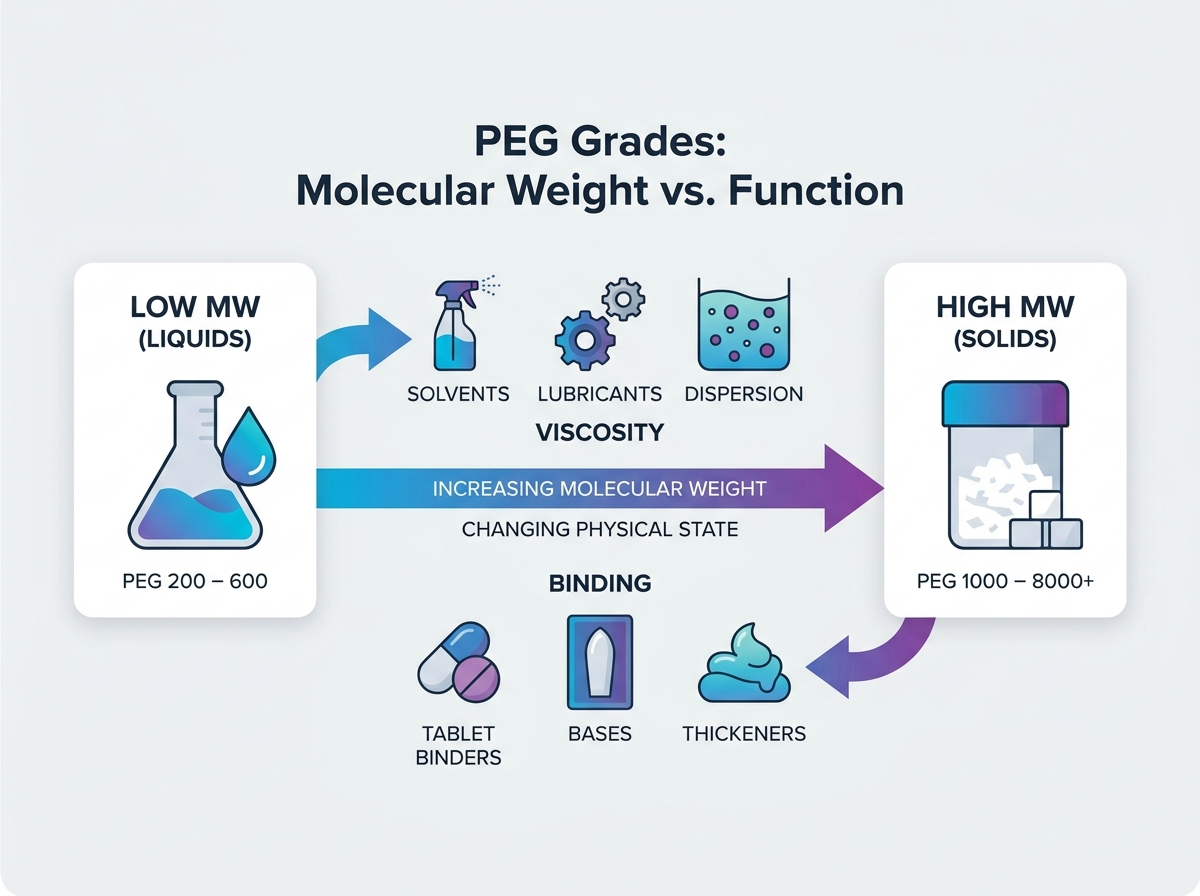
Differentiating various grades based on manufacturing controls, impurity thresholds, and intended end-use remains essential. A single chemical structure can serve vastly different markets. The required refinement process dictates the final application suitability.
Technical grades offer highly cost-effective formulation solutions. They work perfectly in environments where trace impurities do not negatively impact the final product. Industrial lubricants, commercial detergents, and agricultural chemical carriers routinely utilize these specific variants. They provide excellent lubricity and solvency at a lower price point. However, they carry distinct and rigid limitations. They lack strict biological safety certifications. You should never use them in any human-contact applications. Using technical grades inappropriately exposes manufacturers to severe liability. It frequently leads to massive product recall risks. Impurities like heavy metals remain largely unmonitored in these bulk industrial batches.
These premium grades maintain stringent, rigorous control over heavy metals, ethylene oxide, and 1,4-dioxane levels. Governing regulatory bodies mandate incredibly low impurity thresholds to ensure absolute human safety. Primary use cases include active pharmaceutical ingredient (API) delivery systems. High-end cosmetics, often referred to under the INCI name Macrogol, heavily rely on these purified variants. They also serve essential roles in direct and indirect food contact materials. Trust factor is paramount during procurement. These grades require comprehensive, rigorous documentation. Buyers must verify the Certificate of Analysis (COA) explicitly matches specific pharmacopeia standards. Common mistakes include assuming standard "high purity" implies full pharmacopeial compliance. Always check the batch-specific COA for specialized 1,4-dioxane testing results before acceptance.
Analyzing the toxicological profile and regulatory requirements for handling CAS 25322-68-3 at scale guarantees operational continuity. Ignorance of regional or global chemical regulations can halt your production lines instantly. Safety protocols protect your workforce and your bottom line simultaneously.
Authoritative bodies like the American Industrial Hygiene Association (AIHA) provide established Occupational Exposure Limits (OELs). The German MAK guidelines also offer rigorous safety benchmarks. While the polymer holds a generally safe profile, hazards exist. Aerosolized liquid mists or airborne dust from solid grades present distinct respiratory hazards. Safety measures require strict, unwavering adherence. Facilities must implement proper PPE protocols immediately. You must maintain adequate ventilation standards across all handling zones. Employees handling raw materials need access to localized exhaust systems. This proves especially critical during bulk powder transfer operations. Best practices dictate regular ambient air quality monitoring. You must keep particulate levels well below the recommended safety thresholds.
Implementation reality extends far beyond localized safety protocols. Modern companies must ensure their selected supplier maintains active REACH registration. This is non-negotiable for entering European markets. Similarly, suppliers must fully comply with the Toxic Substances Control Act (TSCA). The EPA strictly manages this framework in the United States. Sourcing undocumented materials creates immense, avoidable legal vulnerability. Procurement teams should mandate compliance certificates during the initial vendor onboarding phase. This proactive step prevents massive supply chain bottlenecks. Customs inspections routinely flag shipments lacking proper dossier documentation.
Procuring the correct material represents only half the challenge. Operational challenges frequently arise during warehousing and active handling. Mitigating these risks preserves material integrity and maximizes shelf life. Poor storage destroys expensive raw materials rapidly.
The hygroscopic nature of the polymer presents a significant operational risk. This proves especially true for the lower molecular weights. These liquids readily absorb ambient moisture directly from the warehouse environment. This rapid absorption alters the concentration. It shifts the precise viscosity and can ruin sensitive, tightly toleranced formulations. The solution requires strict, engineered storage conditions. Facilities often employ nitrogen blanketing in large bulk storage tanks. Climate-controlled warehousing and specialized airtight packaging represent standard industry best practices. You must keep dispensing drums tightly sealed immediately following any extraction. Even minimal atmospheric exposure degrades performance over several days.
Over time, prolonged exposure to oxygen and heat induces severe degradation. This risk involves the slow, steady formation of peroxides. Acidic by-products also develop under poor storage conditions. Such degradation compromises the performance of the material entirely. It can react unpredictably alongside other delicate formulation ingredients. The solution involves evaluating the absolute necessity of added stabilizers. Antioxidants like BHT (Butylated hydroxytoluene) frequently mitigate these breakdown pathways. Manufacturers must balance this inclusion against utilizing pure, unstabilized grades. This decision depends entirely on your specific shelf-life requirements. If your product demands an extended shelf life, stabilized grades provide excellent, low-cost insurance against premature oxidation.
A rigorous decision matrix helps you select a highly reliable supplier. This structured framework ensures consistent chemical quality and robust supply chain resilience. You cannot afford arbitrary procurement decisions.
Request physical sample batches and highly detailed specification sheets immediately. Your internal QA/QC team must perform rigorous, independent validation. Do this before you commit to long-term bulk supply contracts. Never bypass this vital pilot testing phase. Theoretical chemical specifications sometimes behave quite differently within proprietary, high-speed production environments.
Sourcing CAS 25322-68-3 effectively requires aligning the exact molecular weight alongside your specific formulation needs. Furthermore, you must expertly match purity grades alongside the strict regulatory demands of your target market.
Contact expert technical sales representatives for tailored, application-specific grade recommendations today. Request a comprehensive COA, or download a full product specification catalog to secure your chemical supply chain.
A: Macrogol serves as the International Nonproprietary Name (INN) utilized primarily in global pharmacopeias. While the underlying chemical structure remains completely identical to standard PEG, Macrogol specifically refers to high-purity, pharmaceutical-grade variants. These grades strictly comply with stringent medical standards and rigorous impurity limits.
A: Yes, formulators frequently mix different molecular weights together. Blending allows manufacturers to achieve highly specific viscosities. You can create customized melting points or unique textural properties. Standard commercial grades often cannot provide these exact customized parameters individually.
A: The typical shelf life generally ranges between 12 to 24 months under optimal storage conditions. Key variables affecting stability include ambient temperature exposure and atmospheric humidity. Additionally, the inclusion of protective antioxidants like BHT prevents peroxide formation, extending viability.
A: It boasts a generally recognized safe and remarkably low-toxicity profile. Specific high-purity grades actually hold FDA GRAS (Generally Recognized As Safe) status for targeted, regulated uses. You should always consult the specific batch Safety Data Sheet (SDS) for precise handling guidelines.


