
English
Views: 0 Author: Site Editor Publish Time: 2026-08-04 Origin: Site


Sourcing specialty copolymers requires balancing precise technical specifications alongside strict supply chain reliability. Buyers face unique daily challenges when securing high-quality raw materials for their diverse production lines. The chemical industry consistently demands stringent oversight and rigorous testing. Treating this specific copolymer as a simple commodity often leads to dangerous batch-to-batch inconsistencies. These unexpected material inconsistencies can trigger expensive formulation failures. They might also create severe regulatory compliance bottlenecks in highly regulated biomedical or industrial sectors. You need uncompromising oversight to maintain end-product integrity and consumer safety. We provide procurement teams and lead laboratory researchers an evidence-based framework. You will learn how to evaluate global suppliers effectively. This guide helps you forecast complex pricing trends accurately. You will also discover how to mitigate common vendor sourcing risks during your next procurement cycle.
Buyers must accurately categorize their required material based on specific application criteria. Sourcing the wrong grade often causes immediate production delays. It can also ruin entire manufacturing batches. You must communicate your exact technical requirements clearly to potential suppliers.
Medical applications demand the highest possible purity levels. Manufacturers use these specialized grades as vital excipients. They also incorporate them into complex drug delivery systems. You must verify extremely low endotoxin levels before finalizing any purchase. Suppliers must guarantee exact molecular weight distributions. Furthermore, the material must strictly comply with major pharmacopeia standards. These include United States Pharmacopeia (USP) and European Pharmacopoeia (EP) guidelines. Failing to secure pharmacopeia compliance will halt your regulatory approval process immediately.
Biological assays require exceptionally pure reagents to function correctly. Impurities can easily disrupt sensitive cellular environments. When buying for laboratory environments, you must scrutinize cytotoxicity data carefully. High purity prevents unwanted cellular reactions during critical experiments. Vendors selling cell culture grades should routinely provide detailed biological testing data.
Industrial applications operate under entirely different constraints. Manufacturers typically use CAS 9003-11-6 as surfactants, defoamers, or dispersants. These processes tolerate much less stringent purity limits. Procurement teams prioritizing bulk cost-efficiency usually select industrial grades. You can save significant capital by avoiding over-specified pharmaceutical grades for routine cleaning or manufacturing applications.
This unique copolymer exists in several distinct physical forms. Depending on the specific polyethylene and polypropylene oxide ratio, you might receive liquids, pastes, solid flakes, or powders. Buyers must carefully specify the exact physical state required. Your facility must possess the right processing capabilities to handle the chosen format. Solid flakes require different mixing equipment than liquid variants. Always align the physical format directly to your internal manufacturing equipment capabilities.
Grade and Property Comparison Chart
| Grade Type | Primary Use Cases | Key Specification Focus | Common Physical Form |
|---|---|---|---|
| Pharmaceutical | Drug delivery, Excipients | USP/EP Compliance, Endotoxins | Solid powder or flake |
| Cell Culture | Biological assays, Research | Cytotoxicity, High Purity | Liquid or paste |
| Industrial | Defoamers, Surfactants | Cost-efficiency, Bulk availability | Liquid or solid |
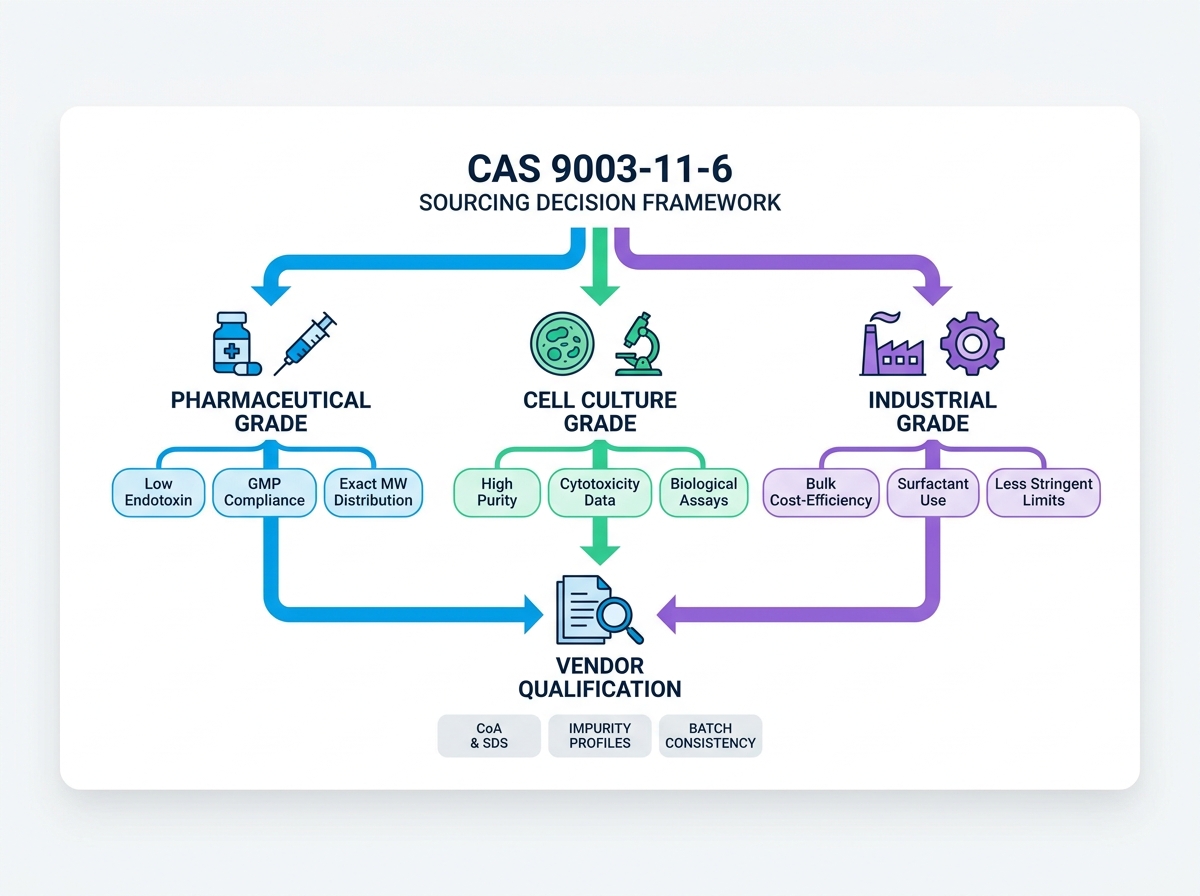
Establishing authority and trustworthiness separates excellent suppliers from unreliable ones. A credible supplier must proactively provide comprehensive documentation. You should never have to beg for essential quality records. Strict documentation ensures product safety and regulatory alignment.
The Certificate of Analysis remains your most critical procurement document. Every CoA must display specific, batch-level data. Generic specification sheets do not replace a true batch CoA. You must check the reported hydroxyl value carefully. Verify the cloud point against your formulation requirements. Ensure moisture content falls within acceptable limits. Finally, check the pH levels to prevent unexpected chemical interactions.
Safety Data Sheets dictate how your facility handles the material. Ensure the vendor provides localized compliance documentation. Depending on your manufacturing region, rules vary significantly. North American buyers need TSCA and OSHA compliance. European buyers require strict REACH registration proof. An outdated or poorly translated SDS signals a massive red flag regarding supplier competence.
High-tier suppliers gladly provide transparent impurity data. Trace contaminants can ruin sensitive formulations. You must demand data regarding residual monomers. Specifically, check for residual ethylene oxide and propylene oxide. Heavy metal contamination also poses severe risks for medical applications. Ask vendors to disclose their heavy metal testing protocols explicitly.
Procurement teams need a ruthless evaluation framework. If a vendor hesitates to provide historical batch data, walk away. Refusal to supply standard reference materials indicates poor quality control. Disqualify secretive vendors immediately for any sensitive applications. Transparency remains the only reliable indicator of consistent manufacturing quality.
Understanding baseline pricing expectations prevents budget overruns. Pricing remains highly volatile in the specialty chemical market. The final cost depends entirely on specific purity levels and requested volumes. Research-grade catalog pricing per gram looks vastly different from industrial metric-ton pricing. You must dissect the unit economics carefully.
Volume heavily dictates your final purchase price. Standard MOQ tiers exist across the industry. Research samples under one kilogram carry a massive premium. Pilot scale orders between one and twenty-five kilograms offer moderate pricing relief. Commercial scale orders involving large drums or totes unlock the best unit pricing. Always forecast your annual volume accurately to negotiate better bulk rates.
Solid forms of CAS 9003-11-6 are often highly hygroscopic. They actively pull moisture from the surrounding air. Protective packaging becomes an absolute necessity. Nitrogen purging and specialized moisture-barrier liners add to upfront costs. However, these investments prevent moisture degradation. Skipping protective packaging inevitably causes severe material loss during transit.
Logistics significantly impact your final landed costs. Certain liquid variants demand strict temperature-controlled shipping. Freezing temperatures can permanently damage specific copolymer ratios. High heat might cause unwanted viscosity changes. Detail these temperature requirements in your initial vendor negotiations. Standard freight quotes often exclude temperature-control fees. Always ask shipping partners to itemize specialized climate-control charges clearly.
Onboarding a new chemical supplier introduces significant operational friction. You must anticipate these practical challenges early. Experience shows that switching vendors rarely happens seamlessly. Procurement teams must plan for extensive testing periods. Ignoring implementation realities often disrupts active production schedules.
Batch consistency remains your most significant ongoing risk. Variations in the polymer chain length cause severe downstream issues. Even minor chain length differences can drastically alter the final cloud point. These molecular variations also change the viscosity of your final product. You must lock in strict chain length parameters within your purchasing agreement. Hold suppliers financially accountable for out-of-spec deliveries.
Assess the geographic risks tied to your chosen vendor. Relying on single-origin overseas manufacturing carries high logistical risk. Port strikes or customs delays can freeze your supply line instantly. Alternatively, domestic distributors offer local warehousing. Local stock drastically reduces standard lead times. Weigh the cheaper overseas unit price against the reliability of domestic inventory.
Never commit to an annual supply contract based on one sample. Manufacturers can easily handpick a perfect "golden" sample. You must verify their actual production consistency.
Moving a supplier from "potential" to "approved" requires strict filtering logic. Do not waste time negotiating with unverified factories. You must confirm baseline capabilities before discussing price. First, ask if they offer the specific molecular weight you require. Check if they manufacture the exact variant of polyethylene-polypropylene glycol needed. Next, verify their facility certifications. ISO 9001 and cGMP certifications demonstrate a baseline commitment to quality management.
Vague requests generate inaccurate quotes. Provide a structured Request for Quote (RFQ) to avoid endless back-and-forth emails. A precise RFQ demonstrates your professionalism. It also forces vendors to give you their best possible terms immediately. Include the following checklist items in every RFQ:
Successful procurement goes far beyond finding the lowest price per kilo. You must rigorously align the material's physicochemical properties to your specific end-use application. Prioritize batch-to-batch consistency above marginal unit cost savings. Demand robust documentation, including transparent CoAs and localized safety sheets. Protect your supply chain by rigorously testing multiple batch samples before signing annual agreements. Treat your vendor qualification process as a critical defensive strategy against production failures.
We encourage buyers to proactively reach out to trusted suppliers. Share your specific formulation requirements early in the conversation. Ask vendors for targeted molecular specifications. Request detailed sample testing protocols tailored to your industry. By structuring your procurement approach, you can confidently secure reliable volumes and negotiate advantageous pricing.
A: The chemical industry uses several synonyms interchangeably. You will frequently see it listed as Poloxamer or Polyethylene-polypropylene glycol. Many suppliers also use the trade name Pluronic. Using these synonyms during your sourcing research will yield a wider variety of potential global vendors.
A: The standard shelf life typically spans two to three years. However, this depends entirely on proper storage conditions. You must keep the material completely dry. Solid forms are hygroscopic. Store them at appropriate ambient temperatures away from direct heat to prevent premature degradation.
A: Yes, you can request custom weights. Because this material is a versatile polymer class, manufacturers control the synthesis process. Suppliers often synthesize custom block ratios upon request. Enterprise buyers frequently order unique polyethylene/polypropylene ratios to achieve highly specific viscosity or cloud point targets.
A: You must audit their batch-specific Certificates of Analysis rigorously. Never accept generic data sheets. Request third-party laboratory verification for critical purity claims. Finally, check their ISO and GMP registrations through official international databases to ensure their facility meets global manufacturing standards.


