
English
Views: 0 Author: Site Editor Publish Time: 2026-08-09 Origin: Site


Polyethylene Glycol (PEG) acts as a highly versatile, non-toxic, and water-soluble polymer anchoring modern manufacturing. Under its universal identifier, CAS 25322-68-3, this essential chemical supports countless global supply chains across pharmaceuticals, personal care, and industrial processing. You will find it in everything from life-saving medical devices to everyday industrial lubricants.
Despite its ubiquitous presence, procurement teams and formulators frequently struggle to select the exact specifications needed. Choosing the wrong molecular weight, purity grade, or compliance tier creates costly manufacturing bottlenecks. Incorrect material selection can also lead to severe regulatory failures downstream.
This guide breaks down technical specifications, application matrices, compliance frameworks like REACH, and supplier evaluation criteria. You will learn how to match the correct grade to your commercial applications. We aim to streamline your formulation decisions and simplify your purchasing processes entirely.
Understanding the fundamental chemistry behind this polymer ensures accurate sourcing and safer formulation. Buyers often face confusion due to the myriad of naming conventions used globally.
Accurate nomenclature drives procurement success. Suppliers and regulatory bodies use various names for the exact same chemical. In the pharmaceutical sector, professionals typically refer to it as Macrogol. Chemists often call it Polyethylene oxide (PEO) when dealing with ultra-high molecular weights. Industrial buyers might recognize it by legacy trade names like Carbowax. Using the universal registry number eliminates ambiguity during global sourcing.
The core structure dictates how the material behaves in different environments. Its general chemical formula is H−(O−CH2−CH2)n−OH. This unique polyether structure provides several critical baseline traits:
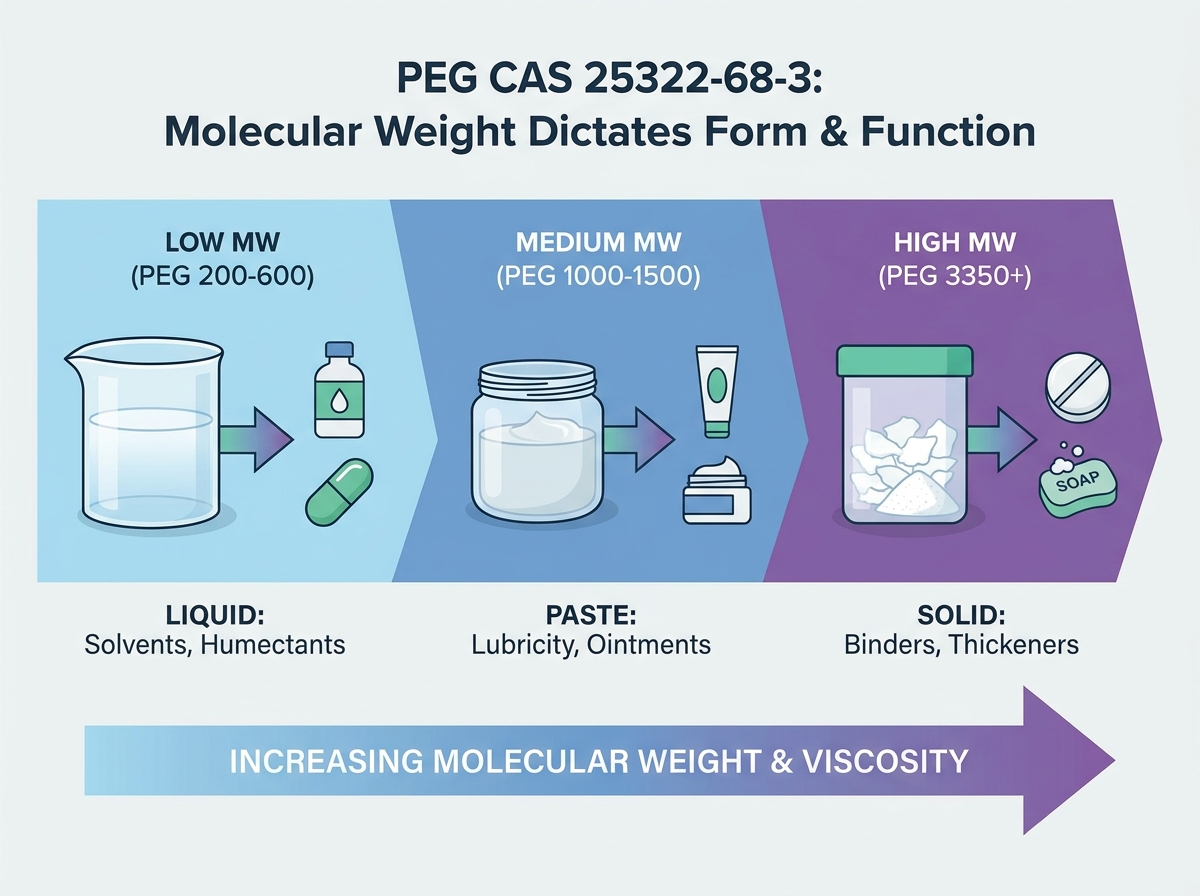
The average molecular weight fundamentally alters the physical state. We indicate this weight using the 'n' value in the chemical formula. At room temperature, lower 'n' values produce clear, slightly viscous liquids. As the chain length increases, the material shifts into opaque pastes. Finally, at high molecular weights, the polymer crystallizes into hard, flaked solids. Formulators must account for these transitions when designing mixing protocols and temperature profiles.
Selecting the optimal molecular variant requires matching physical properties to specific product demands. A minor miscalculation in chain length can ruin the texture or efficacy of a final product.
These variants feature short polymer chains. They remain highly fluid at standard room temperatures.
Best Practice: Always store liquid variants in temperature-controlled areas. Extreme cold can induce unwanted cloudiness or temporary crystallization.
Intermediate chain lengths provide unique rheological benefits. They bridge the gap between pure liquids and hard solids.
Long-chain polymers offer structural rigidity and superior binding properties. They require heat to melt for uniform blending.
PEG Molecular Weight Selection Chart
| Category | Molecular Weight Range | Room Temp State | Primary Functions |
|---|---|---|---|
| Low | 200 – 600 | Clear Liquid | Solvent, Humectant, Dispersant |
| Medium | 1000 – 1500 | Semi-solid Paste | Lubricant, Moisture Base |
| High | 3350 – 8000+ | Flake / Powder | Binder, Thickener, Plasticizer |
You cannot universally apply one standard grade across all sectors. Commercial viability relies entirely on aligning the purity level to the end-use product requirements. Ignoring these distinctions often causes severe compliance bottlenecks.
The medical sector demands the highest possible scrutiny. Pharmacopeia standards dictate rigorous testing protocols for human consumption and internal contact.
In this space, the polymer functions as an inactive excipient. It stabilizes active drug compounds and facilitates smooth pill coatings. Certain molecular weights, like PEG 3350, serve directly as active ingredients for osmotic laxatives. Cutting-edge medicine also utilizes PEGylation. This process attaches the polymer to biologic drugs to shield them from the patient's immune system.
Decision Factor: Extreme purity requirements govern this sector. You must verify strict limits on toxic impurities like ethylene oxide and 1,4-dioxane before purchasing.
Beauty and hygiene products rely heavily on this material for texture and stability. It enhances the consumer experience without altering active ingredients.
These grades function as moisture-stabilizers in skin lotions. They act as gentle surfactants in facial cleansers and serve as viscosity modifiers in toothpaste. By retaining moisture, they prevent personal care products from drying out on store shelves.
Decision Factor: Sensorial profiles drive cosmetic procurement. The chosen material must be completely odorless and colorless. Dermatological safety data remains crucial to prevent skin sensitization.
Heavy industry prioritizes performance and volume over microscopic purity. Industrial environments utilize the material's physical traits rather than its biological safety.
Factories deploy it as an anti-dusting agent for agricultural chemicals. It serves as an effective wood preservative, preventing shrinkage during drying. Rubber manufacturers use it as an internal lubricant and mold release agent. It also enhances metalworking fluids by providing superior cooling and lubrication during high-speed cutting.
Decision Factor: Cost-efficiency at scale drives industrial purchasing. Standard industrial grades typically suffice, provided bulk handling characteristics meet the facility's equipment parameters.
Navigating international regulations requires diligent documentation. Chemical supply chains face increasing scrutiny regarding traceability and impurity profiles. You must secure comprehensive paperwork before authorizing bulk shipments.
Entering international markets requires specific regulatory clearances. If you sell products into the European Union, your chemical supply must comply with REACH regulations. REACH registration proves the material meets stringent environmental and health safety thresholds. In the United States, the FDA monitors these polymers closely. While generally recognized as safe (GRAS), applications involving direct food contact or pharmaceutical formulation require specific FDA-approved grades.
Buyers must rigorously analyze supplier documentation. You should always demand a comprehensive Technical Data Sheet (TDS) and a lot-specific Certificate of Analysis (COA). Critical data points to review include:
Common Mistake: Failing to test for byproducts can trigger costly recalls. Detail the importance of vetting suppliers for validated purification processes. During polymer synthesis, toxic byproducts often form. The most notorious is 1,4-dioxane, a potential human carcinogen. Quality suppliers utilize advanced vacuum stripping techniques to monitor and eliminate this toxic trace element. Always request independent lab verification for impurity thresholds.
Protecting warehouse staff and preserving chemical integrity requires standardized handling protocols. Despite its benign reputation, bulk storage presents specific logistical challenges.
The material remains fundamentally non-hazardous and non-flammable under standard operating conditions. It poses no significant dermal toxicity or acute chemical burn risks. However, dust generated from solid variants (flakes or powders) can pose a mild inhalation risk for factory workers. In highly concentrated, suspended clouds, fine polymer dust presents a combustible dust risk. Facilities must ensure adequate ventilation and ground their equipment to prevent static discharge.
Environmental exposure degrades the polymer rapidly if mishandled. You must implement strict warehouse controls.
Modern industries prioritize sustainability. Fortunately, these polymers exhibit favorable environmental profiles. They are largely biodegradable in aerobic environments. Most municipal and industrial wastewater treatment facilities handle standard disposal safely. However, highly concentrated industrial spills require professional chemical containment protocols before discharge into public sewers.
Vetting a chemical partner requires moving beyond simple price comparisons. Supply chain stability depends on a partner's technical capability and logistical reliability. Use this checklist to audit potential vendors.
Successful procurement of this versatile polymer relies heavily on precisely matching the molecular weight and regulatory grade to your end product. From viscous liquids acting as solvents to solid flakes binding pharmaceutical tablets, understanding physical transitions remains critical. Always prioritize suppliers who provide transparent impurity mitigation data, especially regarding 1,4-dioxane.
Your next steps should involve proactive vendor engagement. We encourage buyers to request physical samples for bench-testing immediately. Compare Certificates of Analysis across multiple suppliers to establish baseline quality expectations. Finally, consult directly with technical sales representatives to finalize your material selection and secure your supply chain.
A: It serves as the universal registry number for all homopolymers of ethylene oxide. This single identifier covers the entire chemical family, regardless of the specific average molecular weight, physical state, or commercial grade.
A: No. Industrial grades often contain trace impurities, including heavy metals and 1,4-dioxane. Cosmetic and pharmaceutical grades undergo rigorous purification and testing. You must mandate these higher-purity grades for any products involving human contact.
A: The number indicates the average molecular weight of the polymer chain. This value dictates the physical state. Lower numbers (like 400) represent liquids, while higher numbers (like 3350) represent solid flakes or powders.
A: Yes. It naturally absorbs moisture directly from the surrounding atmosphere. You must use proper sealed storage, such as lined bags or tight drums, to prevent water absorption and ensure long-term formulation stability.


