
English
Views: 0 Author: Site Editor Publish Time: 2026-08-03 Origin: Site


Formulation scientists and procurement teams face a persistent dilemma. They must find surfactants capable of delivering exceptional solubilization without compromising strict biocompatibility. Many traditional emulsifiers trigger cellular toxicity or cause active pharmaceutical ingredients to degrade prematurely. This reality forces teams to constantly weigh performance against regulatory and safety risks. CAS 9003-11-6, widely recognized as Poloxamers or block copolymers, provides a powerful non-ionic alternative.
This article provides an evidence-based framework comparing these block copolymers against other common surfactant classes. You will learn how to navigate molecular weight variations, mitigate formulation risks, and make confident procurement decisions for sensitive applications. We will explore specific use cases and break down exact comparison metrics to guide your overall strategy.
To fully leverage this surfactant class, you must first understand its foundational chemistry. Its behavior differs vastly from simpler emulsifiers.
These synthetic polymers feature a distinctive triblock copolymer structure. They consist of a central hydrophobic chain of polypropylene glycol (PPG). Two hydrophilic chains of polyethylene glycol (PEG) flank this central block. The exact ratio between these hydrophilic and hydrophobic segments dictates the final physical state and function of the polymer. By altering the chain lengths during synthesis, manufacturers create a diverse family of surfactants ranging from free-flowing liquids to hard waxy solids.
Several key traits separate these copolymers from standard alternatives. First, they are entirely non-ionic. They carry no electrical charge in solution. This lack of charge translates directly into remarkably low cellular toxicity. They do not disrupt biological membranes aggressively.
Second, specific grades exhibit a rare thermo-responsive phase transition. They remain liquid at cold temperatures. However, they transition into a firm gel as they warm to room or body temperatures. This thermo-reversible gelation provides immense value for sustained-release medical applications. You can inject a cold liquid formulation easily. It then forms a localized gel depot upon entering the warm body.
Because of this versatile profile, formulators deploy these copolymers across several high-value industries. The most common primary use cases include:
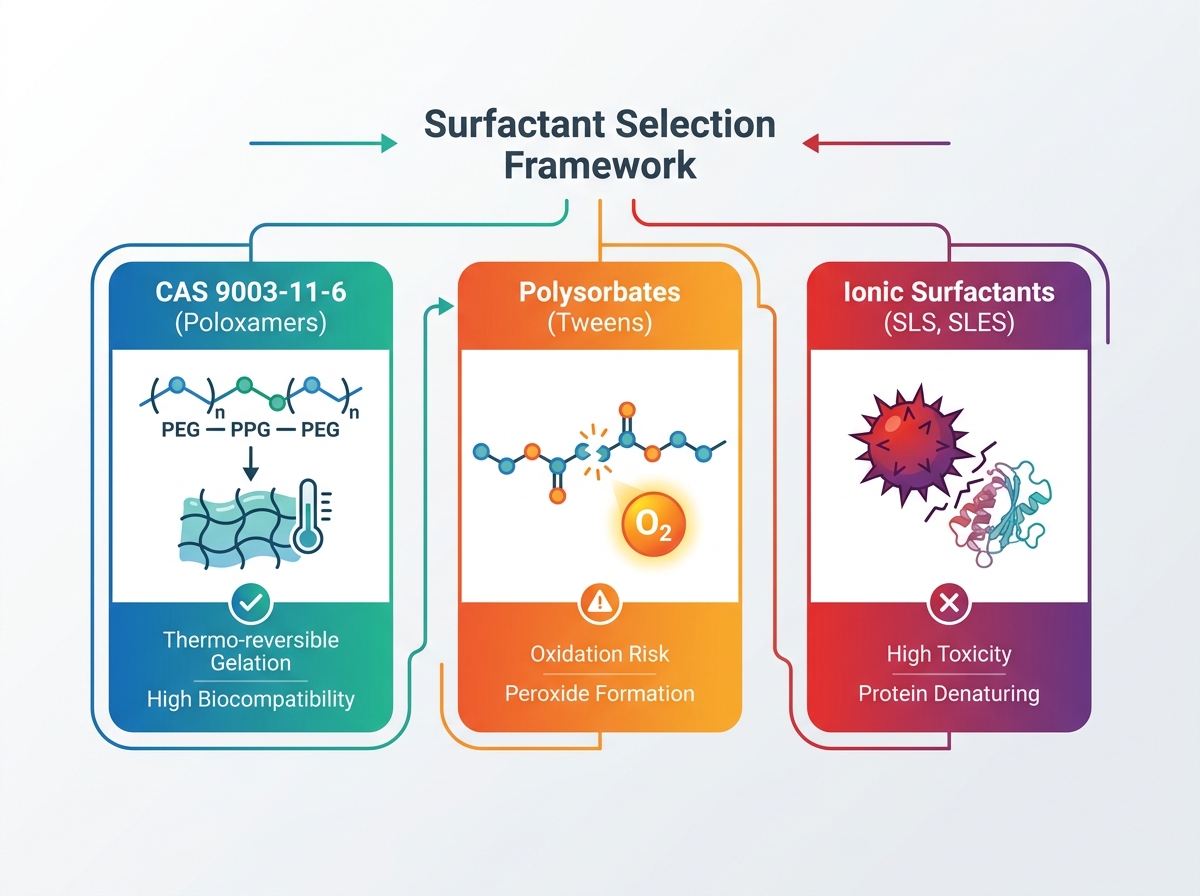
Polysorbates and standard polyethylene glycols serve as industry staples. However, they carry inherent chemical vulnerabilities. Switching to block copolymers often resolves these long-standing stability issues.
Polysorbates (such as Tween 20 and Tween 80) pose a well-documented chemical stability risk. They contain unsaturated fatty acid chains and complex ether linkages. Over time, exposure to light, trace metals, or ambient oxygen triggers auto-oxidation. This process yields reactive peroxides and aldehydes.
These peroxides readily attack vulnerable APIs. They cause oxidative degradation, reducing shelf life and altering drug efficacy. CAS 9003-11-6 lacks these reactive ester bonds and unsaturated chains. It demonstrates a vastly superior chemical stability profile. By removing the primary source of peroxide generation, formulators can protect highly sensitive compounds over extended storage periods.
Biologic drugs, particularly monoclonal antibodies (mAbs), are fragile structures. They tend to unfold and aggregate when exposed to liquid-air interfaces during manufacturing and transport. Historically, formulators added Polysorbates to coat these interfaces and protect the proteins.
However, as Polysorbates degrade, their breakdown products can actually accelerate protein aggregation. Free fatty acids accumulate, forming visible sub-visible particles in intravenous solutions. Poloxamers offer a safer stabilization mechanism. They gently shield the protein surfaces. They prevent unfolding at interfaces without leaving behind hazardous degradation byproducts.
When dealing with poorly water-soluble APIs, solubilization capacity becomes the deciding factor. Standard PEGs act primarily as co-solvents. They alter the polarity of the water, but they do not form true micelles effectively.
Conversely, block copolymers form highly organized micellar structures in solution. Their hydrophobic PPG cores encapsulate lipophilic drugs, while their hydrophilic PEG coronas keep the entire complex suspended in water. This targeted encapsulation often achieves higher drug loading capacities than standard PEGs.
| Performance Metric | Block Copolymers (Poloxamers) | Polysorbates (Tweens) | Standard PEGs |
|---|---|---|---|
| Auto-Oxidation Risk | Very Low | High (Generates peroxides) | Low to Moderate |
| Biologic Stabilization | Excellent, highly stable over time | Effective initially, risky long-term | Poor interface protection |
| Micelle Formation | Robust micellar core encapsulation | Good encapsulation, risks of cleavage | Minimal to no micelle formation |
| Thermo-Reversible Gelling | Yes (Specific grades only) | No | No |
Comparing non-ionic copolymers to anionic or cationic surfactants highlights a stark contrast in biological impact. The choice between them usually comes down to cost versus tissue compatibility.
Ionic surfactants like Sodium Lauryl Sulfate (SLS) carry a strong electrical charge. This allows them to bind aggressively to the hydrophobic regions of proteins and cellular lipids. The reality is harsh. They strip away protective oils, denature essential proteins, and routinely disrupt fragile cell membranes. This mechanism causes visible tissue irritation and cellular death in laboratory assays.
In contrast, CAS 9003-11-6 represents the mildest end of the surfactant spectrum. Its non-ionic nature prevents aggressive protein binding. It interacts gently with cellular structures. This mildness makes it a cornerstone ingredient for ophthalmic drops, contact lens solutions, and tissue engineering mediums where cell survival is non-negotiable.
We must establish transparent assumptions regarding these ingredients. Ionic surfactants remain incredibly cost-effective. They generate massive amounts of foam. They excel at dissolving heavy grease. If you are formulating industrial floor cleaners, agricultural sprays, or budget-friendly foaming body washes, ionic surfactants are the logical choice.
However, you must immediately disqualify ionic surfactants for parenteral (injectable) formulations, ophthalmic preparations, or delicate mammalian cell cultures. They simply cannot meet the safety thresholds required. In these strict environments, the low-toxicity profile of block copolymers makes them the only viable, regulatory-compliant option.
Transitioning to these advanced copolymers solves many biological challenges. Yet, it introduces unique engineering and manufacturing hurdles. You must adapt your production processes accordingly.
The thermo-reversible gelation property is a massive advantage for drug delivery. It is also an absolute nightmare for unprepared manufacturing teams. Mixing these specific polymer grades requires strict temperature-controlled compounding.
If your warehouse or mixing floor gets too warm, the liquid solution will spontaneously convert into a thick, immovable gel. This can jam pipes, ruin impellers, and halt production lines. Scaling up these formulations requires jacketed vessels. You must maintain continuous cold-water circulation to keep the material fluid until it is safely bottled or vialed.
You cannot treat all grades interchangeably. Varying the molecular weights drastically alters the rheology of the final product. For example, Pluronic F-127 contains a high percentage of hydrophilic PEG. It readily forms a stiff, rigid gel at room temperature.
Meanwhile, Pluronic F-68 possesses a different molecular weight and block ratio. It typically remains fluid, serving better as a liquid cell culture protectant than a gelling agent. Formulators must test multiple molecular weights to dial in the exact viscosity curve required for their specific application.
These polymers are highly hygroscopic. They actively draw moisture out of the ambient air. If left exposed, they will clump, harden, and alter their total weight. This invisible moisture absorption ruins batch-to-batch consistency and throws off precision measurements during compounding.
To prevent warehouse storage disasters, teams must enforce strict handling requirements:
Sourcing these complex molecules goes far beyond checking price tags. Procurement teams must validate multiple layers of quality assurance before onboarding a new vendor.
If you formulate for human health, regulatory compliance is your first hurdle. You must verify that the vendor provides pharmaceutical grades adhering to recognized monographs. Depending on your target market, the material must comply with the United States Pharmacopeia (USP/NF), the European Pharmacopoeia (EP), or the British Pharmacopoeia (BP).
Evaluating a vendor's Certificate of Analysis (CoA) requires technical scrutiny. Do not accept a CoA at face value. You must actively look for specific purity markers. The synthesis of CAS 9003-11-6 involves ethylene oxide and propylene oxide monomers. These are toxic.
Your CoA must show minimal residual solvents. Heavy metals must remain well below toxic thresholds. For injectable or ophthalmic applications, you must strictly monitor endotoxin limits. Excessive endotoxins cause severe immune reactions in patients. Only work with manufacturers who reliably test and guarantee low-endotoxin thresholds.
Procurement teams must navigate the cost-to-compliance ratio carefully. During early benchtop research, lab-grade materials offer a budget-friendly way to test formulations. However, moving into clinical trials or commercial manufacturing requires cGMP-manufactured lots.
cGMP (Current Good Manufacturing Practice) materials cost significantly more due to rigorous documentation, validated cleaning procedures, and strict quality control overhead. Waiting too long to transition to cGMP grades can delay product launches. Transitioning too early wastes R&D budgets. You must align your procurement grade precisely with your development timeline.
Polymer synthesis is difficult to master. Slight variations in the manufacturing process cause shifts in the molecular weight distribution. If a vendor cannot control their polymerization tightly, your end-product viscosity will fluctuate wildly from batch to batch.
Audit your suppliers for supply chain resilience. Ask them for historical data proving consistent batch-to-batch molecular weight distribution over several years. A reliable vendor prevents costly out-of-specification formulation failures on your production floor.
For high-value, sensitive formulations, few ingredients provide the strategic value of these advanced block copolymers. They solve severe chemical stability issues, prevent biologic degradation, and offer unparalleled biocompatibility compared to ionic alternatives. Their unique phase-transition capabilities open the door for innovative, sustained-release drug delivery mechanisms.
However, successful integration relies heavily on technical precision. You must match the specific polymer grade—accounting for exact molecular weight and HLB value—to your intended regulatory and rheological outcomes. Misunderstanding the phase-transition temperatures or failing to control warehouse humidity will lead to costly production delays.
Take action today to optimize your formulation strategy. Request updated specification sheets from your vendors. Order multiple pilot samples across different molecular weights for bench testing. Consult with a technical polymer specialist to finalize the exact grade necessary for your specific application environment.
A: It is most commonly known by the generic name Poloxamer. Major manufacturers sell it under well-known trade names like Pluronic® (by BASF) and Kolliphor®. You will often see grade suffixes (e.g., F-127, F-68, or Poloxamer 407, 188) attached to these names. These numbers denote the specific molecular weight and physical state (Flake, Liquid, Paste) of that exact polymer grade.
A: Yes, it can serve as an excellent replacement to reduce oxidation and peroxide formation. However, it is not a simple drop-in swap. Because their critical micelle concentrations (CMC) and spatial structures differ, formulators must re-evaluate the micelle dynamics, protein-binding kinetics, and overall stability of the new mixture through rigorous accelerated testing.
A: Block copolymers exhibit very limited biodegradability under standard environmental conditions. Their dense polyether linkages resist rapid microbial breakdown in wastewater treatment facilities. While considered non-toxic and environmentally safe in low concentrations, manufacturers using massive industrial volumes must account for local environmental regulations regarding persistent polymer disposal.
A: You must look at the Hydrophilic-Lipophilic Balance (HLB) value corresponding to specific product grades. Grades with low HLB values have more hydrophobic PPG and work well as defoamers or W/O emulsifiers. Grades with higher HLB values contain more hydrophilic PEG and excel as solubilizers, O/W emulsifiers, and micelle formers in aqueous solutions.


