
English
Views: 0 Author: Site Editor Publish Time: 2026-08-03 Origin: Site


Have you ever wondered what makes certain chemical formulations incredibly stable and effective? The secret often lies in versatile nonionic triblock copolymers. Specifically, CAS 9003-11-6 serves as the official registry number for Poloxamer. You likely know this chemical by global trade names like Pluronic® or Kolliphor®.
Formulators and procurement teams often struggle when navigating this complex chemical landscape. They find it challenging to match the precise molecular weight and purity grade to exact applications. Choosing an industrial surfactant when you actually need a pharmaceutical excipient can ruin an entire production batch. The wrong grade often causes severe regulatory delays.
We will resolve this complexity today. You will get a clear, evidence-based breakdown of chemical properties, grading standards, and evaluation criteria. We will help you source the exact specifications you need for successful formulations. This guide empowers buyers to make highly informed purchasing decisions.
Understanding the fundamental chemistry is vital for correct application. This chemical belongs to a family of synthetic polymers. We classify them as nonionic triblock copolymers. They exhibit unique structural characteristics.
The molecular architecture drives its core functionality. The structure consists of three distinct polymer blocks. A central hydrophobic chain of polyoxypropylene (PPO) anchors the molecule. Two hydrophilic chains of polyoxyethylene (PEO) flank this central block. This precise arrangement creates an amphiphilic molecule. It loves both water and oil. Because it possesses both traits, it acts as an outstanding surfactant. It reduces surface tension between different liquids. It also stabilizes emulsions effectively.
Molecular weight varies significantly across different variants. Manufacturers control the lengths of the PEO and PPO blocks during synthesis. This variation produces different physical states. Some variants exist as mobile liquids. Others form semi-solid pastes. Many heavier variants present as solid white flakes or powders.
Solubility profiles remain consistently favorable. These copolymers dissolve readily in water. They also dissolve well in polar solvents like ethanol. Melting points fluctuate based on the specific molecular weight. Let us examine a comparison chart outlining these differences.
Poloxamer Variant Characteristics
| Poloxamer Variant | Average Molecular Weight | Physical Form at 25°C | Typical Melting Point |
|---|---|---|---|
| Poloxamer 124 | 2,090 - 2,360 | Liquid | Approx. 16°C |
| Poloxamer 188 | 7,680 - 9,510 | Solid (Flakes/Powder) | Approx. 52°C |
| Poloxamer 407 | 9,840 - 14,600 | Solid (Flakes/Powder) | Approx. 56°C |
Chemical naming often confuses new procurement officers. The registry number identifies the exact chemical substance globally. However, scientists usually refer to it by the generic name "Poloxamer" in academic literature. Furthermore, commercial suppliers use proprietary trade names. You will often see labels reading Pluronic®, Synperonic®, or Kolliphor®. They all refer to the same base polymer family. You must map these trade names back to the specific block ratio required.
This polymer family offers immense versatility across multiple sectors. Industries leverage its surfactant properties for highly specialized tasks. We see its implementation in everything from life-saving drugs to heavy-duty industrial cleaners.
Drug delivery systems rely heavily on this excipient. Many modern active pharmaceutical ingredients (APIs) suffer from poor water solubility. Formulators use these copolymers as potent solubilizers. They encapsulate the hydrophobic API within a micelle core. This drastically improves drug bioavailability. Additionally, the polymer acts as a robust stabilizer in liquid suspensions. It prevents particles from clumping together. It also serves as a premium emulsifier in topical creams, ointments, and medicinal gels.
Biotechnology manufacturing presents unique challenges. Cells grown in large bioreactors face extreme physical stress. Agitator blades and gas sparging create destructive shear forces. Engineers introduce specific variants, notably Poloxamer 188, into the cell culture media. The polymer coats the outer cell membrane. This protective layer acts as a physical buffer. It drastically reduces shear-induced cell death. It ensures higher yields of monoclonal antibodies and recombinant proteins.
Consumers demand effective yet gentle personal care products. Harsh surfactants often strip the skin of natural oils. They cause redness and irritation. This nonionic polymer offers a superior alternative. It features an exceptionally mild cleansing profile. Cosmetic chemists use it extensively in micellar waters. It gently lifts makeup and sebum without damaging the skin barrier. You will also find it in mouthwashes and sensitive skin lotions. It improves texture while maintaining a neutral, non-irritating footprint.
Industrial sectors value the polymer for completely different reasons. They prioritize detergency and surface wetting. Agricultural chemical manufacturers use it to disperse pesticides evenly across crop leaves. Metalworking facilities incorporate it into cutting fluids. In these high-friction environments, severe foaming can disrupt operations. The polymer provides excellent foaming control. It ensures the lubricating fluids maintain a consistent, workable viscosity.
Common Mistake: Never assume an industrial-grade variant works for a cosmetic formulation. Industrial grades often contain trace impurities. These impurities can cause severe skin sensitization.
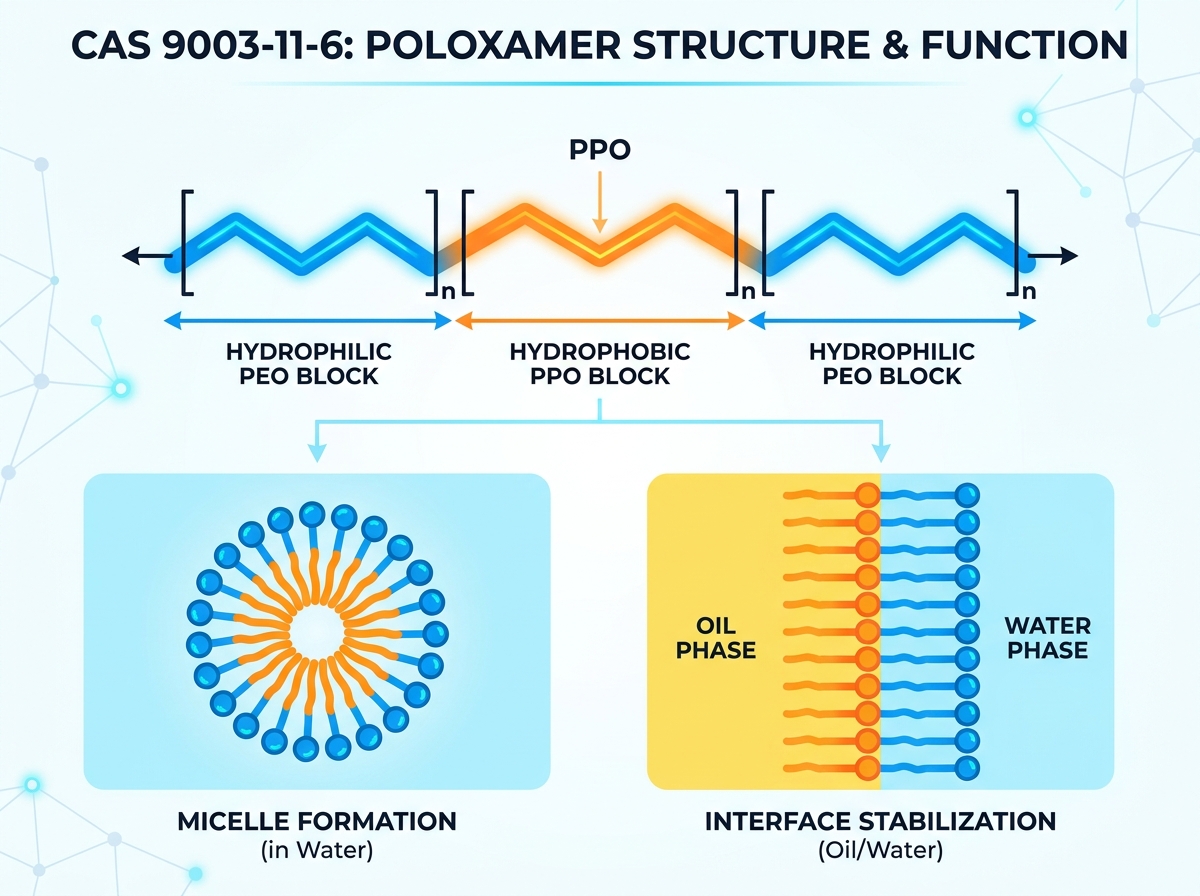
Selecting the correct purity tier is critical for project success. A chemical formula alone does not guarantee usability. You must rigorously evaluate the manufacturing standards and regulatory compliance levels.
You will encounter several distinct grading tiers during procurement. Pharmacopeia-grade materials meet the strictest global standards. They comply with the United States Pharmacopeia (USP), European Pharmacopoeia (EP), or Japanese Pharmacopoeia (JP). These monographs dictate exact testing methods and allowable limits. Conversely, standard commercial or research grades do not undergo this rigorous auditing. You must reserve research grades strictly for preliminary R&D or non-regulated industrial applications.
Always demand a comprehensive Certificate of Analysis (CoA). You must review several key evaluation metrics carefully.
Injectable medications and cell cultures require extreme purity. Even sterile products can contain endotoxins. These are dead bacterial cell wall fragments. They trigger severe immune responses in humans. They also poison sensitive cell cultures. If your application involves biologics or injectables, you must verify low endotoxin levels. Suppliers usually verify this via Limulus Amebocyte Lysate (LAL) testing. You should also request specific biological activity data to ensure lot-to-lot consistency.
A reputable supplier provides a robust regulatory support package. Do not commit to bulk orders without these documents.
Best Practice: Build a checklist of required documents before contacting vendors. This eliminates unqualified suppliers immediately.
Proper facility management ensures the chemical remains stable and safe to use. While generally considered benign, it still requires specific operational protocols. Following these guidelines prevents costly material degradation.
Always review the Safety Data Sheet (SDS) thoroughly. Regulatory bodies typically classify this polymer as non-hazardous. It does not pose severe toxicity risks. However, you must implement standard laboratory precautions. Solid forms, like flakes or powders, can generate airborne dust. Avoid inhaling this dust to prevent mild respiratory irritation. Direct contact may cause minor eye irritation. Operators should wear standard safety goggles and gloves. They should use dust masks when transferring bulk solid materials.
Environmental control dictates product longevity. The polymer exhibits hygroscopic properties. It actively absorbs moisture from the surrounding air. Absorbed moisture causes solid powders to clump into hard blocks. This ruins flowability and complicates manufacturing scales. You must store the chemical in tightly closed, sealed containers. Keep these containers in a cool, dry, and well-ventilated area. Avoid direct sunlight and extreme temperature fluctuations.
This chemical boasts excellent stability under normal conditions. It does not degrade rapidly at room temperature. Most high-quality manufacturers assign a standard retest date. This period typically spans 24 to 36 months from the date of manufacture. Procurement teams should note this timeline. You must balance bulk purchasing discounts against inventory turnover rates. Buying a five-year supply risks material expiration before you can use it all. Size your procurement batches to match a realistic 12-to-18-month consumption forecast.
Identifying the right vendor requires strategic analysis. You cannot simply select the lowest bidder. Supplier quality directly impacts your final product yield, safety, and market readiness.
You must assess chemical suppliers far beyond the basic price-per-kilogram. Investigate their operational infrastructure. Do they operate out of ISO-certified facilities? If you formulate pharmaceuticals or biotech media, you must demand cGMP compliance. Current Good Manufacturing Practices ensure the vendor follows strict, traceable, and audited workflows. A minor contamination event at the supplier level can destroy millions of dollars of your active ingredients.
Evaluate the supplier's packaging flexibility. Your project will likely scale over time. Initially, you might only need a 500-gram research bottle for formulation trials. Later, pilot runs may require 50-kilogram fiber drums. Full commercial manufacturing often necessitates bulk Intermediate Bulk Containers (IBCs). Choose a vendor who can seamlessly support this entire growth trajectory. Changing suppliers mid-scale requires tedious and expensive re-validation.
Global supply chains remain volatile. You must assess supplier reliability rigorously. Inquire about their standard lead times. Ask how they guarantee lot-to-lot consistency. A shifting molecular weight average between batches will ruin your emulsion stability. Furthermore, evaluate their technical support capabilities. When your formulation suddenly fails, you need a vendor who can provide expert troubleshooting. A responsive technical team proves invaluable during production crises.
Do not rush into bulk purchasing agreements. You should initiate a structured qualification process. First, ask the shortlisted buyers to provide a Technical Data Sheet (TDS). Review this against your internal specifications. Next, request a small sample for benchtop formulation testing. Finally, demand a batch-specific CoA for the sample provided. Test the sample to verify the CoA data. Only after successful validation should you place your commercial orders.
This triblock copolymer stands out as an incredibly versatile chemical tool. It drives innovation across pharmaceuticals, cosmetics, and industrial applications alike. However, achieving successful outcomes requires meticulous attention to detail. You must match the specific molecular weight variant to your exact functional requirement. Furthermore, navigating the landscape of regulatory grades prevents costly compliance failures down the line.
Take action today by reviewing your current formulation blueprints. Benchmark your precise requirements against the specifications offered by top-tier suppliers. Prioritize vendors who supply comprehensive documentation, cGMP compliance, and robust technical support. By securing a reliable, high-quality supply chain, you protect your product integrity and accelerate your path to market.
A: The registry number covers the entire family of these copolymers. It acts as a broad umbrella identifier. Specific numbers, like 188 or 407, denote the exact block ratios of the polymer. They indicate the specific molecular weights and the exact ratio of hydrophilic to hydrophobic segments within the molecule.
A: Yes, specific grades are highly safe. Many variants achieve FDA GRAS (Generally Recognized As Safe) status. They also feature heavily in approved pharmacopeia monographs. However, safety depends entirely on using the correct pharmaceutical grade and adhering to established usage limits within the formulation.
A: Certain high-concentration variants exhibit a unique property called reverse thermal gelation. At lower temperatures, they remain as mobile, pourable liquids. As you increase the temperature toward body heat, they transition into semi-solid gels. This makes them highly valuable for sustained-release drug delivery systems.
A: You must build a comprehensive compliance file. Always request a batch-specific Certificate of Analysis (CoA) and a current Safety Data Sheet (SDS). You should also demand cGMP manufacturing certification, residual solvent statements, and TSE/BSE animal-free declarations.


