
English
Views: 0 Author: Site Editor Publish Time: 2026-08-05 Origin: Site


Formulators constantly face the complex challenge of balancing efficacy, stability, and regulatory compliance. Selecting the right nonionic surfactants for commercial formulations is rarely straightforward. Block copolymers, particularly Poloxamers, often hold the key to solving these complex chemical puzzles. Bridging the gap between raw chemical data and practical procurement remains a persistent hurdle across industries. Formulation scientists and sourcing managers must thoroughly evaluate these compounds based on their unique physicochemical properties. They need to assess application suitability against strict global regulatory standards.
This article breaks down the essential technical aspects of these versatile polymers. You will learn how successful implementation relies heavily on matching the precise molecular weight and purity grade to your specific industrial or pharmaceutical application. We explore quality control metrics and sustainable sourcing strategies to optimize your supply chain. By understanding these core principles, you can significantly reduce formulation instability and streamline large-scale production.
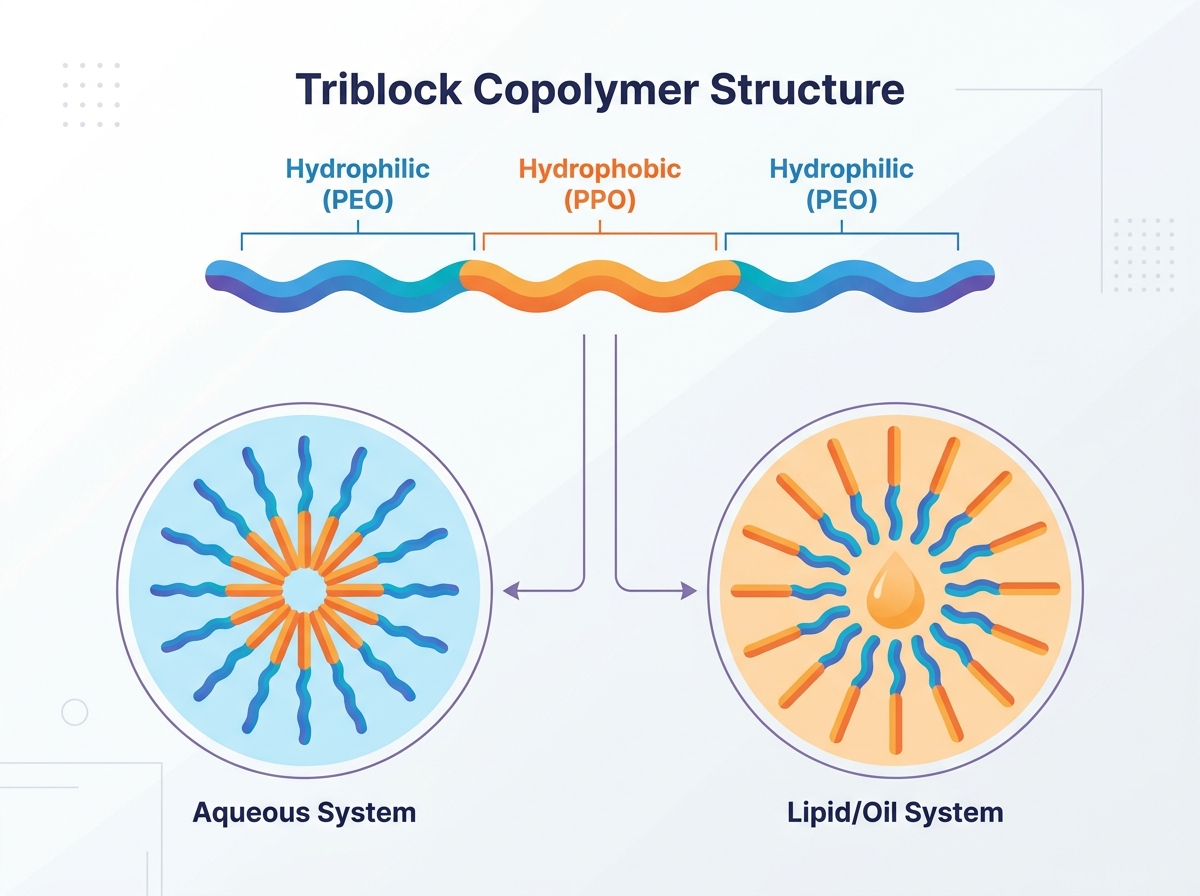
Block copolymers possess a unique architectural advantage. They consist of a central hydrophobic core flanked by hydrophilic chains. Specifically, a polyoxypropylene core sits between two polyoxyethylene chains. This distinct triblock structure dictates how the molecule behaves in both aqueous and lipid systems. In water, the hydrophilic ends extend outward to interact freely. Meanwhile, the hydrophobic core minimizes water contact.
This molecular behavior initiates a precise micellization process:
These micelles encapsulate poorly soluble compounds efficiently. You can leverage this mechanism to stabilize emulsions quickly. Common mistakes occur when formulators ignore this micelle-forming behavior. Failing to account for it often leads to phase separation over time. Therefore, incorporating CAS 9003-11-6 requires careful alignment of this structural mechanic to your base solvent system.
Varying the ratio of these blocks fundamentally changes the physical state of the compound. As you adjust the molecular weight, the material transitions from a liquid to a paste, or even a solid flake. This ratio directly impacts the hydrophilic-lipophilic balance (HLB). The HLB value governs the specific function the surfactant will perform within your formula.
Formulators must select the correct physical state for their manufacturing environment. Pumping liquid grades requires entirely different equipment than handling solid flakes. Matching the exact HLB to your intended function prevents costly formulation failures.
Poloxamers exhibit fascinating temperature-dependent behaviors. They dissolve readily in cold water. However, as temperatures rise, their solubility actually decreases. This unique trait enables thermoreversible gelation. At lower temperatures, the solution remains a free-flowing liquid. Once it reaches body temperature or specific industrial heating thresholds, it transforms into a viscous gel.
This dynamic proves crucial for controlled-release drug formulations. It also benefits temperature-sensitive industrial processes requiring temporary thickening. Best practices suggest measuring your exact operating temperatures carefully. A sudden viscosity spike during manufacturing can damage delicate mixing equipment if you do not anticipate this thermal dynamic.
Life science applications demand pristine raw materials. Formulators rely heavily on these block copolymers as essential solubilizers. They dramatically improve the bioavailability of poorly water-soluble active pharmaceutical ingredients (APIs). Biologic formulations also require them to prevent costly protein aggregation. When using them for in vitro or in vivo applications, biocompatibility remains non-negotiable. You must establish strict low-toxicity baselines early in development. Only ultra-high-purity grades pass these rigorous safety checks. They provide excellent cell viability during long-term storage.
The personal care industry values these compounds for their distinct sensory benefits. They play a vital role in formulating highly stable microemulsions. These microemulsions deliver active ingredients deep into the epidermis effectively. Organoleptic properties improve significantly when you select the correct grade. They offer gentle cleansing profiles perfectly suited for sensitive skin formulations. Furthermore, they excel at advanced fragrance solubilization. They incorporate complex essential oils into water bases effortlessly. Most importantly, they achieve this without altering the delicate scent profiles. Formulators appreciate how they maintain complete transparency in clear gel products.
Heavy-duty sectors require robust performance under extreme conditions. Industrial cleaning solutions utilize these surfactants to remove stubborn greases rapidly. Agrochemical dispersions depend on them to evenly distribute active pesticides and herbicides. Metalworking fluids require mandatory high shear stability. They must endure immense mechanical stress without breaking down thermally. Additionally, low-foaming characteristics remain essential here. Excessive foam causes severe cavitation in industrial pumps. You must select grades engineered specifically to suppress foam while maintaining excellent boundary lubrication properties.
Sourcing raw materials requires navigating a complex maze of regulatory standards. You must differentiate clearly between standard technical grades and refined pharmaceutical grades. Pharmacopeia standards like USP, EP, and BP impose strict analytical limits. Compliance teams heavily scrutinize trace impurities. Ethylene oxide and 1,4-dioxane levels must remain incredibly low. These toxic byproducts result naturally from the standard manufacturing process. Manufacturers use vacuum stripping to remove them. Technical grades might tolerate higher impurity levels for agricultural use safely. However, medical applications demand near-zero concentrations. Misunderstanding these grade distinctions frequently leads to severe compliance violations.
Certificates of Analysis (CoA) provide a reliable snapshot of chemical integrity. You must know exactly what analytical indicators to look for during routine inspections. Reviewing these QC metrics prevents substandard batches from entering your manufacturing facility.
Standard Quality Control Parameter Reference Chart
| Parameter | Typical Acceptable Range / Limit | Impact on Formulation |
|---|---|---|
| pH Value (Aqueous Solution) | 5.0 to 7.5 | Prevents rapid degradation of pH-sensitive active ingredients. |
| Water Content | Less than 1.0% | Minimizes microbial growth potential and ensures accurate dosing. |
| Cloud Point | Varies by specific grade | Dictates the maximum operating temperature before phase separation occurs. |
| Heavy Metals | Below 20 ppm | Ensures regulatory compliance and substantially reduces toxicity risks. |
High water content often indicates improper storage conditions at the distributor level. A fluctuating cloud point signals an inconsistent molecular weight distribution during synthesis.
Global regulatory acceptance simplifies international distribution logistics. The FDA lists specific grades of these copolymers directly in its Inactive Ingredient Database. This listing accelerates the approval process for new drug applications significantly. In European markets, strict REACH compliance remains mandatory for bulk imports. You must ensure your supplier holds valid REACH registrations. This certification ensures the chemical was manufactured safely and responsibly. Comprehensive dermal toxicity data confirms they are safe for topical applications. Safety assessors globally recognize their low irritation potential when formulated correctly.
Chemical synthesis methods are rapidly evolving globally. Traditional routes rely heavily on petroleum-derived precursors. They polymerize propylene oxide and ethylene oxide under highly controlled conditions. Today, emerging renewable pathways offer a compelling alternative. These green methods utilize bio-based propylene glycol precursors instead. Manufacturers derive these starting materials from renewable agricultural feedstocks. This shift reduces reliance on fossil fuels significantly. Formulators must understand both synthesis routes intimately. They perform identically in formulations but differ vastly regarding their overall carbon footprint.
Corporate ESG (Environmental, Social, and Governance) goals now drive major procurement decisions. Incorporating green-synthesized nonionic surfactants aligns perfectly with these ambitious targets. It helps future-proof supply chains against unpredictable petrochemical volatility. Oil price fluctuations directly impact traditional chemical production costs. Bio-based alternatives offer long-term pricing stability. Consumers increasingly demand sustainable end-products from their trusted brands. Transitioning to renewable grades gives brands a distinct competitive marketing advantage. Procurement teams should actively seek suppliers investing heavily in green chemistry. Incorporating sustainable CAS 9003-11-6 options can elevate your entire product line.
Adopting renewable options presents certain practical scalability realities. You must assess current market availability carefully before committing. Ultra-high-purity and bio-based grades often carry notably longer lead times. Global manufacturing capacity for green precursors is still expanding steadily. Sourcing managers must plan inventory cycles accordingly. Do not assume renewable variants are available for immediate spot-buying. Build strategic partnerships with manufacturers early to secure long-term allocations. Balancing traditional and renewable sourcing mitigates immediate supply chain risks while meeting gradual ESG goals.
Selecting a reliable supplier demands rigorous vetting protocols. Documentation acts as your critical first filter. Reject suppliers who cannot provide immediate access to current technical documentation. You need up-to-date Material Safety Data Sheets (MSDS) and accurate CoAs immediately. Clear synthetic route documentation is also absolutely essential. Transparent suppliers willingly share their manufacturing processes. They disclose residual catalyst levels openly. Hidden impurities cause catastrophic failures during final product scaling. Demand full transparency before officially approving any new chemical vendor.
Formulation scientists must demand extensive historical lot data. A single pristine sample does not guarantee long-term production reliability. Block copolymers require precise molecular weight distributions to function correctly. Inconsistent polymerization leads to fluctuating cloud points unpredictably. It also alters the required hydrophilic-lipophilic balance randomly. Request CoAs from multiple past production batches. Analyze them thoroughly to ensure the molecular weight distribution remains tight. Reliable suppliers utilize advanced process controls to guarantee batch-to-batch consistency. Integrating high-quality CAS 9003-11-6 protects your brand's reputation for uncompromising quality.
Chemical integrity relies heavily on proper commercial packaging. Many variants are highly hygroscopic by nature. They absorb ambient moisture rapidly from the surrounding air. Evaluate your supplier's packaging capabilities thoroughly. They must provide robust moisture-barrier packaging solutions. Nitrogen-purged drums or vacuum-sealed foil bags prevent moisture degradation effectively. Assess their standard shipping conditions as well. Extreme temperatures during ocean transit can alter the physical state or cause separation. Ask for clear shelf-life guarantees backed by rigorous stability testing data.
Scaling up from the lab bench introduces unexpected mechanical challenges. Prioritize suppliers offering flexible pilot-to-production support. R&D teams require manageable sample sizes for initial laboratory evaluations. Avoid suppliers demanding massive commercial-scale Minimum Order Quantities (MOQs) upfront. A supportive partner will provide dedicated technical assistance during the pilot phase. They help troubleshoot solubility issues or sudden viscosity spikes. This collaborative approach ensures a smooth transition to full-scale commercial manufacturing.
Procuring nonionic block copolymers involves far more than simply finding the lowest market price. It represents a highly strategic formulation decision. Successful implementation requires strict physicochemical alignment with your specific application demands. You must navigate complex regulatory compliance frameworks and prioritize batch consistency above all else. Sourcing bio-based alternatives further strengthens your long-term supply chain resilience.
Remember to evaluate the exact molecular weight and HLB required to stabilize your unique system. Demand comprehensive documentation from all prospective suppliers before proceeding. Assess historical lot data to verify consistency. Plan for proper moisture-barrier storage to prevent degradation.
We encourage technical buyers and formulation scientists to take immediate action. Request a sample today to begin your pilot testing phase. Download technical data sheets to verify purity specifications. Contact a technical specialist to perfectly match a block copolymer grade to your precise formulation needs.
A: Industry professionals frequently refer to this chemical using various trade names and generic classifications. Common synonyms include Poloxamer, Pluronic, Kolliphor, and PEG/PPG copolymers. These names often indicate specific molecular weights or proprietary grades manufactured by different global chemical companies.
A: The cloud point indicates the specific temperature where the polymer becomes insoluble in water. Once the solution reaches this thermal threshold, it separates into two distinct phases, appearing cloudy. Formulators must ensure their required operating temperatures remain below the cloud point to maintain stable, clear solutions.
A: Yes, it is widely considered safe for topical applications. Cosmetic Ingredient Review (CIR) panels and global safety assessors have extensively evaluated dermal toxicity data. They conclude that cosmetic and pharmaceutical grades present a very low potential for skin irritation or sensitization when properly formulated.
A: Standard storage requires keeping the chemical in a cool, dry, and well-ventilated area at ambient temperatures. Because many grades are highly hygroscopic, you must store them in tightly sealed, moisture-barrier containers. Proper storage prevents water absorption and ensures a standard shelf life of typically 24 months.


