
English
Views: 0 Author: Site Editor Publish Time: 2026-07-27 Origin: Site


Formulators face a constant battle in modern industrial chemistry. You must consistently balance rapid wetting properties alongside strictly controlled, low-foaming profiles. Furthermore, you have to achieve this performance while adhering to increasingly strict environmental regulations across the globe. Traditional long-chain surfactants often fail to hit this specific sweet spot. They tend to generate persistent, hard-to-break foam or simply lack the molecular agility needed for high-speed industrial processing. This leaves many chemists actively searching for viable alternatives to maintain cleaning performance without violating stringent eco-toxicity limits. Mid-cut (C8-C10) fatty alcohol ethoxylates directly solve these issues as high-performance, exceptionally versatile nonionic surfactants. The following sections will provide an evidence-based framework for evaluating critical structural variations. You will learn exactly how to match precise chemical properties to various industrial applications and proactively mitigate common formulation risks.
Surfactant performance relies heavily on the carbon backbone length. Formulators frequently debate using mid-cut versus standard lauryl (C12-C14) chemistries. Longer carbon chains naturally entangle. They form rigid, tightly packed structures at the air-water interface. This structural rigidity generates dense, highly stable foam. While desirable for personal care products like shampoos, this foam causes severe mechanical issues in industrial settings. Shorter carbon chains behave differently. They migrate rapidly through solutions. This agility allows them to reduce dynamic surface tension almost instantly. They create fragile foam structures. These bubbles collapse quickly under high agitation. Consequently, these shorter molecules excel in spray washing, automated cleaning, and high-speed textile processing environments.
Understanding phase behavior prevents catastrophic formulation failures. The hydrophobic C8-C10 backbone interacts intimately with varying moles of hydrophilic ethylene oxide (EO). This specific ratio dictates exactly how the molecule dissolves in water. As you increase the EO moles, you increase overall water solubility. The cloud point represents the exact temperature where the surfactant separates from the water, turning the solution cloudy. Molecules possessing 4 to 6 EO moles typically exhibit lower cloud points. They might require coupling agents for clarity at room temperature. Conversely, variants carrying 8 to 10 EO moles remain perfectly clear at elevated temperatures. You must align these thermal characteristics directly to your operational environments. Below is a comparative chart detailing general behavioral shifts based on EO addition.
| EO Mole Ratio | HLB Range (Approx.) | Aqueous Solubility at 25°C | Typical Primary Application |
|---|---|---|---|
| 3 - 5 Moles | 8 - 10 | Insoluble / Dispersible | W/O Emulsification, Defoaming |
| 6 - 8 Moles | 11 - 13 | Soluble (Low Cloud Point) | Hard Surface Wetting, Degreasing |
| 9 - 12 Moles | 13 - 15 | Highly Soluble (High Cloud Point) | O/W Emulsification, High-Temp Cleaning |
Regulatory agencies no longer tolerate environmentally persistent chemicals. Formulators must establish a strict regulatory baseline for every ingredient. Fortunately, shorter chain ethoxylates generally demonstrate excellent environmental compatibility. Microorganisms easily digest these mid-cut carbon chains. They routinely pass standard ready biodegradability testing protocols, such as OECD 301. They break down rapidly in municipal wastewater treatment facilities. However, you cannot assume universal compliance. You must proactively verify aquatic toxicity data on the manufacturer's Technical Data Sheet (TDS). High performance does not excuse environmental harm. Securing specific eco-labels often requires documented proof regarding toxicity limits for local aquatic life.
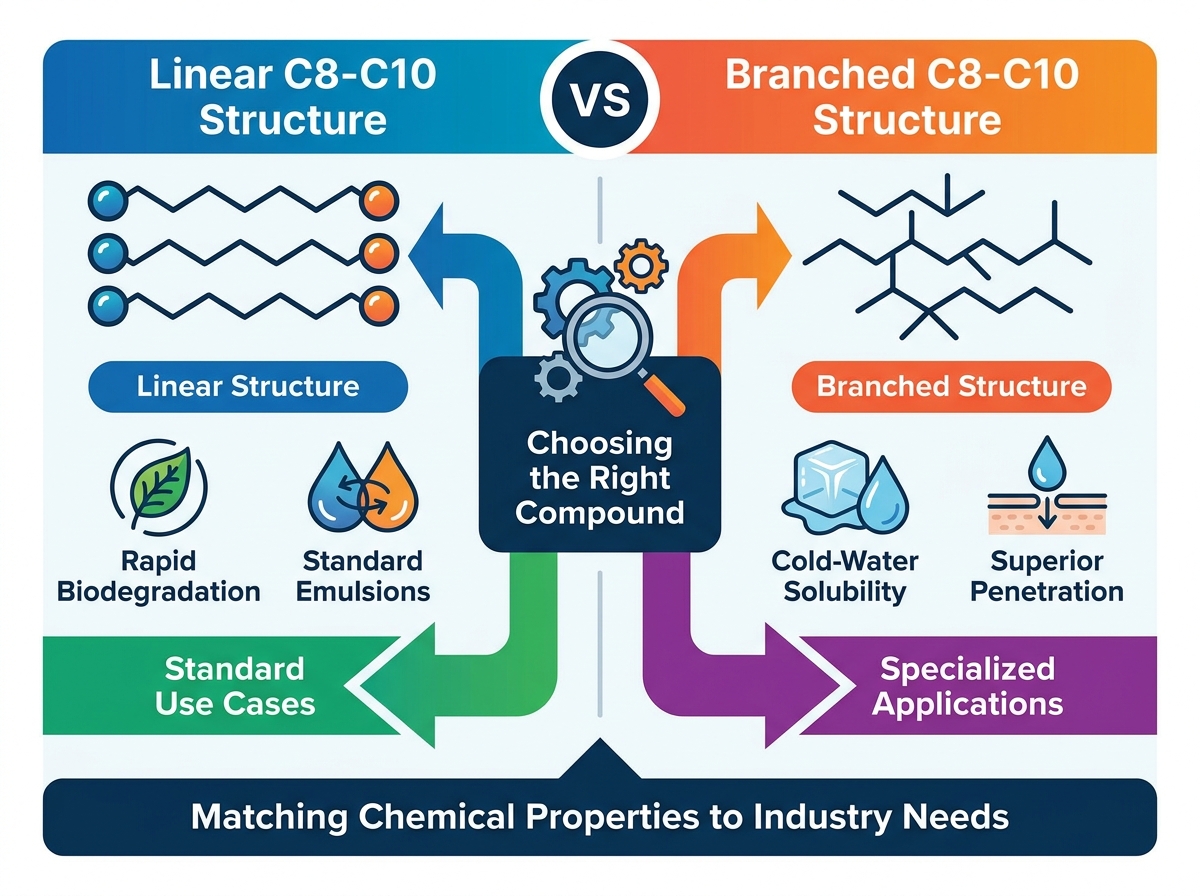
Linear molecules feature a straight carbon backbone. They pack together neatly and predictably in solution. You will typically select linear variants when rapid biodegradation ranks as your absolute highest priority. Bacteria consume straight chains much faster than complex structures. They also provide straightforward, highly predictable emulsion profiles for standard degreasers. However, linear structures carry distinct physical limitations. Their neat packing behavior works against them in cold environments. They tend to crystallize or form gels during winter storage. Furthermore, they frequently struggle to maintain stability in highly concentrated electrolyte solutions or heavy brine.
Branching fundamentally changes physical chemistry. Introducing a bulky side chain creates steric hindrance. This bulky tail physically prevents neighboring molecules from packing tightly together. Because they cannot align neatly, branched variants exhibit significantly lower pour points. They remain fluid and pumpable at much colder temperatures. They also dissolve exponentially faster in frigid water compared to their linear counterparts. This presents a clear commercial trade-off. You typically pay a slightly higher raw material premium for branched chemistry. In return, you gain superior penetrating power, enhanced handling ease, and robust stability in extreme environments.
Industrial degreasers require serious chemical muscle. They must rapidly lift polymerized grease without leaving unsightly streaks behind. A C8-C10 alcohol ethoxy compound fits perfectly into these demanding formulations. It penetrates oily soils quickly. More importantly, it demonstrates excellent compatibility alongside harsh alkaline builders like sodium metasilicate or potassium hydroxide. For optimal dirt penetration on hard surfaces, you should target an HLB range between 11 and 13. This specific hydrophilic-lipophilic balance ensures the surfactant remains active at the soil-water interface rather than fully dissolving into the bulk water phase.
Plant leaves naturally repel water to survive. Agrochemical sprays require powerful wetting agents to defeat this waxy hydrophobic barrier. Short-chain ethoxylates reduce surface tension aggressively. They force spray droplets to spread rapidly and evenly across the entire leaf surface. This maximizes pesticide uptake and improves crop yields. However, formulators must carefully monitor phytotoxicity. Overly aggressive wetting agents can burn delicate plant tissues. You must also guarantee the surfactant remains chemically stable when mixed into harsh, multi-active pesticide tank mixes. Farmers routinely blend multiple chemicals together, and your adjuvant cannot precipitate out of solution.
Textile mills operate under intense mechanical agitation. Scouring and bleaching processes demand instant fiber wetting to keep production lines moving. If a surfactant generates excess foam, the bubbles will cavitate heavy industrial pumps. Foam also prevents dyes from penetrating fabric evenly. Shorter chain ethoxylates deliver the necessary instant penetration. Crucially, they maintain an exceptionally low foam profile even under violent agitation. This specific trait prevents costly mechanical downtime. It also allows textile manufacturers to drastically reduce their reliance on expensive silicone anti-foaming agents.
Diluting concentrated surfactants often creates unexpected manufacturing nightmares. When you add water to certain ethoxylates, the mixture can suddenly form highly viscous liquid crystals. We refer to this stiff, unpumpable state as a gel phase. It ruins batch processing times and traps expensive raw materials in mixing tanks. You can mitigate this risk by altering your standard procedures. Always add the surfactant into the water phase slowly. Never dump water directly onto concentrated surfactant. If gelling persists, you should incorporate specific hydrotropes. Ingredients like sodium xylene sulfonate (SXS) effectively break up these crystalline structures. Small additions of co-solvents like propylene glycol also keep the solution fluid.
Nonionic molecules generally play well alongside other chemistries. They lack a permanent electrical charge. Therefore, you can mix them freely into anionic or cationic systems without fear of immediate precipitation. Despite this versatility, they are not invincible. Extreme pH environments will eventually degrade the ether linkages over prolonged periods. Boiling alkaline solutions or highly concentrated mineral acids cause gradual hydrolysis. To maximize shelf life, we recommend maintaining your final formulation pH between 3 and 11. If your product requires extreme alkalinity, you must seek out specialized, chemically capped ethoxylates designed specifically for aggressive environments.
Do not ignore practical warehouse realities. Severe temperature fluctuations destroy product uniformity. If a liquid surfactant drops below its specific freezing point, the components will separate. You must establish strict safe storage guidelines. Keep these materials in temperature-controlled environments whenever possible. For higher EO mole variations, you will likely need drum heating protocols. Gently warm the containers and agitate the material thoroughly before pumping. Never apply direct, localized heat sources like blowtorches or unjacketed band heaters. Localized scorching permanently destroys the chemical structure and discolors the entire batch.
A comprehensive Technical Data Sheet serves as your primary defense against bad raw materials. You must scrutinize the documentation rigorously before requesting samples. A credible chemical supplier will always transparently provide several non-negotiable metrics.
Fluctuating raw materials destroy commercial scaling efforts. The Hydroxyl Value (OHV) tells you the precise average molecular weight of the surfactant lot. If the OHV swings wildly between different deliveries, your final product viscosity will fluctuate unpredictably. Strict pH control matters equally for long-term stability. You must insist on reviewing historical Certificates of Analysis (COA) from prospective suppliers. Demand evidence showing tight, highly predictable specification ranges across multiple production runs.
Missing regulatory paperwork causes disastrous product recalls. Baseline documentation requirements vary heavily by region, but strict compliance remains mandatory. If you plan to sell formulations within the European Union, require verifiable REACH registration numbers. In the United States, look for ingredients listed on the EPA Safer Choice standard. If the base fatty alcohol originates from palm kernel oil, you must demand RSPO (Roundtable on Sustainable Palm Oil) mass balance certification. Sustainable sourcing transparency is no longer optional for major retail buyers; it is a strict prerequisite for doing business.
Never scale formulation production blindly. A small error in a laboratory beaker becomes a massive financial loss in a 5,000-liter mixing tank. We recommend executing a strict micro-batch piloting protocol before committing to large IBC tote or bulk isotank orders.
Optimizing an industrial formulation requires a continuous balancing act. You must perfectly align specific physical chemistry traits with aggressive real-world application demands. Understanding structural nuances, particularly the divergent behaviors between branched and linear carbon chains, often defines your ultimate commercial success. Furthermore, demanding absolute transparency from your chemical suppliers ensures your production lines run without unexpected interruptions. We encourage you to review your current manufacturing wetting times and foam profiles today. Identify areas where performance lags or regulatory pressures mount. Finally, reach out to a qualified manufacturer to request a targeted sample matrix based on these specific molecular insights.
A: The typical HLB range spans from roughly 8 to 14, depending entirely on the moles of ethylene oxide added. Lower HLB variants (8-10) excel as defoamers or wetting agents. Higher HLB variants (12-14) act as powerful oil-in-water emulsifiers and heavy-duty degreasers.
A: Branched molecules perform significantly better in cold water. The bulky side chains create steric hindrance, which physically prevents the molecules from neatly packing and crystallizing. This structural trait leads to dramatically faster dissolution rates and lower pour points during winter storage.
A: Yes. They serve as highly effective, environmentally compliant drop-in replacements for NPEs. They match or exceed the wetting and detergency performance of NPEs across most industrial cleaning, agrochemical, and textile formulations while fully adhering to strict global eco-toxicity regulations.
A: They remain completely stable in moderate alkalinity (pH 8-11). However, boiling temperatures combined with extreme alkaline conditions will eventually cause hydrolysis. For extreme environments, formulators usually require specialized capped ethoxylates to completely prevent chemical degradation.


